
Why My Early Hours Felt Like a Trap Before 9 AM
Does waking up feel like you are already running late for a race you never signed up for? I used to drag myself out of bed, instantly grab my phone, and doom-scroll through terrible news before my feet even touched the floor. By 10 AM, I was highly caffeinated but completely exhausted, staring blankly at my laptop screen unable to focus on a single sentence. I thought I just had a bad attention span, but I recently discovered that three very specific, sneaky habits were secretly destroying my brain's energy levels before I even left my bedroom. Let me show you exactly what is stealing your focus and how to fix it starting tomorrow morning.
This is not just my story; it is a silent struggle happening in bedrooms all across the world. You wake up with the best intentions to have a highly productive day, but somehow, your energy crashes before noon.
The mental toll of a bad morning is heavy and exhausting. When you start your day feeling rushed and distracted, that chaotic energy follows you everywhere. You sit down to work, but your brain refuses to concentrate on a single task.
You find yourself opening multiple browser tabs, staring blankly at your screen, and feeling a deep sense of guilt because you are not getting things done. This lack of focus makes simple tasks take twice as long, eating away at your personal time.
It creates a vicious cycle of stress. You worry about your uncompleted tasks all evening, which ruins your sleep, and then you wake up the next morning feeling even worse. Your mental peace is slowly stolen by a few tiny choices you make within the first twenty minutes of waking up. We often blame our workload or lack of sleep for our brain fog. But the truth is much closer to home, hiding quietly in our everyday routines.

Your Quick Morning Fix Action Plan
- Stop the Dopamine Hijack: Never look at social media or emails in bed. It instantly rewires your brain to crave cheap distractions all day long.
- Delay Your Coffee: Drinking coffee immediately upon waking causes dehydration and a severe 2 PM energy crash. Wait exactly 90 minutes before your first cup.
- Kill the Snooze Button: Hitting snooze tricks your body into starting a new sleep cycle, leaving you feeling groggy and "heavy-headed" for up to 4 hours.
- Eat the Frog: Your brain has the most willpower in the first three hours of the day. Use that golden window to tackle your hardest task before doing anything else.
The Silent Focus Killers Hiding in Plain Sight
Many people believe that focus is something you either have or you do not. They think productivity is a rare talent granted only to a lucky few.
The reality is entirely different and much more manageable. Your daily focus is a direct result of how you treat your brain in the first hour of your day. Let us explore the specific morning habits that are quietly draining your mental battery and how you can stop them.
1. The Dopamine Hijack: Checking Your Phone in Bed
The most common and destructive habit modern humans share is reaching for a screen the second they wake up. Your brain transitions through different brainwave states as you wake up, moving from the deep sleep delta waves to a relaxed theta state.
When you immediately open emails, news apps, or social media, you violently pull your brain out of that peaceful state. You are flooding your nervous system with cortisol (the stress hormone) and cheap dopamine.
This sudden spike in dopamine creates a massive problem for the rest of your day. Your brain gets used to this high level of instant stimulation right from the start. Later in the day, when you need to read a report, study, or write an email, your brain finds it boring and begs for another distraction. You have essentially trained your mind to lose focus.
My personal struggle with this was intense. I used to think checking emails in bed made me a proactive person.
Instead, I realized my phone was hijacking my mood before I even had a chance to set my own intentions for the day. I finally bought a cheap digital clock and started charging my phone in the living room, which instantly cured my morning brain fog.
2. The Snooze Button Deception: Tricking Your Body Clock
We all love the idea of "just five more minutes" of sleep. Hitting the snooze button feels like a small act of self-care at the moment.
However, science shows that snoozing is actually doing massive damage to your daily concentration. When your alarm goes off, your body is ready to wake up. When you hit snooze and go back to sleep, your brain thinks it is starting a brand new sleep cycle.
A full sleep cycle takes about 90 minutes to complete. But your alarm will ring again in just nine minutes. This forcefully interrupts a deep sleep phase, leaving you with a condition known as sleep inertia.
Sleep inertia is that groggy, heavy-headed feeling that can last for up to four hours after you wake up. It severely impairs your decision-making, memory, and attention span. You are sacrificing hours of sharp mental focus for a few minutes of low-quality, fragmented sleep.
Do you want to know exactly how sleep inertia affects your brain performance and how to wake up instantly? Watch this highly informative breakdown below to understand the science of waking up refreshed.
3. The Caffeine Trap: Drinking Coffee Before Water
Most people stumble into the kitchen and head straight for the coffee maker. We rely on that hot cup of caffeine to jolt us into a productive state.
But drinking coffee as your very first action of the day is a major biological mistake. While you sleep, you lose a significant amount of water through breathing and sweating. You wake up naturally dehydrated.
Dehydration shrinks your brain tissue slightly and directly impacts your ability to concentrate. Pouring coffee—a mild diuretic—into a dehydrated body only makes the problem worse. Furthermore, your body naturally produces its highest levels of cortisol (an alertness hormone) between 8 AM and 9 AM.
If you drink coffee during this natural cortisol peak, the caffeine does not actually wake you up more. Instead, it builds your tolerance to caffeine, meaning you will need more coffee in the future to feel the same effect. It also guarantees a massive energy crash around 2 PM, completely destroying your afternoon focus.
The 90-Minute Caffeine Delay (Why It Works)
- Waking Up (0 Minutes): Your body is severely dehydrated. Drink 16oz of room-temperature water.
- 30 Minutes In: Your body is releasing natural Cortisol to wake you up. Coffee now will just make you anxious and jittery.
- 90 Minutes In: Cortisol levels begin to drop naturally. Now is the perfect time for your first cup of coffee to ride a smooth, crash-free energy wave all afternoon.
Breaking Down the Morning Conflict
To make this easier to understand, let us look at how different choices create completely different outcomes for your day.
As you can see, the habits that feel good in the short term are the exact things ruining your long-term daily focus.
4. Decision Fatigue at Dawn: Overloading Your Mind Early
Your brain has a limited amount of decision-making energy every single day. Think of it like a battery on your smartphone.
Every time you make a choice, you use up a tiny percentage of that battery. Many people drain their mental battery before they even step out the front door.
You stand in front of your closet trying to decide what to wear. You stare into the refrigerator wondering what to make for breakfast. You debate whether you should take the bus or drive to work. These seem like harmless micro-decisions, but they add up quickly.
By the time you sit down at your desk to do actual meaningful work, a huge chunk of your mental energy is already gone. This psychological phenomenon is called decision fatigue. When decision fatigue sets in, your brain starts looking for the easiest way out of hard tasks.
You start procrastinating, checking your phone unnecessarily, and avoiding complex problems. To protect your daily focus, you must eliminate these morning choices.
5. Consuming Negative News: The Stress Response
Staying informed is a good thing, but reading negative news right after waking up is terrible for your concentration. News outlets are designed to grab your attention using fear and outrage.
When you read about economic crises, political arguments, or local tragedies in the morning, your brain activates its "fight or flight" response. Your heart rate increases, and your stress levels shoot up.
Your brain starts scanning your environment for threats instead of focusing on your personal goals. Trying to write a creative essay, code a program, or analyze a business report is incredibly hard when your nervous system feels threatened.
You spend the rest of the day carrying a heavy, invisible weight of anxiety. If you want to maintain a sharp, laser-like focus throughout your workday, you must actively protect your mental peace in those early hours.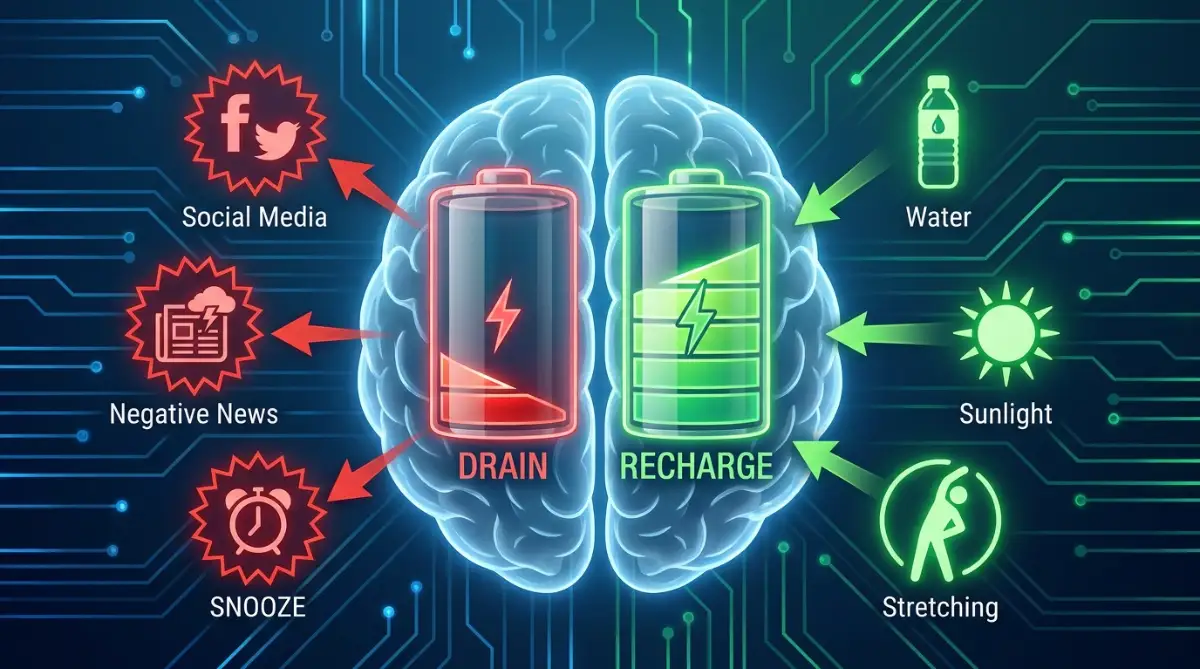
How to Rebuild a Focus-Friendly Morning Routine
Now that we know exactly what is destroying our attention, we need a practical system to fix it. You do not need to wake up at 4 AM or take an ice bath to be highly productive.
You just need to remove the friction and replace bad habits with natural energy boosters. The goal is to create a calm, predictable start to your day.
Prepare the Night Before
The secret to a focused morning actually begins the evening before. If you eliminate morning decisions tonight, your brain can coast on autopilot tomorrow.
Pick out your clothes and lay them on a chair before going to bed. Pack your work bag and place your keys exactly where you will see them.
Plan your breakfast in advance. Write down the top three most important tasks you need to complete the next day. When you wake up, you will not have to waste a single ounce of mental energy thinking about what to do next. You simply wake up and execute the plan.
The 15-Minute Rule for Screens
You must fiercely protect the first fifteen minutes of your day from digital intrusion. Buy a traditional alarm clock so you do not have to touch your phone to turn off the alarm.
Leave your phone on airplane mode or plugged in across the room. Use this screen-free time to let your brain wake up naturally.
Open the curtains and look outside to let natural sunlight hit your eyes. Sunlight exposure stops your brain from producing melatonin (the sleep hormone) and naturally signals your body that it is time to be alert. This simple act of looking at natural light is ten times more effective for waking up than staring at a harsh phone screen.
Rehydrate Before You Caffeinate
Before you even think about the coffee machine, drink a large glass of room-temperature water. After eight hours of sleep, your body desperately needs hydration to jumpstart your metabolism and wake up your organs.
If you want an extra boost, squeeze a little fresh lemon into the water. This provides a quick dose of Vitamin C and electrolytes.
Wait at least 90 minutes after waking up before you drink your first cup of coffee. By delaying your caffeine intake, you allow your natural cortisol levels to drop slightly. When you finally drink that coffee, it will work much better, and you will completely avoid that terrible afternoon energy crash. Your focus will remain steady from the morning all the way through the late afternoon.
Next-Level Strategies for Sustained Mental Energy
Fixing your morning routine is not just about avoiding bad habits; it is about building a completely new biological rhythm. Once you remove the focus killers we discussed earlier, you need to replace them with highly effective, science-backed actions.
This is where you move from just surviving your morning to actually mastering your entire day. Your brain operates on specific energy cycles, and if you learn how to ride these waves, your productivity will double.
Many high performers use a concept called Ultradian rhythms to manage their focus. Instead of trying to concentrate for eight hours straight, they work in intense 90-minute blocks followed by a 20-minute rest. You can read more about how these 90-minute biological cycles regulate your brain power through the American Psychological Association.
When you align your morning tasks with these natural cycles, everything feels easier. You stop fighting your own body and start working alongside its natural clock.
To make this work, you need a clear set of advanced strategies that keep your mind sharp from the moment you wake up. These are the pro-level secrets I use to protect my own mental peace.
Triggering the Waking Temperature Shift
Your body needs a slight increase in its core temperature to wake up completely. While you sleep, your body temperature naturally drops to keep you relaxed and deeply rested.
When your alarm rings, your body is still in a cooled-down, low-energy state. You have to send a strong physical signal to your nervous system that it is time to heat up and get moving.
The easiest way to do this is by splashing cold water on your face immediately after getting out of bed. This sudden shock activates your trigeminal nerve, instantly increasing your heart rate and oxygen intake.
If you want an even stronger effect, take a quick 60-second cold shower. This might sound uncomfortable, but it creates a massive, natural dopamine spike that lasts for hours. According to research on cold water immersion published by the National Institutes of Health, this practice significantly improves daytime alertness and immune function.
The Power of Low-Friction Movement
You do not need to run five miles at 6 AM to be a productive person. Heavy, exhausting workouts first thing in the morning can actually drain your energy if you are not used to them.
Instead, focus on low-friction movement that gently wakes up your joints and muscles. A simple five-minute stretching routine on your bedroom floor is more than enough to get your blood flowing.
This light movement sends fresh oxygen directly to your brain, clearing away any remaining sleepiness. Think of it as a gentle warm-up for your mind.
Just like you would want to figure out why your AI generated content sounds robotic and the exact prompting technique to fix it, you need to figure out the right physical "prompts" to make your brain function naturally. Light yoga, a short walk around your living room, or even just doing ten jumping jacks can completely change your mental state.
Eating for Cognitive Endurance
What you put into your stomach during the first two hours of your day dictates your afternoon focus. Most traditional breakfasts are loaded with simple carbohydrates and processed sugars.
Eating a massive bowl of sugary cereal or a thick bagel causes a rapid spike in your blood sugar. Your pancreas then releases a huge amount of insulin to manage that sugar, leading to a severe energy crash shortly after.
This biological rollercoaster makes you feel tired, hungry, and incredibly distracted by 11 AM. To maintain a sharp mind, you need to feed your brain healthy fats and high-quality protein in the morning.
Foods like eggs, avocados, nuts, and Greek yogurt provide a slow, steady release of energy that lasts for hours. Proper nutrition acts as an insurance policy for your brain. Understanding this is just as important as knowing the costly mistakes you are probably making when filing a health insurance claim—if you put the wrong things in, you will pay a heavy price later.
Scheduling Your Most Difficult Task First
Your willpower and decision-making abilities are at their absolute peak within the first three hours of waking up. This is the perfect time to tackle your most challenging, brain-heavy project.
Mark Twain famously called this "eating the frog." If you do the hardest thing on your to-do list first, the rest of your day will feel like a breeze.
Do not waste this premium brain power on organizing your desk, checking trivial emails, or scrolling through chat messages. Use this golden window to write that difficult report, study for that complex exam, or map out your long-term goals.
If you waste your best morning energy on low-value tasks, you will never have enough willpower left for the big things. Setting clear priorities is highly effective, much like having the ultimate beginner's blueprint to decoding term life coverage terminology to secure your family's future. You must secure your daily goals before distractions take over.

Where Most People Fail When Changing Their Mornings
Even with the best strategies in the world, building a new routine is incredibly hard. I have seen so many people try to revamp their mornings, only to fall back into their old, toxic habits a week later.
They usually fail because they misunderstand how human psychology actually works. You cannot simply force your brain to change overnight without facing some resistance.
There are a few massive pitfalls that trap almost everyone who tries to become a "morning person." Identifying these traps beforehand is the only way to ensure your new habits actually stick for the long run. Let us look at the most common psychological mistakes that destroy your progress.
The "All or Nothing" Mindset Trap
This is by far the biggest reason people give up on their new routines. You plan out a perfect morning: wake up at 6 AM, drink water, stretch, read for twenty minutes, and start working.
But one day, you accidentally sleep past your alarm and wake up at 7:30 AM. Panic sets in, and you immediately feel like a complete failure.
Because you missed the first part of your routine, you decide the whole day is ruined. You grab your phone, start scrolling out of frustration, and eat a terrible breakfast.
You let one small mistake trigger a complete collapse of your daily discipline. This kind of thinking is just as damaging as those silent credit score killers ruining your chances for a mortgage approval; it quietly ruins your future progress. You have to remember that a routine is a tool to serve you, not a strict prison you must perfectly obey every single day.
Here is a better approach: If you wake up late, simply execute a five-minute mini-routine. Drink a glass of water, take three deep breaths, and move forward with your day. Consistency is always better than perfection.
Changing Too Many Variables at Once
When people get motivated, they usually try to overhaul their entire life in a single morning. They decide they will quit coffee, start running ten miles, meditate for an hour, and learn a new language before 8 AM.
Your brain hates sudden, massive changes. When you try to adopt ten new habits at once, your nervous system gets overwhelmed and quickly burns out.
Within three days, you will feel so exhausted that hitting the snooze button will feel like your only option. You need to treat habit-building like writing simple code; if you change too much, the system crashes.
This relates perfectly to the untold truth about low code development software replacing human programmers in the tech industry—simple, manageable systems always win out over complex, unmanageable ones. Pick just one single habit to change this week, like drinking a glass of water before coffee. Master that one thing for seven days before adding anything else to your plate.
The "Weekend Reversal" Disaster
You work so hard from Monday to Friday to wake up early and protect your focus. Then Friday night arrives, and you decide to stay up until 3 AM watching movies.
You sleep until noon on Saturday and Sunday, completely destroying your carefully built biological clock. Come Monday morning, your brain is in a state of severe "social jetlag."
According to sleep researchers at Harvard Medical School, shifting your sleep schedule by more than an hour on weekends severely disrupts your circadian rhythm. Your body feels like it just traveled across multiple time zones.
This makes waking up on Monday feel like pure torture, and your focus will be terrible until at least Wednesday. If you want a sharp mind all week, you must keep your weekend wake-up times within one hour of your weekday schedule. You can still relax and have fun, but you cannot afford to bankrupt your sleep debt.
My Personal "Weekend Sleep-In" Compromise:
I know waking up at 6 AM on a Saturday sounds awful. To protect my biological clock without going crazy, I allow myself exactly one extra hour of sleep on weekends. If I wake up at 6 AM during the week, my Saturday alarm is set for 7 AM. This keeps my sleep debt low and completely prevents that terrible "Monday Morning Fog.
Relying on Motivation Instead of Systems
Motivation is a highly unreliable emotion. Some mornings you will wake up feeling like you can conquer the world, and other mornings you will want to hide under the blankets forever.
If your morning routine depends on you "feeling motivated," it will fail on the days you are tired, sad, or stressed. You need a bulletproof system that operates regardless of your mood.
Your environment should do the heavy lifting for you. If you want to stop checking your phone in bed, simply put the charger in the bathroom.
If you want to read more, place a book directly on top of your laptop so you have to move it before working. Creating an environment that forces good habits is a game-changer. For more tips on building better digital habits and organizing your online life, you can explore the helpful resources on hubnestify.
Your New Action Plan for Tomorrow Morning
We have covered exactly what is destroying your attention span and the science-backed methods to get it back. The truth is, building a highly focused day is entirely within your control.
It does not require magic, expensive supplements, or a superhuman level of discipline. It simply requires making slightly better choices in the first hour of your day.
The Evening Checklist (Do This Tonight)
- Set a digital curfew: Turn off all bright screens one hour before your target sleep time.
- Relocate your phone: Plug your phone into a charger outside of your bedroom. Buy a cheap battery-powered alarm clock if you need an alarm.
- Prepare your launchpad: Set out your clothes, pack your work bag, and put a glass of water on your nightstand.
- Write it down: Jot down the single most important task you need to accomplish tomorrow on a piece of paper.
I used to spend my entire mornings feeling rushed, stressed, and completely out of control. Once I started treating my first waking hour as sacred, protected time, my anxiety dropped, and my daily productivity skyrocketed. I truly believe that if you try just one of these small changes tomorrow morning, you will immediately feel a sense of calm and clarity you have not experienced in years.
Common Questions About Morning Routines and Daily Focus
What happens if I miss my morning routine one day?
Do not stress about missing a single day; your brain is highly adaptable. Simply acknowledge the slip-up, take a few deep breaths, and focus on making the next right decision in your day. Getting back on track the very next morning is what truly builds long-term consistency.
Can I ever drink coffee immediately after waking up?
It is highly recommended that you wait at least 90 minutes before drinking caffeine. If you absolutely must have something warm, try herbal tea or warm lemon water first. This simple delay prevents the dreaded afternoon energy crash and keeps your natural cortisol levels balanced.
Why do I still feel tired even after sleeping for 8 hours?
You might be waking up during the deepest part of your sleep cycle, causing severe sleep inertia. It could also be due to poor sleep quality caused by looking at bright screens right before bed. Ensure your bedroom is completely dark and slightly cool to improve the actual quality of your rest.
How long does it take for a new morning habit to stick?
Research shows it takes anywhere from 21 to 66 days to form a strong, automatic habit. The key is to start extremely small and attach the new habit to an existing one, like stretching right after you brush your teeth. Be patient with yourself and focus on tiny, daily victories.
Is checking my emails in the morning really that bad?
Yes, checking emails immediately puts your brain in a reactive, stressful state before you even get out of bed. It forces you to think about other people's demands instead of your own personal goals. Give yourself at least thirty minutes of screen-free time to start your day on your own terms.
Disclaimer: The information provided in this blog post is for educational and informational purposes only and is not intended as medical or psychological advice. Always consult with a qualified healthcare professional before making significant changes to your sleep habits, diet, or physical exercise routines, especially if you have an underlying medical condition.