
I used to panic every time a client sent me money. Why? Because the cash went straight into my personal checking account, and I knew deep down that one angry customer could easily sue me and take my car, my savings, and my peace of mind. If you are running your side hustle without a legal safety net, you are playing a very dangerous game. Let me show you exactly how I built a bulletproof legal wall around my freelance work, so you can stop worrying and start growing your income safely.
Freelancer Legal Checklist (At a Glance)
- Stop Using Your Personal Name: An LLC acts like a legal shield to protect your house and private savings.
- Get an EIN Today: Never give clients your personal Social Security or ID number. Get a free business tax number instead.
- Open a Business Bank Account: Do not mix your grocery money with your client payments. Keep it 100% separate.
- Save 30% for Taxes: The government will not take taxes out of your paychecks automatically anymore. Save a chunk of every payment immediately.
The Hidden Anxiety of Operating in the Gray Area
Let us have a completely honest conversation about how you currently run your side income. You probably started offering your services on a random weekend.
Maybe you designed a logo for a friend, or you wrote a few blog posts for a local marketing agency. They sent money directly to your personal cash app or personal bank account.
It felt amazing. You made real money outside of your normal day job.
But as the months pass by, your client list keeps growing. You are now making a few thousand dollars extra every single month.
Instead of feeling pure joy, a heavy knot of anxiety starts forming in your stomach. You wake up wondering what happens if the tax authorities suddenly audit your personal accounts.
You read terrifying stories online about freelancers getting sued by angry clients. Because you do not have a registered company, you realize that an angry client could legally come after your personal savings, your car, or even your family home.
This lingering fear completely destroys your mental peace. You want to advertise your services to bigger, high-paying corporate clients, but you feel like an impostor.
You know that massive companies do not want to send payments to "John's Personal Checking Account." They want to work with real, verified companies.
You are standing at a major crossroad right now. Your side project has entirely outgrown its casual beginnings.
It is time to stop playing small and hoping nobody asks for your official tax documents. We are going to walk through the exact, completely legal path to building a protective shell around your hard work today.

Escaping the Hobby Mindset: The First Major Shift
Before you fill out a single piece of government paperwork, you must fix how you view your own work. The government has very strict rules about what qualifies as a hobby and what qualifies as a real business.
If you treat your freelance work like a fun weekend activity, you cannot claim professional tax deductions. You cannot write off your new laptop, your internet bill, or your home office space.
To legally deduct these expenses, you must operate with a clear motive to make a profit. You need a dedicated system.
A Real-Life Example:
Imagine Sarah, who knits sweaters on Sunday afternoons and occasionally sells one to her neighbor. She keeps no records and just puts the cash in her wallet. The government views this as a hobby.
So, how do tax agencies actually tell the difference? Here is a quick checklist of what they look for:
Now look at David, who does freelance graphic design. He tracks every single dollar he spends on software subscriptions. He actively markets his services online and keeps detailed client contracts.
Even if David makes less money than Sarah in his first month, the law recognizes David as a legitimate business operator.
You must adopt David's mindset today. Start keeping detailed notes of every single business-related expense. This small mental shift will save you thousands of dollars when tax season finally arrives.
Constructing Your Corporate Shield (Choosing an Entity)
The most important physical step in this transition is picking your legal structure. This decision dictates how you pay taxes and how much personal risk you actually carry.
Most freelancers default to the easiest option, but the easiest option is rarely the safest one. Let us break down the two most popular choices in plain English.
The Danger of the Default Sole Proprietorship
If you start doing freelance work and never register anything, the government automatically classifies you as a Sole Proprietor.
This sounds incredibly official, but it offers absolutely zero legal protection. In a sole proprietorship, you and your business are the exact same legal person.
The Worst-Case Scenario:
Let us say you are a freelance web developer. You accidentally write a piece of code that causes a client's e-commerce store to crash during a massive holiday sale.
The client loses fifty thousand dollars in revenue and decides to sue you for damages. Because you are a sole proprietor, the court can legally seize your personal bank accounts to pay that massive debt.
Operating a growing business as a sole proprietor is like driving a fast car without wearing a seatbelt. It is fine until you hit a sudden bump in the road.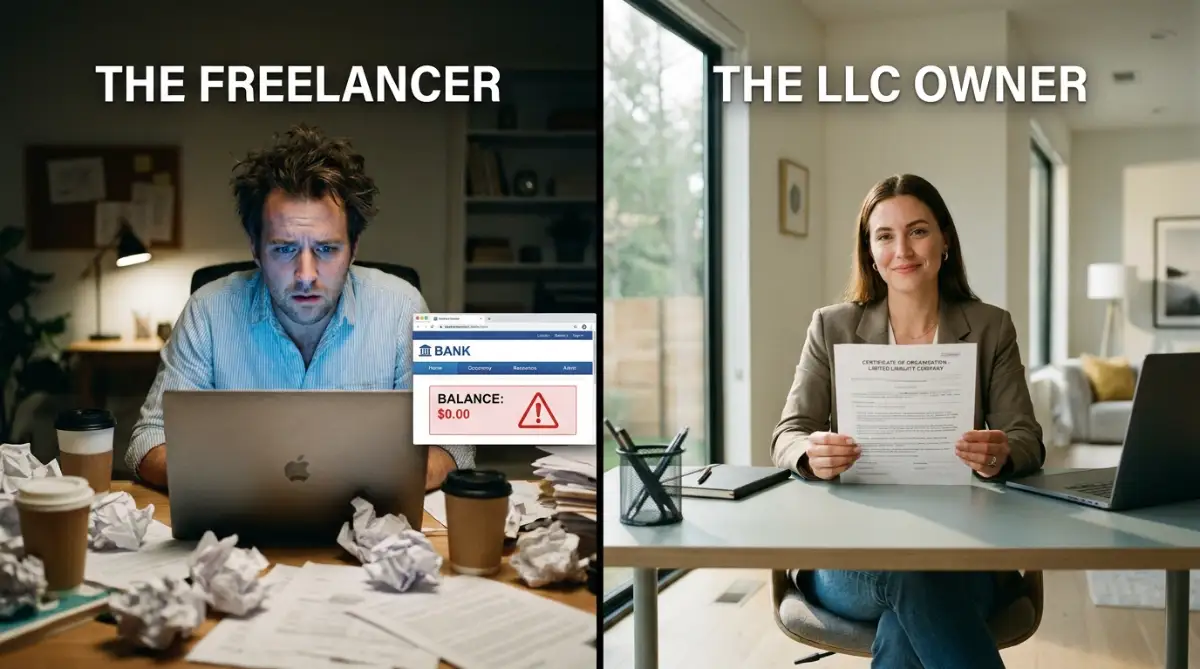
The Ultimate Solution: The Limited Liability Company (LLC)
If you are still on the fence about which legal structure to pick, watch this quick guide. It makes the choice between an LLC and a Sole Proprietorship very easy to understand so you can move forward without any doubt.
If you want to sleep peacefully at night, you need to form a Limited Liability Company, commonly known as an LLC.
An LLC creates an invisible, legal brick wall between your personal life and your professional life. Your business becomes a totally separate legal entity.
If your LLC gets sued by that same angry client, they can only attack the money inside the business bank account. Your personal savings account, your house, and your personal car are completely untouchable.
A Quick Pro Tip from My Experience: Simply paying for an LLC is not enough. If you buy personal groceries using your new LLC debit card, a judge can easily remove your legal protection. Lawyers call this "piercing the corporate veil." Keep your business money and personal money 100% separated from day one.
Setting up an LLC is much easier than most people assume. You simply file a document called the "Articles of Organization" with your local government office and pay a small registration fee.
Expert Insight: Many new freelancers think an LLC will make their taxes much more complicated. This is simply not true.
By default, an LLC is a "pass-through" entity. This means all the business profits simply pass straight through to your personal tax return. You get massive legal protection without the headache of filing complex corporate tax returns.
The Myth vs. Reality of Business Registration
The internet is full of bad advice regarding freelance registration. Let us clear up the noise right now so you can move forward with absolute confidence.
The Myth: I only work online for clients in other countries, so I do not need to register my business locally.
The Reality: Your physical location entirely dictates your legal requirements. If you sit at a desk in your current city to do the work, you must follow the business rules of that specific city and state.
The Myth: Creating an LLC is only for people making over one hundred thousand dollars a year.
The Reality: Legal liability has absolutely nothing to do with your income level. A freelancer making five hundred dollars a month can still get sued for copyright infringement. You need protection from day one.
Securing Your Professional Identity Number
Once you form your LLC, you need to give it an official identity. As a normal citizen, you use a social security number or a national identification number for your taxes.
Your new business needs its own unique number. This is called an Employer Identification Number (EIN).
Do not let the word "Employer" scare you. You need this number even if you plan to work completely alone forever.
Why Giving Out Your Personal Number is Highly Dangerous
When you work as an unregistered freelancer, clients will ask you to fill out a basic tax form before they pay you. If you do not have an EIN, you are forced to write down your personal social security or national ID number.
You are handing highly sensitive personal data to random clients you met on the internet. This is a massive security risk that often leads directly to severe identity theft.
Getting an EIN is completely free and usually takes about ten minutes online. Once you have it, you will only use this specific business number on all your client contracts and tax forms.
Your personal identity stays completely hidden and perfectly secure. This also instantly makes you look like a highly established agency rather than an amateur working from a bedroom.
Opening the Financial Gateway
This is the exact step where ninety percent of freelancers fail miserably. You have your LLC, and you have your EIN.
Now, you must completely separate your money. You cannot run a real business using your personal checking account.
The Messy Reality of Commingling Funds
When you mix your personal grocery money with your client payments, you are committing a major business sin called "commingling funds."
If you get audited by the tax authorities, they will demand to see your bank statements. If they see business income sitting right next to a charge for movie tickets and pizza, they will likely reject all your business deductions.
Furthermore, mixing your money entirely destroys the legal protection of your LLC. Courts refer to this as "piercing the corporate veil."
If a judge sees that you treat the business bank account like your personal piggy bank, they will remove your legal shield. You will become personally liable for all business debts once again.
The Clean Account Strategy
You must walk into a bank, hand them your LLC paperwork and your new EIN, and open a dedicated business checking account.
From that day forward, follow these absolute rules:
- Every single dollar a client pays you must go directly into this new business account.
- Every single business expense you pay for must come strictly out of this business account.
- When you want to pay yourself, you simply transfer a lump sum from the business account into your personal account.

You should label this transfer as an "Owner's Draw."
By following this exact method, your accounting becomes incredibly easy. At the end of the year, you just hand your business bank statements to an accountant.
Every deposit is clearly income. Every withdrawal is clearly a business expense. You will save massive amounts of time and avoid expensive accounting headaches entirely.
One thing I wish I knew earlier is that tax time doesn't have to be scary. I used to keep my receipts in a messy shoe box, and it was a total nightmare. Now, I just use my business debit card for every single work purchase. This keeps my records clean and makes me feel like a real professional every time I pay for a new tool.
Scaling Safely: Pro-Level Strategies for the Registered Freelancer
Now that your new business bank account is officially open, a huge weight should lift off your shoulders. You have successfully built a legal wall between your personal life and your business risks.
However, opening the account is only the foundation of your new corporate life. To keep your business completely healthy over the next decade, you must operate like a seasoned chief executive officer.
This means anticipating legal problems and financial stress long before they actually reach your desk. Let us look at a few highly advanced strategies that separate successful agency owners from struggling amateurs.
The Thirty Percent Tax Shield Rule
When you were a traditional employee, your boss automatically removed taxes from your paycheck. You never had to think about it.
As a new business owner, the government hands you your entire paycheck upfront. This feeling of sudden wealth is incredibly dangerous.
You might look at your business account, see five thousand dollars, and think you can spend it all. If you do this, you will face a devastating shock when tax season arrives.
How to protect yourself today:
You must create a secondary savings account connected directly to your main business checking account. Every single time a client pays an invoice, immediately transfer thirty percent of that money into this savings account.
Do not look at it, and do not touch it. When the government asks for their tax payment at the end of the year, you will write a check with zero stress.
Investing in Professional Liability Insurance
Your Limited Liability Company (LLC) is fantastic for protecting your personal home and your private savings. But what happens if a client sues your business and demands fifty thousand dollars?
If your business bank account only has five thousand dollars in it, your company will immediately go bankrupt. This is exactly why serious business owners carry Professional Liability Insurance.
You understand that protecting your digital assets requires proactive defense. You already know that the hidden dangers of browsing without antivirus protection can instantly wipe out your hard drive.
Skipping business insurance leaves your company entirely exposed to a very similar invisible threat. A single unhappy client can completely wipe out your entire business operation in a matter of weeks.
According to guidelines provided by the U.S. Small Business Administration regarding business insurance, specialized liability coverage protects you against claims of negligence, misrepresentation, or inaccurate advice. For just a few dollars a month, this insurance acts as a massive financial shock absorber.
Upgrading to Master Services Agreements (MSA)
When you operated as a casual freelancer, you probably accepted jobs through simple email exchanges. A client would ask for a project, and you would reply with a price.
Operating a legal entity requires a much stronger paper trail. You need to start using a Master Services Agreement (MSA) for every single new client.
An MSA is a foundational contract that outlines your payment terms, your working hours, and your intellectual property ownership. You cannot apply random, unwritten rules to your professional clients.
A clear contract prevents scope creep, ensures you get paid on time, and establishes you as an absolute professional.
Q&A: Navigating Everyday Business Operations
Question: Can I use my home address to register my new LLC?
Answer: You can, but it is highly discouraged. When you register a business, that address becomes public government record. Anyone on the internet can search your company name and find where you sleep. Instead, rent a cheap virtual business address or a private mailbox to protect your physical privacy.
Question: What should I do if a client refuses to sign my new official contract?
Answer: You walk away immediately. A client who refuses to sign a basic protective agreement is secretly planning to take advantage of you. Protecting your business means saying no to toxic revenue.
Question: Do I need to hire an expensive accountant right away?
Answer: Not necessarily on day one. If you keep your business and personal expenses completely separate, basic bookkeeping software is enough for your first few months. However, once you start making consistent profit, a certified accountant will easily save you more money than they cost.

The Silent Legal Traps That Destroy New Business Owners
The transition from a casual side hustle to a legal business is filled with emotional highs and lows. When you finally get your official company paperwork, you feel entirely invincible.
This false sense of absolute security often leads new founders into massive legal traps. They drop their guard and make careless mistakes that cost them everything.
Let us carefully examine the most dangerous pitfalls you will face in your first year of official operation.
The Estimated Quarterly Tax Penalty
Earlier, we discussed saving thirty percent of your income for taxes. But simply saving the money is not enough to keep you completely safe.
Most new business owners assume they only need to pay their taxes once a year. This is a terrifying and expensive misunderstanding.
The government wants their tax money as you earn it, not twelve months later. If you wait until the end of the year to hand over your tax money, you will be hit with massive financial penalties and heavy interest rates.
As a self-employed business owner, you are legally required to make payments four times a year. The Internal Revenue Service strictly requires independent contractors to pay estimated quarterly taxes if they expect to owe more than one thousand dollars.
Missing these quarterly deadlines is the fastest way to trigger a highly stressful government audit. Put the four quarterly tax dates on your physical calendar today and treat them like life-or-death deadlines.
The "Fake Employee" Misclassification Trap
When you upgrade to a legal business, you might land a massive contract with a large corporate client. This client might demand that you work specific hours, use their company laptop, and report to their daily meetings.
While the high pay seems incredible, this setup is legally toxic. You are no longer acting as an independent business owner; you are acting as an unbenefited employee.
This is known as worker misclassification. It completely ruins your legal independence.
If you allow a client to treat you like an employee, you lose your ability to claim business tax deductions. You also hand over your entire schedule and freedom.
Trying to force a bad client relationship will always make your business suffer.
You must avoid controlling clients to keep your business legally clean. You are the CEO of your company, and you get to decide how, when, and where the work is actually completed.
The Danger of Handshake Deals with Friends
One of the most emotionally painful mistakes you can make is lowering your business standards for your friends. A friend might ask your new company to build them a quick website or design a marketing campaign.
Because you trust them, you skip the official contract and do not ask for an upfront deposit. You assume everything will be perfectly fine because you have known them for years.
The Reality of Casual Agreements:
Business introduces money into the relationship, which completely changes human psychology. When the project takes longer than expected, your friend might refuse to pay the final bill.
Because you have no written contract, you cannot legally force them to pay. You lose your hard-earned money, and your friendship is permanently destroyed.
Do's and Don'ts of Client Management
To ensure your new legal entity survives its first year, closely follow this simple behavioral guide.
- Do: Ask for at least a fifty percent non-refundable deposit before you begin any project.
- Do not: Start working just because a client sent an email saying they agree to the terms. Wait for the actual signature.
- Do: Send highly professional, branded invoices using dedicated accounting software.
- Do not: Accept client payments through personal cash applications that do not offer business protection features.
Your Action Plan for Corporate Independence
We have covered a massive amount of legal and financial ground today. You now completely understand why operating in the shadows is a terrible long-term strategy.
You know exactly how to choose the right corporate structure, separate your banking, and protect your mind from tax anxiety.
But simply reading this guide will not protect your assets. You must take actual, physical steps to secure your future this week.
Instead of feeling overwhelmed by the paperwork, I want you to focus on a very simple, immediate action plan.
Phase 1: The Identity Setup
First, decide on a highly professional name for your business. Make sure the matching website domain is actually available to purchase.
Go to your local government website and file your basic Limited Liability Company paperwork. While you wait for the approval, apply for your free Employer Identification Number online.
Phase 2: The Financial Wall
The moment your official paperwork arrives in the mail, take it directly to a local bank. Open a completely free business checking account.
Move all your future client payments into this specific account. Set up your automatic thirty percent tax savings transfer so you never have to worry about the government again.
Phase 3: The Professional Upgrade
Finally, take one hour this weekend to draft a basic Master Services Agreement. You can easily find free templates online to use as your starting point.
Update your invoices to include your new official business name and your business address.
You are entirely capable of running a massive, highly profitable company. You just needed the right structural blueprint to get started safely. Stop treating your incredible skills like a weekend hobby. Step into your role as a true business owner today, and watch your professional confidence completely transform.
Turning my hobby into a real business gave me a level of peace I never thought possible. I stopped feeling like an amateur and started acting like the CEO of my own life. Take that first step today—your future self is going to be so proud of the solid foundation you are building right now.
Disclaimer: The information provided in this educational guide is for general informational and personal development purposes only. It does not constitute formal legal, financial, or tax advice. Business registration laws and tax requirements vary heavily depending on your specific state and country of residence. Always consult with a licensed business attorney and a certified public accountant (CPA) before forming a legal entity, signing contracts, or filing business taxes.