
The Domino Effect of Disorganized Travel
I used to think that having 20 browser tabs open meant I was a travel pro. I was wrong. I was just one click away from a $400 mistake. After losing a whole day of my vacation and a lot of money on a missed flight in Asia, I realized the old way of booking trips is broken. I’m going to show you my simple system for planning a multi-country trip that won't leave you stressed or broke.
I remember doing exactly this for a trip to Southeast Asia, nearly pulling my hair out as I stared at a screen full of errors and crazy price hikes. I ended up making a rookie mistake that cost me a whole day of my vacation and almost 400 extra dollars just to fix a missed flight. It took that painful disaster for me to finally realize that booking a multi-country trip needs a completely different set of rules.
You have a notebook filled with scribbled departure times, random airport codes, and a growing sense of panic. You are trying to figure out how to get from New York to London, then to Rome, down to Cairo, and finally back home.
Every time you try to connect the dots, the total price suddenly jumps by five hundred dollars. Or worse, you realize that your flight lands in Paris at midnight, but your next connecting flight leaves from a completely different airport on the other side of the city.
This is the exact moment when most people simply give up. They close their laptops, abandon their dream itinerary, and settle for a boring, simple round-trip ticket to a single destination.
We understand this deep frustration entirely. When your schedule is built on weak foundations, one tiny delay acts like a falling domino.
A single missed connection in Germany can instantly ruin your non-refundable hotel reservation in Italy. The fear of this domino effect completely destroys your peace of mind before you even pack your suitcase.

My "No-Panic" Travel Summary
- The Anchor Rule: Book your big over-the-ocean flights first. Everything else follows them.
- Stop Backtracking: Use "Multi-City" search to fly into one city and home from another. It saves days of wasted travel.
- The 3-Hour Buffer: Never book a layover under 3 hours for international flights. Running through airports is for movies, not vacations.
- One Alliance, One Bag: Try to stick to one airline group (like Star Alliance) so your bags go all the way to the end automatically.
Designing Your Global Route Without the Headache
Organizing a trip across three or four different countries requires a completely different mindset. You cannot just type all your desired cities into a search engine and hope the computer figures it out.
The computer does not know your personal energy limits, your sleep schedule, or your stress tolerance. To build a flawless journey, you must act like an architect designing a strong building.
We will break down this complex puzzle into easily manageable blocks. By following this precise logic, you will automatically eliminate the most common logistical nightmares.
Building the Foundation: The "Anchor Leg" Strategy
Think about building a beautiful house. You would never start by painting the bedroom walls before you actually pour the concrete foundation.
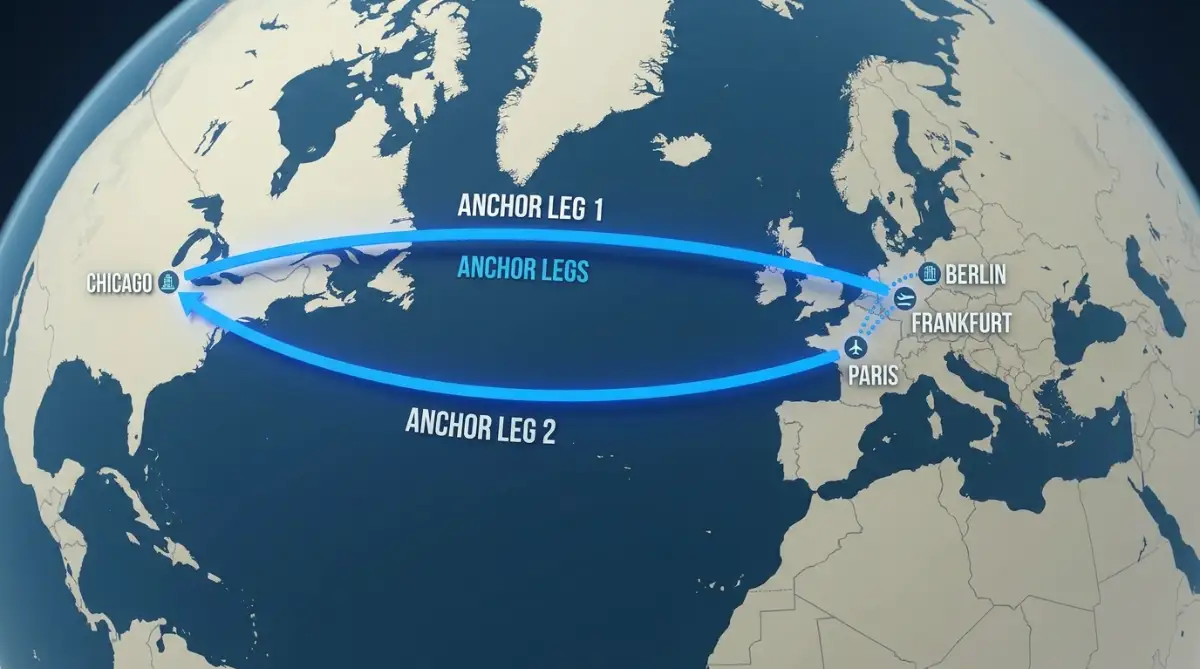
In the travel world, your Anchor Leg is your concrete foundation. This is always the longest, most expensive, and most difficult ocean-crossing flight of your entire journey.
Amateur travelers make the mistake of trying to book every single short regional flight at the exact same time as their big international ticket. This completely limits your options and usually results in terrible pricing.
A Real-Life Application
Let us imagine you want to spend a month exploring Europe, visiting Madrid, Berlin, and Athens. You live in Chicago.
Your Anchor Leg is simply getting from Chicago to the European continent, and then getting back home. You should completely ignore the internal European flights for now.
Look for the absolute best, most direct route from Chicago to a major European hub, like Frankfurt or London. Once you secure this massive foundation, your stress levels will instantly drop.
Wait, why only book the "Anchor Leg" first?
- Question: Won't I miss out on cheap local flights if I wait?
- My Take: No. Local flights in Europe or Asia stay cheap for a long time. But if you don't have your big flight from the US or UK locked in, your whole trip has no dates. Lock the big door first, then worry about the small windows.
Wait, why only book the "Anchor Leg" first?
- Question: Won't I miss out on cheap local flights if I wait?
- My Take: No. Local flights in Europe or Asia stay cheap for a long time. But if you don't have your big flight from the US or UK locked in, your whole trip has no dates. Lock the big door first, then worry about the small windows.
You now have a guaranteed arrival date on the continent and a guaranteed departure date. Filling in the small, cheap regional flights between Madrid and Berlin later becomes an incredibly easy and fun task.
The Open-Jaw Ticket Architecture
One of the absolute biggest wastes of time and money in global travel is the dreaded "backtrack." This happens when you fly into one specific city, travel by train across the country, and then force yourself to travel all the way back to the first city just to catch your flight home.
To solve this, you need to use a ticketing method known as the Open-Jaw Architecture. This sounds like a complex aviation term, but it is actually a very simple and highly effective concept.
An open-jaw ticket means you fly into one city, but you fly home from a completely different city.
Why This Method Always Wins
Let us look at a quick breakdown of why this structure protects your time and your physical energy.
If you are still a bit confused about how open-jaw flights actually work, I highly recommend watching this quick video before you read the rest of the guide. It perfectly explains how to use the multi-city tool to save your time and money, making the advanced hacks below so much easier to understand!
Search engines have a specific button labeled "Multi-City" right next to the standard round-trip option. Using this feature to build an open-jaw route is the ultimate secret of veteran backpackers and global business executives.
The Science of Minimum Connection Times (MCT)
When booking a complex route, search engines will often suggest incredibly tight layovers. They might offer you a flight from New York to Dubai with a mere forty-five-minute stop in London.
On a computer screen, a forty-five-minute layover looks wonderfully efficient. In reality, it is a massive trap that completely ignores human biology and airport logistics.
Every major global airport has an officially published Minimum Connection Time (MCT). This is the absolute shortest amount of time the airline calculates it takes for a healthy adult to walk between two specific gates.
However, this calculation assumes that every single condition is perfectly ideal. It assumes your first flight lands exactly on time, the weather is perfect, and you walk extremely fast.
The Biological Cost of Rushing
When you book a dangerously short layover, your brain enters a state of high alert. As your first flight begins to descend, your heart rate spikes because you are terrified of missing the next plane.
When you finally land, you end up sprinting through a crowded terminal carrying heavy bags. You arrive at your next gate covered in sweat, deeply exhausted, and highly irritable.
This intense spike in cortisol and physical stress completely ruins your internal immune system. This is exactly why so many people get mysteriously sick on the second day of their vacation.
I learned this the hard way when I booked a 50-minute layover in Paris, thinking I could just run to my next gate. I actually missed my flight, lost my luggage for three days, and started my trip crying in an airport hotel. Now, I personally never book any international connection with less than a solid three-hour gap, even if the airline website says it is completely safe.
Always manually check the suggested layover time before you pay for the ticket. For any international connection involving passport control, you should demand a minimum buffer of at least two and a half hours.
Protecting your biological energy is far more valuable than arriving at your destination an hour earlier.
Aligning Global Airline Alliances
When you are bouncing between three different countries, you will likely need to fly on multiple different airlines. This is where most people experience severe baggage headaches.
Imagine flying from Miami to Brazil on one airline, and then transferring to a completely separate, low-cost local airline to reach Argentina. If these two airlines do not have an official partnership, they will not communicate with each other.
This means you must collect your heavy suitcases at the baggage carousel in Brazil. You then have to exit the secure zone, go upstairs to the departure hall, and check your bags all over again with the new airline.
This exhausting process can easily take three hours and requires you to pass through full security screening twice.
The Power of the Single Ticket
To completely bypass this nightmare, you must understand how airline alliances operate. The aviation world is dominated by three massive groups: Star Alliance, Oneworld, and SkyTeam.
When building your complex itinerary, you should try to keep all your flights within one single alliance network. When you book within an alliance, all your separate flights are grouped under one single reservation number.
Because the computer links the airlines together, your baggage is automatically checked all the way through to your final destination. You can simply step off the plane in Brazil, grab a cup of coffee, and walk straight to your next departure gate.
Furthermore, staying within an alliance provides a massive safety net. If your first flight is heavily delayed due to a thunderstorm, the alliance is legally required to rebook your second flight for free.
If you had booked two completely separate, unlinked tickets, the second airline would simply mark you as a "no-show" and cancel your seat without any refund.
Expert Strategies for Hacking Global Routes
Now that we have established a solid foundation with anchor legs and open-jaw tickets, we can explore more advanced methods. Professional travel planners do not just rely on standard booking engines to build their trips.
They use specialized routing techniques that completely bypass standard pricing models. These methods require a slightly different approach, but they yield incredible financial savings and a much richer travel experience.
Let us look at a few highly guarded secrets that frequent flyers use to travel across continents without spending a fortune.
The Magic of the "Free Stopover" Program
Many amateur travelers view a layover as a horrible, exhausting delay in their journey. They actively pay hundreds of dollars more just to avoid sitting in a foreign airport for six hours.
However, clever global explorers actually hunt for massive, multi-day layovers. They use a brilliant concept known as the Airline Stopover Program.
Many national airlines actively want you to visit their home country on your way to your final destination. To encourage this, they allow you to extend your layover in their hub city for several days at absolutely no extra airfare cost.
Think of this strategy as getting a "buy one, get one free" vacation.
A Real-Life Stopover Scenario
Imagine you are trying to book a flight from New York to Rome. The direct flights are incredibly expensive, running well over a thousand dollars.
Instead, you search for a flight on TAP Air Portugal. You can book a ticket to Rome, but schedule a three-day stopover in Lisbon along the way.
You pay the exact same price as a standard connecting ticket, but you suddenly get to spend three beautiful days eating pastries in Portugal. Icelandair, Qatar Airways, and Turkish Airlines offer similar incredible programs that turn a stressful connection into an amazing bonus trip.
If you want to maintain high energy during these extended multi-country trips, you need a solid daily routine. This is exactly why creating a stress-free international itinerary is absolutely mandatory before you leave your house.
A perfectly mapped schedule ensures you never waste your valuable bonus days trying to figure out local train schedules.
The Buffer Day Repositioning Tactic
We briefly discussed the dangers of missing tight connections. When you are building a complex multi-city route, you will sometimes need to buy two completely separate tickets on different airlines.
For example, you might buy a cheap domestic flight to reach a major international hub like Los Angeles. From there, your massive international ticket to Australia begins.
If your cheap domestic flight is delayed, the second airline will simply cancel your expensive Australian ticket. They are not legally responsible for you because the tickets are completely separate.
To completely eliminate this massive financial risk, you must use the Buffer Day Tactic.
Never book your repositioning flight on the same day as your major international departure. Always fly into your departure hub a full twenty-four hours early.
You can book a nice airport hotel, enjoy a relaxing dinner, and sleep perfectly well. The next morning, you can simply walk to your departure gate completely free of any rushing or anxiety.
To understand your exact legal rights regarding delays and separate tickets in different regions, you should always verify the local aviation rules. The official European Union Air Passenger Rights regulations clearly outline exactly what compensation you are owed if a connected flight gets disrupted.

The Hidden Saboteurs of Complex Travel Planning
Even with a perfect map and a great attitude, multi-city travel carries massive hidden risks. When you are crossing multiple international borders, a tiny administrative mistake can instantly destroy your entire vacation.
We often learn the most valuable lessons by analyzing the painful disasters of other travelers. Let us explore the most devastating traps that consistently ruin complex flight schedules.
The Devastating "Transit Visa" Nightmare
Imagine standing at the check-in counter, completely buzzing with excitement for your massive trip to Southeast Asia. Your route takes you from Canada, through a quick connection in China, before finally landing in Thailand.
You hand your passport to the smiling airline agent. She types on her keyboard, frowns deeply, and asks to see your Chinese transit visa.
Your heart suddenly drops into your stomach. You confidently explain that you are not actually visiting China; you are just sitting in the airport for two hours to catch your next plane.
The agent shakes her head and officially denies you boarding. Because you failed to research the local transit laws, your entire ten-thousand-dollar vacation is instantly canceled.
Many travelers incorrectly assume that they never need a visa if they do not leave the airport terminal. This is a terrifyingly dangerous assumption.
Many countries require specific nationalities to hold an official transit visa just to step off the plane and walk to another gate. Before you ever finalize a multi-city payment, you must verify the exact transit requirements for every single country on your itinerary.
Quick Transit Visa Check (Don't Get Kicked Off the Plane)
| If You Fly Through: | You Might Need a Visa If: | My Advice: |
| :--- | :--- | :--- |
| China | You leave the airport or have a long stay. | Check the "24/72/144-hour" visa-free rules. |
| USA | You are just connecting to another country. | You almost ALWAYS need a visa or ESTA to land. |
| UK/Schengen | You have to change airports (like LHR to LGW). | You must clear customs, so you need a transit visa. |
You can easily check these strict border requirements by visiting official government portals, such as the U.S. Department of State's international travel hub. They provide highly accurate, up-to-date entry rules for every nation on Earth.
The "Same City, Different Airport" Trap
When booking complex global routes through aggregate search engines, the computer only looks for the absolute cheapest price. It does not care about your personal comfort or logical logistics.
A search engine might show you an incredibly cheap connecting flight through London. However, if you look very closely at the small print, you will notice a massive red flag.
Your incoming flight lands at London Heathrow (LHR), but your outgoing flight departs from London Gatwick (LGW). You have exactly four hours to make the connection.
The Reality of Ground Transfers
The search engine completely ignores the reality of massive city traffic. To make this connection, you must pass through British customs, collect your heavy luggage, and drag it onto an expensive express train.
Then, you must navigate across the entire city of London during rush hour, arrive at the second airport, and pass through security all over again.
This is not a relaxing vacation; this is a highly stressful athletic event. If a single train is delayed by twenty minutes, you will absolutely miss your next flight.
Always double-check the specific three-letter airport codes on your itinerary. If a connection requires you to physically change airports, you should aggressively avoid that route unless you have a full overnight layover.
Relying on Third-Party Agencies for Complex Routes
We all love hunting for massive discounts on popular online travel agencies. Buying a simple round-trip ticket through these platforms is usually quite safe.
However, building a highly complex, four-country itinerary on a discount third-party website is a recipe for absolute disaster.
If an airline suddenly changes their flight schedule by three hours, the third-party agency rarely updates your entire itinerary automatically. You might show up at the airport for leg three of your journey, only to find out the flight left yesterday.
When you call the airline for help, they will completely refuse to touch your reservation because you bought it through a random website. You are entirely at the mercy of a foreign customer service call center that keeps you on hold for six hours.
Understanding this specific risk is highly similar to understanding flight booking myths exposed by airline algorithms. You must always book complex routes directly on the official airline website to maintain total legal control over your ticket.
Misaligning Your Ground Accommodations
A beautifully planned flight schedule means absolutely nothing if your ground logistics are a complete mess. Multi-city routes often feature bizarre arrival times due to extreme time zone changes.
You might land in Singapore at five in the morning after a brutal fourteen-hour flight. You grab your bags, take a taxi to your expensive resort, and walk up to the front desk.
The staff politely informs you that official check-in does not begin until three in the afternoon. You are now forced to wander the hot city streets like a zombie for ten hours, dragging your heavy backpack.
This common mistake completely ruins your first day in a new country. To prevent this exhaustion, you must always communicate your exact flight arrival times to your chosen property.
Furthermore, you need to protect yourself from predatory hospitality tactics by avoiding hidden traps when booking directly on hotel websites. If you know you are arriving very early, always book your room starting from the night before, ensuring a warm bed is waiting for you immediately.
Your Master Blueprint for Flawless Global Navigation
We have covered a massive amount of highly detailed logistical planning today. Building a multi-city flight schedule does not have to be a confusing, stressful nightmare that leaves you in tears.
By simply shifting your mindset from a casual tourist to a strategic travel architect, you instantly regain total control over your journey. You are no longer guessing; you are intentionally designing an experience that protects your energy and your wallet.
Let us condense everything into a highly actionable checklist that you can use right now.
The Pre-Booking Action Plan
Do not just read this guide and forget these valuable rules. Before you ever enter your credit card numbers for your next big adventure, ask yourself these highly specific questions.
Your Final Routing Checklist:
- Have I built my Anchor Leg first? Did I secure the massive ocean-crossing flight before worrying about small regional train tickets?
- Did I completely eliminate backtracking? Am I using the open-jaw architecture to fly home from my final destination rather than wasting time returning to the start?
- Are my layovers biologically safe? Do I have at least a two-and-a-half-hour buffer for any international connection involving customs and passport control?
- Did I verify the visa rules? Have I checked the official government websites to ensure I do not need a hidden transit visa just to switch airplanes?
Taking Control of Your Next Adventure
Traveling across different cultures and continents is one of the most deeply rewarding experiences a human being can have. Do not let the initial fear of complicated computer booking screens hold you back from exploring the world.
Every single expert traveler started exactly where you are today. They made mistakes, they missed flights, and they slowly learned how the global aviation system actually operates.
You now hold the exact blueprint used by those seasoned professionals. You know how to leverage airline alliances, secure free stopover vacations, and protect your precious mental health.
Open a fresh browser window, grab a hot cup of coffee, and start mapping out that dream itinerary. The world is waiting for you, and you are finally ready to navigate it flawlessly. Safe travels!
Looking back, the trips that used to scare me the most have turned into my absolute favorite memories. Once I stopped fighting the booking engines and started using this simple system, packing my bags became exciting instead of stressful. You can absolutely do this, so take a deep breath, trust the process, and go plan that amazing trip you have been dreaming about!
Disclaimer: The travel, routing, and booking strategies provided in this article are for informational and educational purposes only. Global airline schedules, transit visa requirements, and aviation consumer protection laws change constantly. Always verify current international entry rules, minimum connection times, and ticketing policies directly with your chosen airline and official government agencies before making any financial commitments.