 The Heavy Burden We Carry Every Single Day
By 2:00 PM every day, my neck felt like it was on fire. I would constantly rub the base of my skull, trying to massage away a dull, heavy ache that was ruining my focus. I bought every ergonomic pillow and cheap massage gun on the internet, completely convinced my spine was just broken. It wasn't until I stopped aggressively rubbing my neck and started looking at what I was doing with my chest that the pain finally stopped. If you are reading this while hunched over a keyboard, let's fix that burning tension right now.
She adjusted her computer monitor, sat up perfectly straight, and promised herself she would stop slouching. But exactly ten minutes later, she caught herself completely hunched over her keyboard again, staring closely at the screen.
If this scenario sounds exactly like your normal Tuesday, I want you to know I understand how exhausting it feels. You are fighting a silent, painful battle against your own body.
I used to come home from my office job every single day with a burning, heavy pain at the base of my skull that simply would not go away. I wasted hundreds of dollars on cheap massage guns and special pillows, completely convinced my body was just falling apart. It was only when I realized my daily desk habits were the real enemy that I finally started to heal my neck for good.
That persistent tightness in your upper back is not just a minor inconvenience. It absolutely drains your energy, triggers awful afternoon headaches, and makes it impossible to focus on your work.
By the time you finally clock out and head home, you do not even have the energy to play with your kids or cook a decent meal. Your mood is ruined simply because physical pain is consuming all your mental bandwidth.
You might feel incredibly frustrated, wondering why you cannot just sit up straight like a normal person. You buy expensive ergonomic pillows and massage gadgets, hoping for a quick fix that never actually lasts.
The truth is, your muscles are not just tight; they are entirely confused. Your body is biologically adapting to the unnatural shape you force it into for eight hours a day.
We cannot magically quit our office jobs or stop using our smartphones. But we can absolutely teach our bodies how to fight back against the daily wear and tear.

The 30-Second Tech Neck Survival Guide
- Stop stretching your neck: Your neck hurts because it is already over-stretched. You actually need to stretch your tight chest muscles (pectorals) to stop them from pulling your head forward.
- The Bowling Ball Math: For every inch your head leans forward toward your screen, your neck takes on 10 extra pounds of pressure.
- Ditch the Posture Braces: Strapping yourself into a tight brace makes your actual back muscles incredibly lazy. When you take the brace off, the pain comes back worse.
- Fix the Monitor: Your eyes should hit the exact top-third of your computer screen while looking straight ahead. If you look down, you lose.
Decoding the Mechanics of Forward Head Posture
To truly fix this agonizing problem, we must first understand basic physics. Your head is surprisingly heavy, weighing roughly 10 to 12 pounds in a neutral, upright position.
Think of your head as an average-sized bowling ball resting perfectly balanced on top of a golf tee. When that bowling ball sits exactly in the center, the tee holds the weight effortlessly.
But what happens when you tilt that heavy bowling ball just slightly forward? The pressure on the tee increases dramatically.
The Mathematical Reality of Slouching
For every single inch your head moves forward out of alignment, the weight placed on your neck muscles essentially doubles. This means looking down at your phone puts about 50 to 60 pounds of pressure directly on your delicate cervical spine.
Your upper back muscles were never designed to hold 60 pounds of dead weight for hours at a time. They are screaming in pain because they are being stretched completely beyond their natural limits.
This constant stretching causes the muscles at the back of your neck to become weak and exhausted. Meanwhile, the muscles in your chest become incredibly short and painfully tight.
Myth vs Reality: Understanding Good Posture
Rewiring Your Upper Body Mechanics
If you want to permanently stop the burning sensation in your neck, stretching the sore area is actually a mistake. Stretching an already over-stretched muscle will only give you about ten minutes of relief.
Instead, we need to focus on opening the front of your body while strengthening the back. Let us break down some highly effective, science-backed adjustments you can make starting right now.
If you are a visual learner, watch this incredibly helpful short video below to see exactly how to perform these posture-fixing exercises safely. Watch the video first to get the form right, and then keep reading to find out why your expensive office chair might not actually be helping you!
Releasing the Chest Muscles First
Before we even touch your neck, we must unlock your chest. When you sit at a desk, your shoulders naturally roll forward, causing your pectoral muscles to shrink.
These shortened chest muscles act like tight rubber bands, constantly pulling your head forward. If you do not release these rubber bands, your neck muscles will always lose the tug-of-war.
For years, I made the huge mistake of aggressively stretching the back of my sore neck, which actually made the pain so much worse the next morning. My biggest realization was learning that my tight chest was the actual bully pulling my head forward, and doing a simple doorway stretch felt like absolute magic for my upper back.
The Doorway Stretch Approach:
- Stand right in the middle of an open doorway in your house or office.
- Bend your arms at a 90-degree angle, placing your forearms flat against the doorframe.
- Gently step one foot forward until you feel a deep, warm pull across your chest.
- Hold this exact position for 30 seconds while taking slow, deep breaths.
I highly recommend doing this stretch every time you walk to the kitchen for a glass of water. Frequent, short stretches are far more effective than one long stretching session.
My Hourly Posture Hack
I used to forget to stretch until the pain hit. Now, I tie my posture resets to a daily habit. Every time I get up to refill my coffee or water bottle, I force myself to do 3 chin tucks and one 30-second doorway stretch. It takes zero extra time out of my day, but it constantly breaks the forward-leaning pattern before my muscles get a chance to lock up.
The Power of the Chin Tuck
Once your chest is finally open, we have to teach your head exactly where it belongs in space. The chin tuck is widely considered the gold standard exercise for correcting forward head posture.
It looks a little bit silly, but it targets the deep neck flexor muscles that have gone completely dormant. You can do this easily while sitting at a red light in your car.
How to execute a perfect chin tuck:
- Sit up comfortably and look straight ahead at a fixed point on the wall.
- Place two fingers lightly on the front of your chin.
- Without tilting your head up or down, push your chin straight back.
- Imagine you are trying to make a double chin, pulling your head horizontally backward.
Hold this awkward position for about five seconds, then fully relax. Repeat this simple motion ten times, and you will feel a deep fatigue at the base of your skull. That fatigue means the right muscles are finally waking up.
Upgrading Your Work Environment
You cannot expect to have great posture if your physical environment constantly forces you to look down. Modifying your workspace is non-negotiable if you want lasting results.
Your computer monitor must be directly at eye level. If you are using a laptop flat on a desk, you are absolutely destroying your neck.
Invest in a cheap laptop stand and a separate wireless keyboard. When you look straight ahead, your eyes should land exactly on the top third of your computer screen.
Pro Tip/Expert Insight: Pay close attention to your elbows when you type. If your elbows are reaching forward away from your ribs, your shoulders will naturally round forward. Keep your keyboard close enough that your elbows rest comfortably at your sides.
Thoracic Spine Mobility
Your thoracic spine is the middle part of your back, right between your shoulder blades. Because we sit in chairs all day, this part of the spine becomes as stiff as a solid piece of concrete.
When your middle back cannot bend backward, your neck is forced to bend extra sharply to compensate. We need to restore the natural curve of your upper back.
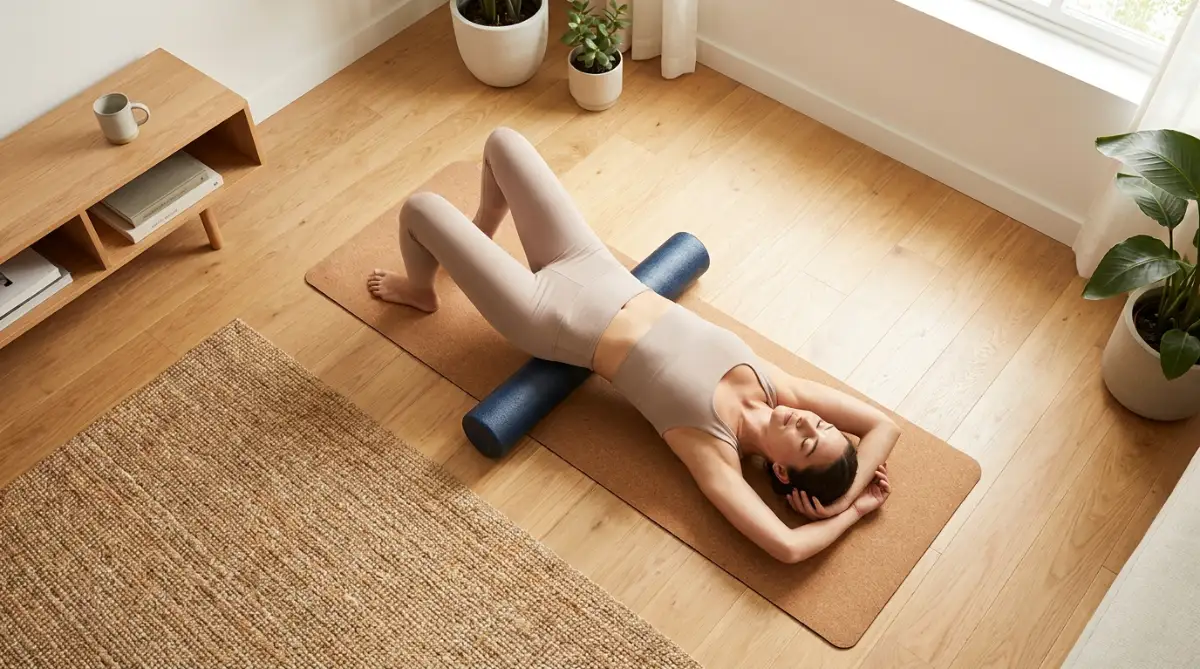
Grab a standard foam roller, or tightly roll up a thick bath towel. Place it horizontally on the floor and lie down so it rests right beneath your shoulder blades.
Support the heavy weight of your head with your hands, and gently lean back over the towel. Take a massive breath in, and as you exhale, let your spine melt backward over the curve.
This movement forcefully reverses the hunched position you maintain all day long. It sends a fresh supply of blood to the tight joints and instantly relieves the pressure on your lower neck.
The 20-20-20 Rule for Muscle Reset
Our bodies are designed for constant, dynamic movement, not static holding patterns. The absolute best posture in the world will still cause severe pain if you hold it for too long.
Eye strain heavily contributes to poor posture because we naturally lean our heads forward to read small text. To fight this, implement the famous visual reset rule.
Every 20 minutes, look at an object that is at least 20 feet away for exactly 20 seconds. This relaxes the tiny muscles in your eyes, which subconsciously signals your neck muscles to relax as well.
Pair this visual break with a quick shoulder roll. Shrug your shoulders all the way up to your ears, squeeze tightly, and then drop them down heavily.
By aggressively breaking up your sitting time with these tiny micro-movements, you prevent the muscles from locking up. You are actively showing your nervous system that you are not stuck in one single position.
Reprogramming Your Body's Deep Muscle Memory
Fixing your physical alignment is not a temporary project you do for a few weeks. If you want to keep your neck pain away forever, you have to completely reprogram how your body moves through the world.
Your brain has spent thousands of hours learning exactly how to slouch over a keyboard. We now have to teach your central nervous system a brand new baseline for what normal posture actually feels like.
This requires moving past basic neck stretches and looking at your body as one heavily connected machine. Let us explore some advanced, expert-level strategies that can permanently bulletproof your spine against modern technology.
The Hidden Core Strength Connection
Most people treat neck pain as an isolated issue located entirely in their upper body. But your spine is basically a tall building, and your abdominal muscles act as the foundational concrete.
If your core muscles are incredibly weak, your lower back begins to sway forward to keep you balanced. This instantly creates a chain reaction of terrible posture all the way up to the base of your skull.
When your foundation collapses, your tiny neck muscles have to work overtime to keep your head upright. According to research published by the National Library of Medicine regarding how core muscle weakness affects spinal stability, a strong midsection is absolutely essential for holding your head in the correct position.
To fix your upper back, you must actively train your abdominal wall. Simple exercises like planks or the "bird-dog" movement build deep spinal support without putting any extra strain on your sore neck.
Is Your Pillow Secretly Sabotaging You?
You can do all the right exercises during the day, but a terrible sleep setup will ruin your progress overnight. We spend roughly a third of our lives lying in bed, completely unaware of our body positioning.
Many people sleep with two large pillows piled high beneath their heads. This forces your chin directly into your chest, mimicking the exact same downward tech posture you hold at your office desk.
You are essentially giving yourself tech neck for eight solid hours while you sleep. To fix this, you need a supportive pillow that keeps your ears perfectly aligned with your shoulders.
If you sleep on your back, use a very thin pillow just under the curve of your neck. If you sleep on your side, make sure the pillow is thick enough to fill the exact gap between your mattress and your ear.
The Surprising Link Between Spinal Discs and Hydration
Between every single bone in your spine, there is a spongy disc that acts as a shock absorber. These little discs are made mostly of water, keeping your joints bouncy and pain-free.
When you sit staring at a screen all day, you probably forget to drink enough plain water. Dehydration causes these spinal discs to dry out and shrink, making your neck feel incredibly stiff and grinding.
Make a strict habit of drinking a large glass of water every time you get up to stretch. Plumping up those spinal discs gives your neck the physical space it needs to move freely.
Reader Q&A: The Unexplained Jaw Pain Mystery
Question: "I have terrible forward head posture, but my jaw is also constantly clicking and aching. Are these two things somehow connected?"
Answer: Yes, they are deeply connected in a very mechanical way. When your head slides forward, it pulls heavily on the muscles located right under your chin.
This unnatural tension forces your lower jaw backward into your facial joints. Your jaw muscles begin clenching incredibly tight just to hold your mouth properly closed while you work.
As you start pulling your head back into proper alignment, you will notice your jaw tension naturally melting away. Your facial muscles finally get to relax when your head sits balanced on top of your spine.

The Dangerous Posture Traps You Must Avoid
When the burning pain gets bad enough, people often panic and try desperate measures to fix their bodies quickly. Unfortunately, many popular posture solutions actually cause significant long-term damage.
I see well-meaning office workers making the exact same mistakes over and over again. They buy aggressive gadgets or push their bodies way too hard, leading to horrible muscle spasms.
You must protect your delicate cervical spine from quick-fix gimmicks that promise instant relief. Let us look closely at the biggest traps that can completely derail your healing journey.
The Illusion of Posture Braces
Meet David, a graphic designer who bought a heavy-duty posture corrector online to fix his slouching. For the first three days, he felt absolutely amazing because the tight straps physically held his shoulders perfectly back.
But after taking the brace off, his pain returned twice as bad as before. He noticed he could no longer hold himself up for even five minutes without the tight physical straps.
This happens because external braces completely shut off your internal muscle activity. When the brace does all the heavy lifting, your own back muscles quickly become incredibly lazy and weak.
You want to train your muscles to support your frame naturally, not teach them to rely on a tight corset. Toss the rigid braces in the trash and use gentle exercise to build your own internal strength instead.
The Trap of Aggressive Over-Stretching
When a specific muscle feels extremely tight and sore, your first instinct is usually to stretch it as hard as possible. You might aggressively pull your head sideways, trying to force the tight neck muscles to release.
But your neck muscles are currently tight because they are exhausted from holding your heavy head all day. Stretching an already exhausted muscle is like pulling violently on a frayed rope.
You are creating microscopic tears in the muscle tissue, which leads to massive inflammation the very next morning. Your body responds to this sudden trauma by locking the joints up even tighter to protect your spinal cord.
Always treat your neck with intense gentleness and respect. Gentle mobility and small movements are far safer and much more effective than harsh, painful stretching.
Ignoring Your Mental Tension
You cannot separate your physical posture from your current emotional state. Whenever you feel overwhelmed by a deadline, your body naturally curls inward into a protective, defensive ball.
You subconsciously hike your shoulders up to your ears to protect your throat from perceived danger. The American Psychological Association explains how chronic stress instantly triggers muscle guarding, keeping your upper body locked in a state of high tension.
If you do not address this underlying stress, you will constantly fight against your own nervous system. You cannot out-stretch a body that believes it is under constant physical attack.
Learning how to actively calm your mind is a massive part of physical pain relief. Incorporating nervous system regulation techniques that actually work will instantly tell your tight shoulders it is finally safe to drop down.
Relying Entirely on the "Perfect" Chair
Many people believe that spending a thousand dollars on a fancy ergonomic office chair will cure their bad posture. While a good chair is definitely helpful, it is never a magical cure for your habits.
If you sit completely frozen in the absolute best chair on the market for ten straight hours, you will still experience pain. Your body requires frequent movement to pump fresh oxygen and blood into your muscle tissues.
You must focus heavily on your daily habits, not just your expensive office furniture. A person taking frequent movement breaks in a cheap wooden chair will always feel better than someone locked perfectly still in a luxury seat.
The "Expensive Chair" Reality Check
Do not blow $1,000 on an ergonomic chair thinking it will cure your neck.
- The Trap: Fancy chairs usually have massive lumbar support that pushes your lower back forward, which actually forces your upper back to round forward even more to compensate.
- The Fix: A basic chair is fine. The secret is sitting all the way back against the seatpan and keeping your feet flat. If your feet dangle, your lower back collapses, and your neck takes all the damage.
Tomorrow's Action Plan For a Pain-Free Neck
We have covered exactly why your body is hurting and the science behind fixing it permanently. Now it is time to take this information and turn it into real, manageable daily habits.
You do not need to spend two hours at the gym every day to see massive improvements in your posture. You simply need to sprinkle tiny, intentional movements throughout your existing daily routine.
Your body is incredibly resilient and desperately wants to heal itself. You just have to give it the proper physical cues and a little bit of daily support.
Setting Up Your Environment for Success
Before you start working tomorrow morning, take five minutes to evaluate your exact physical setup. Following basic Cleveland Clinic guidelines on proper workstation setup can instantly remove hours of unnecessary strain.
Make sure your feet are totally flat on the solid floor, not dangling freely from a high stool. Adjust your monitor so the very top line of your text is perfectly level with your resting eyesight.
Push your keyboard back just enough so your forearms can rest completely flat on your desk. These tiny geometric adjustments make a massive difference in how your upper back feels by late afternoon.
Protecting Your Evening Wind-Down
How you treat your body after work is just as important as how you sit during the day. If you spend your entire evening slumped on a soft couch looking down at an iPad, you are not giving your neck a break.
Pay very close attention to how you hold your technology when you are totally relaxed at home. Prop your arms up with a thick pillow so your digital screen stays directly in front of your face.
A Gentle Reminder for Your Healing Journey
Fixing deep postural issues takes consistent time and quiet patience. There will absolutely be days when you forget all your good habits and catch yourself slouching heavily by 3 PM.
When this happens, do not get angry or completely frustrated with yourself. Simply take a deep breath, sit up a little taller, and gently reset your position without any harsh self-judgment.
Every single time you choose to pull your shoulders back and tuck your chin, you are winning a small victory. You are actively taking control of your physical health and building a much stronger, pain-free future for yourself.
Start with just one single chest stretch tomorrow morning when you wake up. You have the total power to reverse this damage, one small, mindful movement at a time.
I know exactly how hopeless and exhausting chronic neck pain can feel, but I am living proof that you can completely reverse this damage without having to quit your computer job. Just try doing one single chin tuck while sitting in your car today, because your body really does want to heal if you just give it a little bit of support.
Disclaimer: The information provided in this blog post is intended for educational and informational purposes only. It is not a substitute for professional medical advice, diagnosis, or targeted physical therapy. Always consult with a qualified healthcare provider or licensed physical therapist before beginning any new exercise routine, especially if you experience sharp pain, numbness, or tingling in your arms or hands. Do not disregard professional medical guidance based on the content of this article.