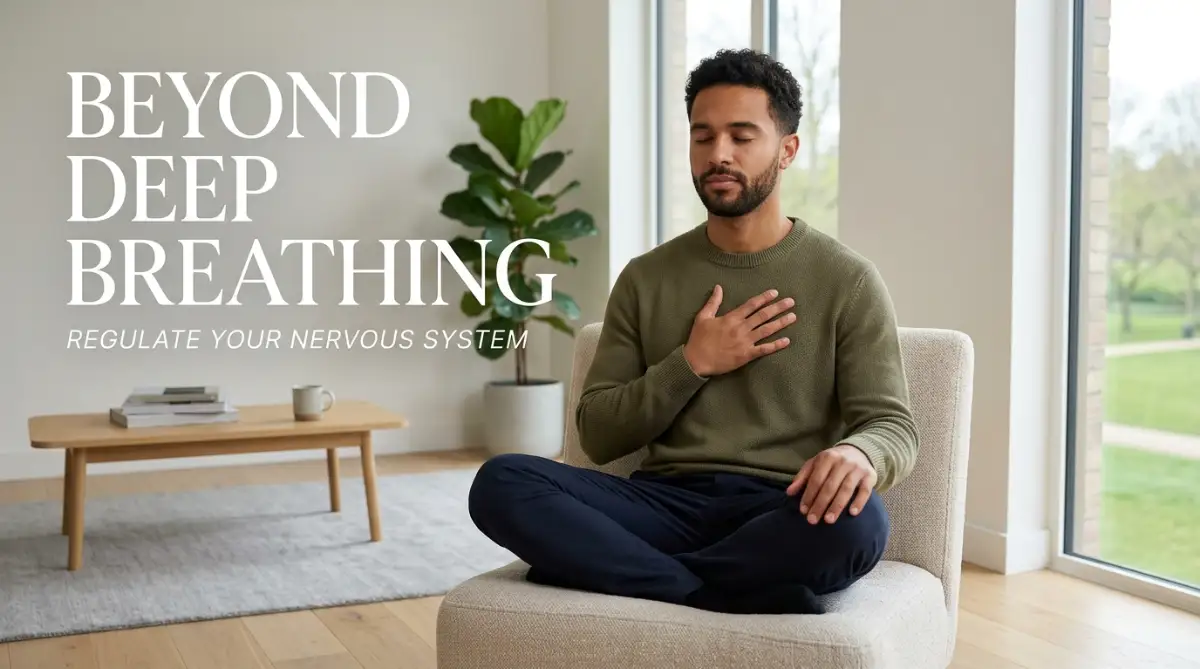
The Silent Battle Inside Your Own Body
Have you ever felt your heart pounding out of your chest while sitting completely still on your couch? You try to take that "deep, relaxing breath" everyone always recommends, but your chest feels like a concrete wall. For years, I woke up every morning feeling like I was bracing for a car crash that never happened. I thought I was losing my mind, but it turns out my nervous system was just stuck in overdrive. Let's talk about why forced breathing sometimes makes panic worse, and how to actually tell your body it is safe.
For years, I woke up every single morning feeling like a heavy brick was sitting on my chest before I even opened my eyes. Everyone kept telling me to "just take a deep breath," but trying to force air into my tight lungs only made my panic worse. It took me a long time to realize that my body was not broken; it was just stuck in a constant state of high alert.
It is incredibly frustrating when basic advice fails you during a silent moment of panic. You might feel totally disconnected from your own body, wondering why you cannot just relax like a normal person.
This silent battle is something millions of people fight every single morning. Your alarm goes off, and immediately, a heavy wave of dread washes over you. You have not even started your day, yet you already feel entirely exhausted.
You drag yourself out of bed, plaster a smile on your face, and pretend everything is fine. But inside, your body is screaming in survival mode. You go through the motions of your day, carrying a heavy weight on your shoulders.
This hidden tension ruins your focus at work and makes you easily snap at your loved ones. It completely steals your joy, making you dread even the smallest daily tasks.
I want you to know that you are not broken, and you are definitely not alone in this fight. What you are experiencing is simply a dysregulated nervous system stuck in overdrive.
When your body feels like it is under constant physical threat, deep breathing alone will never fix the root problem. We need to speak to your body in a language it actually understands.

The Nervous System Survival Guide
- Deep breathing isn't for everyone: When you are in full panic mode, forcing deep breaths can make your chest feel tighter. Try physical touch instead.
- Use the Ice Trick: Holding something freezing cold to your chest shocks your vagus nerve and instantly hits the brakes on an anxiety attack.
- The Sigh Matters: Animals calm down using a "physiological sigh." Taking two quick inhales followed by one long exhale naturally slows your heart rate.
- Don't force positivity: "Toxic positivity" tells your brain you are ignoring a real threat. Acknowledge the tight chest, and then use your physical tools to calm it down.
Decoding Your Body's False Alarm System
Before we jump into the solutions, we need to understand exactly what is happening under your skin. Think of your nervous system as a highly sensitive car alarm.
Normally, this alarm only goes off when someone tries to break a window. This is exactly how our ancestors survived dangerous situations in the wild.
But when you deal with chronic stress, that car alarm becomes way too sensitive. Suddenly, it starts blaring just because a heavy truck drove by, or the wind blew a little too hard.
In your daily life, that "heavy truck" might be a harsh email from your boss. It could be the sound of your children arguing in the next room. Your brain misinterprets these safe, everyday annoyances as life-threatening physical dangers.
Why Traditional Deep Breathing Falls Short
We have all been told to "just take a deep breath" when we feel overwhelmed. But for someone with a dysregulated nervous system, this can actually make things much worse.
When your body is trapped in a fight-or-flight state, forcing air into tight lungs can feel incredibly restrictive. It sends a message of panic to your brain, confirming that you are indeed struggling to survive.
My Personal Trick: The 60-Second Check-In
When deep breathing fails, I use the "5-4-3-2-1 Grounding Method." Before trying to change my breath, I look around and say out loud:
- 5 things I can see (my coffee cup, the window).
- 4 things I can physically feel (the chair under me, my shirt).
- 3 things I can hear (the AC running, cars outside).
- This instantly forces the logical part of your brain back online and hits the brakes on a panic spiral.
Instead of forcing your body to relax, we have to trick it into feeling safe again. We do this through physical actions, completely bypassing the overthinking mind.
Myth vs Reality: Understanding Stress Relief
Somatic Resets: Speaking Your Body's Language
Somatic tools are physical exercises that send safety signals directly to your brain. You can do these anywhere, anytime, without anyone even noticing. Let us look at some highly effective tools you can start using today.
If you want to see exactly how these physical resets look in action before trying them yourself, watch this quick visual guide below—it totally changed how I approach my daily stress. Make sure to keep reading right after the video to find my absolute favorite grounding tricks!
The Power of Temperature Shifts
When you are spiraling into panic, your brain needs a sharp, sudden distraction. One of the most effective ways to do this involves temperature changes.
Grab an ice pack, or even a bag of frozen vegetables from your freezer. Place it directly on the center of your chest, right over your breastbone. Hold it there for a few minutes while you sit quietly.
Why this works: The cold sensation activates your vagus nerve, which acts as the brake pedal for your nervous system. It immediately slows down your heart rate and forces your brain to focus on the physical coldness instead of your racing thoughts.
I use this exact method when I feel completely overwhelmed by deadlines. It snaps me back to reality in less than two minutes.
Visual Orientation: The 180-Degree Scan
When we get stressed, our vision naturally narrows in on whatever is upsetting us. We develop tunnel vision, which keeps our brain locked in threat mode.
To break this cycle, you need to intentionally widen your field of view. Sit comfortably and slowly turn your head from side to side, scanning the room.
How to do it properly:
- Move your head incredibly slowly, as if you are moving underwater.
- Let your eyes rest on objects that are completely neutral or pleasant.
- Notice the colors, textures, and shapes of the things around you.
- Take at least a full minute to scan back and forth.
This slow movement tells your primal brain that there are no predators hiding in the bushes. It confirms that your immediate environment is totally safe.
Vocal Toning: The "Voo" Sound
This technique might sound a little strange, but the science behind it is incredible. Your vocal cords are directly connected to your nervous system.
Take a normal breath in, and on the exhale, make a deep, low "Vooo" sound. Let the sound vibrate deeply in your belly, almost like a foghorn on a ship.
You do not need to make it loud; just make sure you can feel the physical vibration inside your chest. Do this three or four times whenever you feel tension building up in your shoulders.
I often do this in my car right before walking into a highly stressful meeting. The deep vibration acts like an internal massage for your vagus nerve, instantly lowering your stress hormones.
Physiological Sighs: Nature's Reset Button
If deep breathing makes you anxious, try the physiological sigh instead. This is a specific pattern of breathing that animals naturally do when they are calming down.
Take a quick inhale through your nose. Before you let the air out, take another sharp, quick inhale to fill your lungs completely.
Then, let all the air out through your mouth in one long, relaxed sigh. Repeat this exact pattern two or three times.
The science behind the sigh: The double inhale pops open tiny air sacs in your lungs that collapse when you are stressed. The long exhale slowly releases built-up carbon dioxide, which instantly slows down your racing heart.
Grounding Through Sensory Touch
When trauma or stress pulls you out of your body, physical touch can bring you right back. We often do this completely by accident without realizing it.
Have you ever noticed yourself rubbing your own arms when you are cold or scared? This is a natural instinct to self-soothe and find a physical boundary.
You can do this intentionally to manage your daily stress levels. Take your right hand and firmly squeeze your left shoulder, sliding your hand down your arm.
Do the same thing with the other side, giving yourself a firm, steady squeeze. This deep pressure provides proprioceptive input to your brain, essentially telling your body exactly where it is in space.
Pro Tip: The Ear Massage Trick
If you are sitting in a public space and cannot do large movements, try massaging your ears. The vagus nerve runs right behind the cartilage of your ears. Gently rubbing the inner circles of your ears for sixty seconds can provide an instant wave of calm without drawing any attention to yourself.
Creating a Daily Maintenance Routine
You would never wait for your car's engine to catch fire before changing the oil. Your nervous system requires the exact same level of daily preventative maintenance.
I used to make the massive mistake of waiting until I was having a full-blown panic attack to try calming down. I finally realized that treating my body like a daily habit—doing a quick, firm arm squeeze while making my morning coffee—was the real secret to staying grounded all day long.
We often make the mistake of waiting until we are having a full panic attack to use these tools. By that point, your rational brain is completely offline, making it incredibly hard to calm down.
The secret to true stress management is practicing these tools when you already feel completely fine. You have to teach your body the language of safety before the storm actually hits.
The Morning Check-In
Before you even touch your phone in the morning, take one minute to simply notice your body. Are your shoulders hiking up toward your ears? Is your jaw tightly clenched?
Do not judge the tension; just become aware of it. Once you notice the tightness, use the double-inhale sigh to gently release that morning anxiety.
By catching the physical tension early, you prevent it from snowballing into a miserable afternoon. Small moments of awareness are incredibly powerful.
The Mid-Day Reset
Your brain cannot handle eight solid hours of high-stress focus without a break. You need to build tiny speed bumps into your daily routine.
Set an alarm on your phone for lunchtime. When it rings, step away from your desk and do one minute of the slow 180-degree visual scan.
Look out a window, notice the color of the sky, and remind your body that the world is much larger than your inbox. This simple pause stops the continuous build-up of cortisol in your bloodstream.
By treating your nervous system like a delicate instrument, you can finally take control of your daily reactions. You hold the power to reset your body, one small, intentional movement at a time.
Upgrading Your Internal Thermostat: Pro-Level Nervous System Hacks
If you have been practicing basic grounding techniques, you are already making amazing progress. But sometimes, surface-level tools are just not quite enough to break a deeply ingrained cycle of anxiety.
Think of your nervous system like the main thermostat in your house. If the heat is blasting, opening a single window will offer temporary relief. However, to truly fix the problem permanently, you must go down to the basement and reprogram the actual thermostat.
To achieve this long-term stability, we need to look at how your daily habits interact with your biology. Let us explore some advanced, highly effective strategies that the top trauma experts use to reset the body.
The Magic of Bilateral Stimulation
When you are trapped in a state of high stress, your brain actually becomes lopsided in how it processes information. The emotional right side of your brain completely takes over. Meanwhile, the logical left side of your brain basically goes offline.
You can physically force these two halves of your brain to communicate again through a process called bilateral stimulation. This involves creating a rhythmic, alternating physical pattern on both sides of your body.
The easiest way to do this is through the "Butterfly Hug." Cross your arms over your chest so that your fingertips rest just below your collarbones. Slowly tap your left shoulder, then your right shoulder, back and forth in a steady rhythm.
Do this tapping while slowly breathing for about two solid minutes. According to studies on Eye Movement Desensitization and Reprocessing (EMDR) therapy published by the National Institutes of Health, this side-to-side physical action actively drains the emotional intensity out of stressful memories.
I use this butterfly hug while sitting at my desk when a difficult email arrives. Nobody around me even knows what I am doing, but it instantly stops my mind from spiraling into a panic.
The Quick Relief Cheat Sheet
Not every tool works for every moment. Match the tool to your panic level:
- Level 1 (Slightly Annoyed): Do 3 "Physiological Sighs" (Double inhale through the nose, long exhale out the mouth).
- Level 2 (Heart Racing): Do the Butterfly Hug for 2 minutes to balance your brain.
- Level 3 (Full Panic Attack): Grab an ice pack or a frozen bag of peas and hold it to the center of your chest. The cold shocks your vagus nerve and drops your heart rate instantly.
Releasing the "Muscle of the Soul"
Most people carry severe emotional tension in a place they would never even think to look. Deep inside your core sits the psoas muscle, which connects your lower spine to your upper thighs.
Whenever you feel threatened, your brain instantly commands this muscle to contract. This biological reflex is designed to pull your knees to your chest to protect your vital organs.
If you live with constant daily stress, your psoas muscle stays tightly clenched almost permanently. You can trick your brain into feeling safe by intentionally stretching out your hip flexors.
Simply lie flat on your back on a comfortable yoga mat or your bed. Let your arms rest naturally by your sides and take a few slow breaths, focusing entirely on letting your hips melt heavily into the floor.
When you physically open up your hips, you are literally telling your primal brain that the danger has passed. It is an incredibly powerful physical reset button that requires almost zero effort.
The Gut-Brain Connection and Unseen Stressors
We often forget that our digestive system is essentially our second brain. The massive vagus nerve runs straight from the base of your skull directly down into your stomach.
If your gut is inflamed or dehydrated, it sends an emergency distress signal right back up to your brain. You might feel highly anxious without realizing that your body is simply begging for basic nourishment.
When you drink a large glass of cold water, you are not just hydrating your cells. You are actively cooling down your internal organs and signaling profound safety to your nervous system.
Protecting Your Evening Wind-Down Routine
You simply cannot regulate a nervous system that is exhausted from a lack of quality sleep. Your brain needs complete darkness to naturally lower your cortisol levels and produce melatonin.
Unfortunately, our modern evening habits constantly interrupt this natural biological cycle. Staring at bright screens right before bed tricks your brain into thinking the sun is still up, keeping your threat sensors on high alert.
Try setting a strict "tech curfew" exactly one hour before you plan to sleep. Read a physical book, do some gentle stretching, and give your nervous system permission to finally power down for the day.

The Silent Saboteurs: Why Your Calming Efforts Might Be Backfiring
When people first start learning how to heal their nervous system, they often dive in with massive enthusiasm. However, trying too hard to force a feeling of calmness can actually trigger completely the opposite effect.
Your body is incredibly smart, and it knows when you are trying to manipulate it. If you approach relaxation as a strict chore you must complete perfectly, you are just adding more pressure to your plate.
Let us look at some extremely common pitfalls that block people from finding real, lasting peace. Avoiding these mistakes will save you months of deep frustration.
The "Toxic Positivity" Trap
One of the worst things you can do to a dysregulated nervous system is pretend everything is perfectly fine. We often try to instantly replace our anxious thoughts with happy, positive affirmations.
Imagine a small child crying because they scraped their knee on the pavement. If you just yell at them to smile and be happy, they are going to cry even harder because they feel completely misunderstood.
Your nervous system reacts the exact same way when you gaslight your own physical pain. When you force positive thoughts over real physical panic, your brain assumes you are ignoring a real threat.
Instead of forcing a fake smile, simply acknowledge the uncomfortable physical sensation. Say out loud, "My chest feels tight right now, and that is okay," because accepting the feeling removes its scary power.
Obsessing Over Biometrics and Tracking
Technology has given us amazing tools to monitor our personal health on a daily basis. Many smartwatches now track heart rate variability, sleep scores, and daily stress levels in real-time.
While this data can be helpful, it often becomes a massive trap for highly anxious people. Staring at your wrist every ten minutes to see if your stress levels have dropped creates a horrific loop of anxiety.
According to experts at Harvard Medical School on the relaxation response, obsessing over your physical symptoms actually keeps the fight-or-flight response fully activated. You cannot measure your way into a relaxed state of mind.
Take off the smart watch for a few days and practice feeling your body from the inside out. Trust your own internal physical sensations over what a digital screen tells you.
Waiting for the Perfect Zen Environment
Many people completely give up on somatic tools because their house is too noisy or chaotic. They mistakenly believe they need a candlelit room, soft music, and total silence to regulate their nervous system.
Real life is rarely quiet, and you cannot put your healing on hold waiting for the perfect moment. True nervous system regulation happens in the middle of a messy, noisy kitchen while cooking dinner.
You need to practice these simple physical tools exactly where you are right now. Squeeze your own arms while standing in a long grocery store line, or do a long sigh while stuck in annoying traffic.
Quick Checklist: Do's and Don'ts of Somatic Healing
- Do practice consistently: Do small resets when you are already feeling totally calm to build muscle memory.
- Don't force deep breaths: If breathing makes you panic, stop immediately and use a physical grounding touch instead.
- Do honor your limits: If a specific stretching exercise feels emotionally overwhelming, gently back off and try something smaller.
- Don't expect instant perfection: Healing a chronically stressed body takes gentle patience and lots of messy practice.
Your Personal Blueprint for Daily Peace
We have covered a lot of deep psychological and biological ground together today. I know that looking at all of this information at once might feel a tiny bit overwhelming.
Please remember that you do not need to memorize every single technique or do them perfectly. The goal is simply to build a small, personalized toolbox of physical habits that make you feel genuinely safe.
Your body has spent a very long time learning how to stay on high alert to protect you. It is going to take a little bit of time and gentle repetition to teach it a new way to live.
Your Action Plan for Tomorrow Morning
Do not try to change your entire life all at once starting today. Instead, I want you to pick just one single tiny habit to try tomorrow morning when you wake up.
Before you roll out of bed, try doing exactly three physiological sighs to open your lungs. Notice how the heavy weight on your chest feels just a little bit lighter afterward.
Later in the afternoon, when your brain feels completely fried, take sixty seconds to scan your room visually. Let your eyes wander slowly and remind your primal brain that you are entirely safe in your current environment.
A Final Word of Encouragement
You possess an incredible, natural ability to heal yourself from the inside out. Every time you pause, breathe, or touch your own shoulder, you are rewriting your deeply ingrained survival code.
Give yourself plenty of grace on the hard days when everything feels heavy and impossible. Healing is never a perfectly straight line, but every small step forward truly matters.
Take a gentle, easy breath right now, exactly as you are. You have everything you need right inside of you to find your quiet center again.
Looking back at my own daily struggle, I promise you that feeling safe and at home in your own body again is completely possible. Pick just one tiny physical habit to try tomorrow morning, and remember to be incredibly gentle with yourself along the way.
Disclaimer: The information provided in this blog post is for educational and informational purposes only and is not intended as medical advice. Always consult with a qualified healthcare provider or mental health professional before making any changes to your health routine, especially if you have a pre-existing medical condition or severe trauma history. Do not disregard professional medical advice or delay seeking it because of something you have read on this website.