The Silent Struggle of the Modern Student
Ever feel like your brain is a sieve? You pull an all-nighter, drink three cups of coffee, and memorize every page—only to walk into the exam and forget everything. It's not because you aren't smart; it's because you're fighting your brain’s natural 'delete' button. Let’s talk about how you can actually make things stick without losing your mind.
You highlight every single important line until the page looks like a bright neon rainbow. You write down pages of notes, and by midnight, you feel incredibly confident.
Then, you walk into the exam hall the next morning. You flip the question paper over, read the first prompt, and your mind goes completely blank.
Does this painful scenario sound familiar?
I remember sitting in my dorm room at 2 AM, crying over my biology notes because my mind was completely blank just hours before a huge midterm. I had spent the whole weekend highlighting every single page, yet I felt like my brain was a broken sieve. It took me years of failing and feeling stupid before I finally realized that my study methods were the actual problem, not my natural intelligence.
If so, you are definitely not alone. Millions of hardworking students face this exact nightmare every single day.
This cycle creates a massive amount of stress and self-doubt. You might start whispering terrible things to yourself, thinking, "I am just not smart enough," or "I naturally have a terrible memory."
The heavy mental toll of forgetting what you study can totally destroy your academic confidence. It robs you of your peace of mind, leaving you feeling exhausted and entirely burnt out.
But I want to share a massive secret with you right now. The problem is not your brain, and the problem is definitely not your intelligence.
The real issue lies entirely in how you are asking your brain to store information.
### ⚡ Quick Summary: How to Hack Your Memory
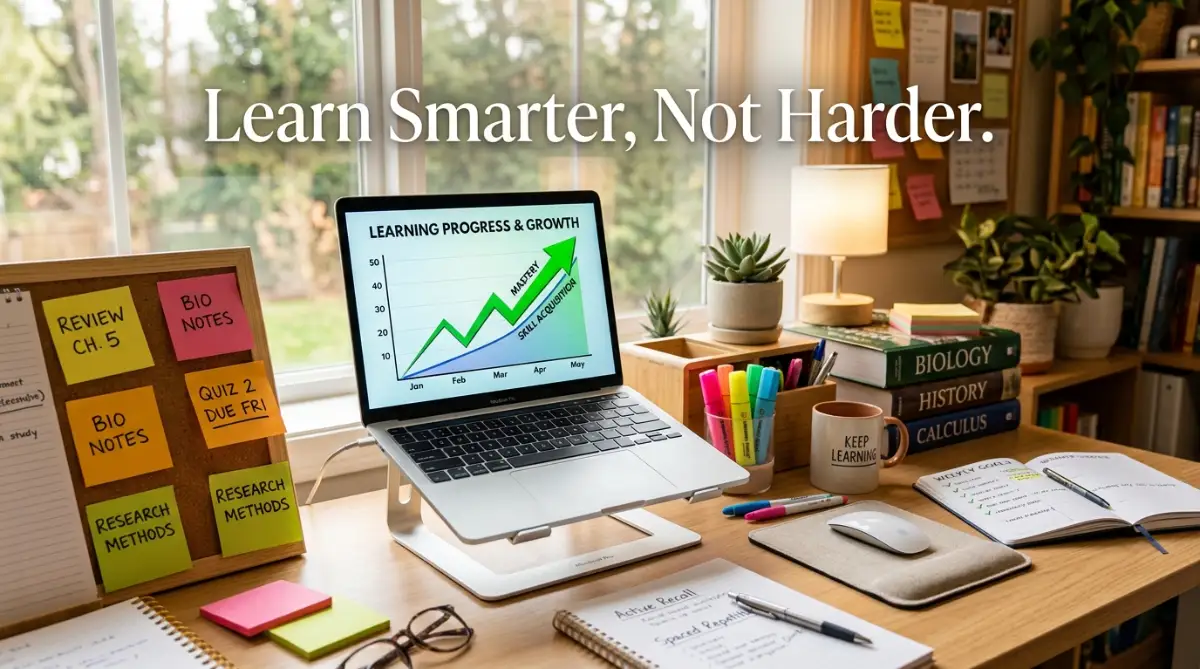
If you’re in a hurry, here’s the game plan for better grades:
- Stop Cramming: Your brain forgets 70% of new info within 24 hours. Spread your study sessions out.
- Test, Don't Read: Closing your book and trying to remember the facts (Active Recall) is 10x more effective than re-reading.
- Use the 1-3-7 Rule: Review what you learned after 1 day, then 3 days, then 7 days to lock it in forever.
- Sleep is a Tool: Your brain moves facts to long-term memory while you sleep. No sleep = no memory."
Why Your Brain Deletes Information (And How to Stop It)
Every single second, your senses take in millions of pieces of data. If your brain kept every single detail, it would crash entirely.
So, it automatically deletes anything it thinks you do not need. This natural process is called the Ebbinghaus Forgetting Curve.
A German psychologist named Hermann Ebbinghaus discovered that within just one hour of learning something new, you forget about 50% of it. Within 24 hours, nearly 70% of that hard-earned knowledge completely vanishes.
Unless you actively tell your brain, "Hey, this information is important, please keep it," your brain will throw it into the trash bin.
The Leaky Bucket Analogy
Imagine your memory is a bucket full of small holes. Pouring water into this bucket is just like reading a textbook for five hours straight. 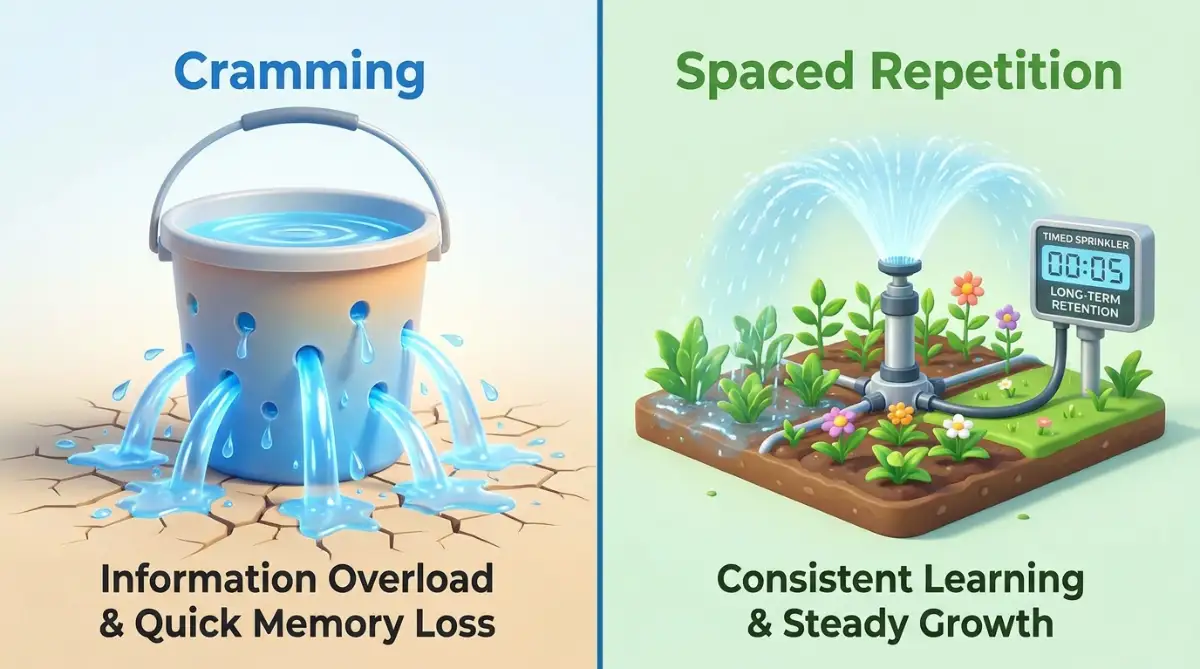
No matter how much water you pour in all at once, most of it is going to leak out very quickly. This is exactly why cramming the night before an exam is a terrible strategy.
You might hold enough water to pass a test the very next day. However, a week later, that bucket will be completely empty.
To keep the bucket full, you do not need a massive flood of water. Instead, you need a steady, well-timed drip of water to constantly replace what leaks out.
The Science of Spaced Repetition
This brings us to the ultimate solution for academic success. Spaced repetition is a highly effective learning technique built directly around how your memory naturally works.
Instead of trying to memorize a topic in one giant, exhausting session, you review the material across increasing intervals of time.
For example, you might review a concept today, then again in three days, then in a week, and then in a month.
Before we get into building your daily schedule, check out this quick video below that perfectly visualizes how spaced repetition actually works in the human brain. Watching this will make the rest of the steps in this guide so much easier to understand and apply!
Watering the Garden of Your Mind
Let me give you a very clear real-life example to explain why this timing matters so much. Imagine you just bought a beautiful indoor plant for your study desk.
If you give that plant an entire gallon of water on the first day of the month and ignore it for the next 29 days, the plant will quickly die.
But if you give that exact same plant a small cup of water every three or four days, it will grow strong and healthy.
Your brain cells work exactly like that plant. They need small, consistent doses of review to build thick, strong neural pathways.
Every time you review a topic just as you are about to forget it, you force your brain to work hard to retrieve the memory. This mental effort sends a powerful signal telling your brain to lock that information into long-term storage.
Myth vs Reality: Common Memory Misconceptions
To help you stay on track, I’ve put together this quick checklist. If you're doing more of the left side than the right, your study habits need an upgrade:
To truly master this method, we need to clear up some bad advice you have probably heard before. Here is a quick breakdown of common study myths versus the actual scientific reality.
How to Build Your First Memory Schedule
Now that we understand the science, let us look at how you can apply this to your daily life. Setting up your own review schedule is surprisingly simple, and you can start doing it today.
You do not need to buy expensive software or hire a private tutor. All you need is a basic plan and a little bit of discipline.
Step 1: Create Meaningful Flashcards
The absolute best tool for this method is the humble flashcard. However, you have to create them correctly for the system to work.
Do not copy an entire paragraph onto the back of a card. Your brain cannot process massive walls of text effectively during a quick review session.
Instead, break your study material down into bite-sized questions and answers. Keep it incredibly simple.
For example, if you are studying biology, the front of the card should ask: "What is the powerhouse of the cell?" The back should simply say: "Mitochondria."
Step 2: Establish Your Time Intervals
Once your cards are ready, you need to set up a specific schedule for reviewing them. As a beginner, you can use a very basic calendar method.
Here is a highly recommended schedule to start with:
- Review 1: 24 hours after learning the topic.
- Review 2: 3 days later.
- Review 3: 7 days later.
- Review 4: 14 days later.
- Review 5: 30 days later.
If you follow this timeline, the information will transition completely from your short-term memory to your long-term memory.
Step 3: Sort by Difficulty
Not all study materials are created equal. Some concepts will instantly make sense to you, while others will feel incredibly confusing.
As you test yourself with your flashcards, you need to be honest about how hard it was to remember the answer.
If you remember a card instantly, you can push the next review date much further into the future. You do not need to waste time studying easy things every single day.
But if you completely forget the answer, or if you struggle heavily to remember it, that card goes back to the very beginning of the schedule. You must review that difficult card again tomorrow.
Pro Tip for Faster Learning: Always say your answers out loud before you flip the card over. If you just think the answer silently in your head, it is too easy to cheat and tell yourself, "Oh yeah, I knew that." Speaking out loud forces complete honesty.
Combining Techniques for Maximum Impact
While managing your review schedule is powerful, pairing it with another technique makes it absolutely unstoppable. This technique is known as Active Recall.
Active recall simply means pulling information completely out of your brain without looking at your notes.
When I first tried this method, my biggest mistake was cheating myself by flipping my flashcards way too quickly just to get it over with. I quickly realized that if I didn't let my brain hurt a little bit while trying to guess the answer, the information simply wouldn't stick for the real exam. Trust me on this—embrace that awkward mental struggle, because that exact feeling is the secret to making your memories permanent.
When you sit down for your scheduled review session, do not just open your textbook and read the highlighted parts. Close the book completely.
Take out a blank sheet of paper and write down everything you can possibly remember about the topic. Draw diagrams, write definitions, and explain the concepts exactly as if you were teaching a five-year-old child.
This process might feel very difficult at first. Your brain might feel tired, and you might get frustrated when you cannot remember a specific term.
But that uncomfortable feeling of struggling to remember is exactly when the real learning happens. Think of it like lifting weights at the gym; if your muscles do not burn a little bit, they are not growing.
The Digital Advantage vs Analog Charm
As a modern student, you have a big choice to make about how you want to manage this system. You can either use traditional paper flashcards, or you can switch to digital apps.
Both methods have unique benefits, and the best choice entirely depends on your personal lifestyle.
If you love the feeling of pen and paper, physical flashcards are a fantastic choice. Writing things down by hand actually helps solidify memories in your brain.
Using physical cards also forces you to step away from your phone and laptop. This naturally removes the heavy distraction of social media notifications and text messages.
On the other hand, digital apps can automate the entire scheduling process for you. These programs use special algorithms to track exactly when you need to see a card again.
You simply answer the question, rate how difficult it was, and the software handles the rest. This is highly beneficial if you are studying thousands of items, like a completely new foreign language or a complex medical textbook.
Whichever method you choose, the most important thing is to just remain consistent. A fancy digital app will not save your grades if you only open it once a month.
Overcoming the Beginner's Resistance
When you first try to implement this study habit, you will likely face some mental resistance. Your brain is heavily addicted to the easy feeling of just reading notes.
The first week of using this new system will feel slow and possibly a bit annoying. You might look at your schedule and think, "I really do not want to test myself today."
This is a totally normal human reaction. We naturally want to avoid difficult mental tasks.
To beat this resistance, start extremely small. Do not try to convert your entire history textbook into flashcards on day one.
Pick just one single chapter or one specific topic. Commit to testing yourself on just ten basic concepts for a few days.
Once you see how easily you can recall those ten concepts a week later, your confidence will naturally grow. You will clearly see the magic happening in real-time.
That small taste of success will motivate you to apply the method to your hardest subjects. Soon, studying will stop feeling like a stressful chore and start feeling like an highly rewarding game.
You will no longer fear exams, because you will actually trust your own mind to remember the answers. Your academic journey will transform from a constant struggle into a smooth, manageable process.
Upgrading Your Mind: Advanced Tactics for Elite Learners
Once you build a basic daily review habit, you will quickly notice a massive difference in your memory. However, to truly dominate your exams, we need to push your skills a little bit further.
There are several highly guarded secrets that top-performing students use to maximize their brain power. These strategies take the basic concept of timed repetition and turn it into a complete learning system.
By applying these advanced methods, you will not just memorize facts for a test. You will actually build a deep, permanent understanding of the subject matter.
Let us look at how you can upgrade your current study routine right now.
The Magic of Subject Interleaving
Most students study by blocking out huge chunks of time for a single subject. They will spend four hours straight trying to memorize biology terms.
While this feels productive, it actually causes your brain to become incredibly bored and lazy. Scientists call this problem "mental fatigue," and it severely damages your ability to retain information.
Instead, you should practice a brilliant method called subject interleaving. This simply means mixing different subjects together during your daily review sessions.
Here is exactly how I mix my subjects to stay fresh. Try this 2-hour 'Power Block' tomorrow:
- 00:00 - 00:45: Focus on a hard subject (like Math or Physics).
- 00:45 - 00:55: Walk away. No phone. Just stretch.
- 00:55 - 01:30: Switch to a creative or reading subject (like History or English).
- 01:30 - 02:00: Review your flashcards from yesterday’s session.
- This keeps your brain from hitting that 'mental wall' where nothing else goes in."
For example, you might review biology flashcards for twenty minutes, then immediately switch to history for twenty minutes. After that, you could practice a few math problems before going back to biology.
This constant switching forces your brain to stay highly alert and actively engaged. It keeps your mind completely fresh and prevents you from going into lazy autopilot mode.
However, you must be very careful not to confuse interleaving with bad study habits. Mixing subjects in a structured way is great, but trying to do them all at the exact same time is terrible for your brain.
If you want to understand exactly why this happens, you should read about how multitasking ruins your study sessions. True focus requires giving your full attention to one specific task at a time, even if that task only lasts for twenty minutes.
Teaching the Invisible Student (The Feynman Technique)
Another massive secret to long-term memory is learning how to explain your flashcards out loud. Do not just silently flip a card over and nod your head.
Imagine you are sitting in a room with a completely clueless five-year-old child. Your job is to teach this child the concept on your study card using the simplest words possible.
If you stumble over your words or use highly confusing jargon, you do not actually understand the topic yet. You have only memorized the shape of the words on the page.
By teaching the invisible student, you force your brain to connect new ideas to things you already know. This creates a powerful web of knowledge that is incredibly hard to forget.
Many top universities heavily recommend this exact approach. You can easily see the proven cognitive benefits of distributed practice when it is combined with active teaching methods.
Building a Long-Term Knowledge Vault
To see truly amazing results, you have to think about your memory as a permanent library. You are not just studying to pass a test next week.
You are building a massive vault of knowledge that will help you in your future career. Therefore, you should never delete your flashcards after an exam is over.
Instead, keep pushing those review intervals further and further into the future. A card that you once reviewed every single day might eventually only pop up once a year.
Reviewing a year-old card takes less than ten seconds of your time. But that tiny ten-second investment guarantees you will remember the concept for the rest of your natural life.
The Hidden Traps That Destroy Your Study Efforts
Even with the best intentions, many beginners fall into some very dangerous traps. This learning system is highly effective, but it is also very easy to misuse if you are not paying close attention.
When you use these techniques incorrectly, you can easily waste hundreds of hours of your precious time. Worse, you might end up feeling more stressed and confused than when you started.
Let us carefully examine the biggest mistakes students make so you can avoid this unnecessary pain.
The "Illusion of Competence" Trap
This is easily the most common and dangerous trap of all. The illusion of competence happens when you look at the front of a flashcard, quickly give up, and flip it over to read the answer.
When you read the correct answer, your brain immediately says, "Oh yes, I totally knew that!" But you did not actually know it.
You simply recognized the words when you saw them. Recognizing an answer is entirely different from pulling that answer out of your own memory from scratch.
If you do not force yourself to struggle and guess the answer before flipping the card, the entire system completely fails. You must let your brain feel that uncomfortable burning sensation of trying to remember.
According to various experts, this mental struggle is exactly what builds permanent memory pathways. If you want to dive deeper into the science, you can explore this peer-reviewed research on retrieval practice.
Creating Massive Walls of Text
Another huge mistake is treating your flashcards like a tiny textbook. Many beginners try to cram an entire page of notes onto the back of a single card.
When your review session pops up, you are suddenly forced to read a giant, boring paragraph. Your brain will instantly panic and refuse to process that much dense information.
This habit actually stems from poorly managed classroom habits. Writing down too much information is a classic example of note-taking mistakes that are secretly sabotaging your exam scores.
Your brain needs very short, sharp, and specific questions. If a topic is highly complex, break it down into five or six entirely separate cards.
Remember this golden rule: One study card should always equal one single idea. If you want a better study experience, you absolutely must fix your silent note-taking mistakes before you even begin creating your review materials.
The Danger of Ignoring the Algorithm
Whether you use a paper calendar or a digital app, the review schedule is your ultimate boss. You cannot simply skip a few days just because you feel a little bit lazy.
If you skip your daily reviews, the carefully timed system completely breaks down. The cards will start to pile up rapidly, creating a massive mountain of overdue work.
Waking up to see five hundred overdue study cards is a deeply terrible feeling. The emotional anxiety alone will make you want to quit the entire method completely.
To prevent this nightmare, you must treat your daily review session like brushing your teeth. You do not need to spend hours doing it, but you must do it every single day without fail.
Even if you only have fifteen spare minutes while riding the bus, use that time to clear out your daily cards. Consistency is always much better than intensity.
Sacrificing Sleep for More Study Time
Finally, please understand that your memory does not actually form while you are staring at a book. The real magic happens exclusively while you are sleeping.
When you fall asleep, your brain quietly replays everything you learned that day. It carefully moves all the new data from your fragile short-term memory directly into your secure long-term storage.
If you stay up until three in the morning to review your cards, you are completely destroying this natural process. You are doing the hard work but actively refusing the final reward.
Medical experts have proven time and time again that a tired brain cannot hold onto new facts. You can read more about the powerful role of sleep in memory consolidation to understand why rest is your ultimate study weapon.
You should aim for at least seven to eight hours of high-quality sleep every single night. A well-rested brain will always outperform an exhausted brain, no matter how many flashcards you make.
Your Immediate Action Plan for Academic Success
We have covered a massive amount of valuable ground today. You now hold the exact same learning strategies used by top medical students, language experts, and successful scholars around the world.
You completely understand why your brain deletes things, and you know exactly how to stop that process. You also know how to avoid the dangerous pitfalls that cause most normal students to fail.
But reading this guide will not change your grades by itself. You have to take immediate, physical action to see real results in your life.
I know it can feel highly intimidating to change the way you have studied for years. But I promise you, the initial effort is absolutely worth the mental freedom you will gain.
The 7-Day Memory Challenge
To help you get started without feeling overwhelmed, I want you to try a very simple one-week experiment. Do not worry about changing everything all at once.
Day 1: Pick the single hardest subject you are currently studying. Find ten highly important terms or concepts that you always struggle to remember.
Day 2: Create ten incredibly simple flashcards for those specific concepts. Remember, use only one simple idea per card.
Day 3: Test yourself on those ten cards. Be completely honest about what you know, and say the answers out loud.
Days 4 to 7: Follow your daily review schedule. Only review the cards when your calendar or app tells you to.
By the end of this single week, you will experience a totally magical moment. You will look at a difficult question and the answer will instantly appear in your mind with zero stress.
That feeling of true confidence is completely addictive. Once you realize you actually have control over your own memory, your entire relationship with learning will change forever.
You will stop viewing exams as terrifying threats and start seeing them as fun opportunities to show off your knowledge. You will finally have the free time and the mental energy to actually enjoy your life outside of school.
So, grab a blank piece of paper or open a new app on your phone right now. Your incredible journey to a sharper, faster, and much stronger memory starts today.
Looking back, switching to this smart learning method was the absolute best thing I ever did for my grades and my mental health. You do not have to be a genius to ace your exams; you just need to start working with your brain instead of fighting against it. Take a deep breath, commit to that simple 7-day challenge, and watch how quickly you surprise yourself!
Disclaimer: The information provided in this blog post is for educational and informational purposes only and does not constitute professional academic or medical advice. Every individual's learning style and cognitive abilities are entirely unique. Always consult with a qualified educational professional or medical provider if you are experiencing severe memory issues or high levels of academic anxiety.