The Frustrating Gap Between Hard Work and Bad Grades
I used to leave my classes feeling like an absolute genius, only to open my notebook three days later and feel totally lost. I would stare at pages full of my own handwriting, colored with five different highlighters, and realize I could not remember a single thing. If you are tired of writing until your hand physically hurts but still getting bad grades, you are definitely not alone. Let me show you the exact note-taking mistakes you are making right now, and how to fix them today.
You stare intensely at pages filled with your own handwriting. The words are right there on the paper, but they make absolutely no sense to your brain anymore.
Does this exact scenario sound like your daily reality? You might be sitting at your desk right now, your hand physically aching from writing down every single word the professor said.
You use five different colored highlighters to make everything look perfect. You spend your hard-earned money on expensive journals. You dedicate hours just to making your pages look beautiful.
Yet, when the actual test begins, your mind goes completely blank. You cannot recall the most basic facts you spent hours writing down.
The frustration builds up heavily inside your chest. You wonder why your classmate, who barely writes anything down, consistently gets higher marks than you do.
You start doubting your own intelligence. You feel like all your intense hard work is just flying out the window. This painful cycle creates a deep sense of academic anxiety that steals your sleep and ruins your weekend peace.
I want you to pause and take a deep breath right now. Your brain is not broken, and you are definitely smart enough to get top grades.
The real enemy hides in a few invisible habits you picked up back in middle school. You are likely making silent errors in how you physically record information. Let us explore these hidden traps and fix this frustrating problem together.
I clearly remember sitting in my freshman history exam, staring at a blank page and holding back tears. I had spent three entire nights making my notes look perfect with five different colored highlighters, yet I could not remember a single fact when it mattered most. That awful moment made me realize that my obsession with making my notebook look pretty was actually stopping my brain from learning, and I knew I had to find a completely different approach.
Your Study Blueprint (Key Takeaways):
- Stop acting like a human recorder; write less and listen more.
- Put your highlighters away during your very first read-through.
- Use the "Split-Page" method to force your brain to practice active recall.
- Always review your new notes within the first 24 hours to lock them in forever.
The "Human Recorder" Syndrome: Why Transcribing Fails
One of the biggest lies we are told as students is that more notes equal better notes. We naturally assume that capturing every single word a teacher says is the ultimate path to success.
This dangerous habit turns you into what I call a "Human Recorder." Your only goal becomes moving the words from the professor's mouth directly to your paper.
When you do this, the information completely bypasses your brain. You are typing or writing so fast that you have zero time to actually understand the meaning behind the words.
Think about taking a photograph of a beautiful mountain. You just press a button, and the image is saved forever. You do not have to think about the colors or the shadows.
But if you sit down to paint that exact same mountain, you have to carefully observe every single detail. You have to understand how the light hits the rocks.
Transcribing a lecture is like taking a quick photograph. You have the data, but you did not process it. Taking smart notes should be like painting a picture.
The Note-Taking Trap: Myth vs. Fact
- Myth: If I write down every single word the teacher says, I will have everything I need to pass the test.
- Fact: Your brain cannot listen and write at the exact same time. By trying to copy everything, you actually stop yourself from understanding the core lesson. You should always focus on listening first, and then write down a quick summary.
The Solution: Becoming an Active Filter
Instead of acting like a sponge that absorbs everything, you need to become a strict filter. Your notebook should only welcome the most valuable pieces of information.
Real-Life Scenario:
Imagine you are sitting in an economics class. The professor spends five minutes telling a long story about how a specific company went bankrupt.
A "Human Recorder" will frantically try to write down the names of the company founders and the dates mentioned. They will miss the actual lesson because they are obsessed with minor details.
A smart student will simply drop their pen and listen carefully to the story. When the story finishes, they will write down one single sentence: "Poor cash flow management causes rapid bankruptcy, even in popular companies."
By forcing your brain to summarize a five-minute story into one single sentence, you create a very strong memory. You are actively learning instead of just passively copying.
The Highlighting Illusion: A Dangerous Trap
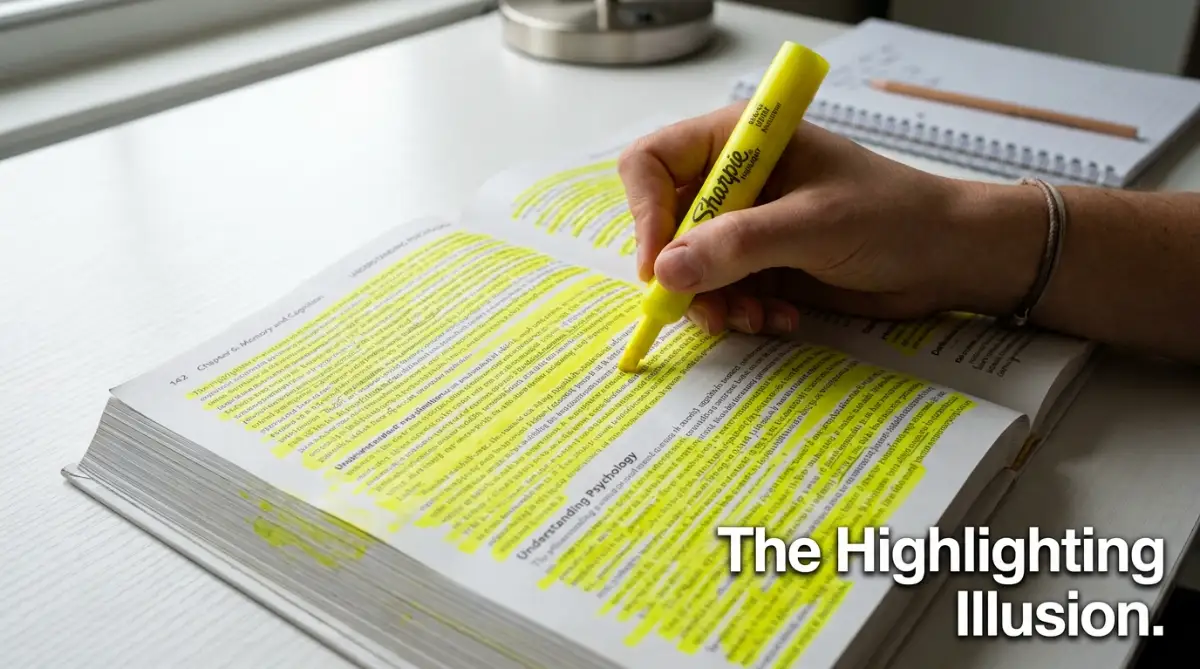
Let us talk about a habit that almost every single student struggles with. You buy a brand new textbook, grab a bright yellow highlighter, and start reading.
Every time you see a sentence that looks somewhat important, you drag that neon marker across the page. By the time you finish the chapter, your book literally looks like a bright coloring book.
This feels incredibly productive. Your brain gets a tiny hit of satisfaction every single time you highlight a block of text.
But this is a massive illusion. Highlighting does not equal learning.
When you highlight something, your brain secretly tells itself, "I have marked this for later, so I do not need to remember it right now." You are actively giving yourself permission to forget the material.
Myth vs. Reality: The Truth About Colors
The Myth: Using multiple colors helps your brain organize information better and speeds up your reading time.
The Reality: Constantly switching between different colored pens distracts your mind from the actual subject matter. You focus more on making the page look pretty than understanding the complex topic.
If you want to use highlighters effectively, you must completely change your approach. Never highlight anything on your very first read-through of a chapter.
Read an entire section first with your pen completely put away. Once you fully understand the main concept, close the book. Ask yourself what the most important takeaway was.
Only then should you open the book again and highlight just one or two specific keywords that trigger that memory.
For years, I made the huge mistake of dragging a yellow highlighter across entire paragraphs on my first read, thinking it would magically lock the information into my brain. I finally realized that putting my pen completely out of reach during my first read forced me to actually understand the story, rather than just painting the pages. If you can simply force yourself to wait ten minutes before picking up your marker, your memory retention will go through the roof.
The Messy Dump: Operating Without a Structure
Have you ever looked at your notes from a month ago and felt like you were reading a foreign language? This happens because your notes lack a logical structure.
Most people just write down bullet points in a straight line, from the top of the page to the bottom. We call this the "linear note-taking" method.
Linear notes are extremely hard for the human brain to scan and review. When everything looks exactly the same, nothing stands out as important.
Your brain completely hates walls of text. It loves clear patterns, open space, and visual hierarchy.
Adopting the Split-Page Strategy
To fix this problem immediately, you need to change how you format your physical notebook. Stop writing across the entire width of the page.
Try drawing a line down the left side of your paper, about two inches from the edge. This creates a narrow column on the left and a wide column on the right.
During your class, only write your main notes in the wide right column. Leave the narrow left column completely blank.
After class ends, review your notes. In that blank left column, write down short questions that correspond to the information on the right.
For example, if your notes describe the water cycle, write "What are the three main stages of the water cycle?" in the left margin.
When it is time to study for your exam, you simply cover the right side of the page with your hand. You test yourself by answering the questions you wrote on the left.
This simple visual structure instantly forces you to practice active retrieval, which is the single best way to prepare for a big test.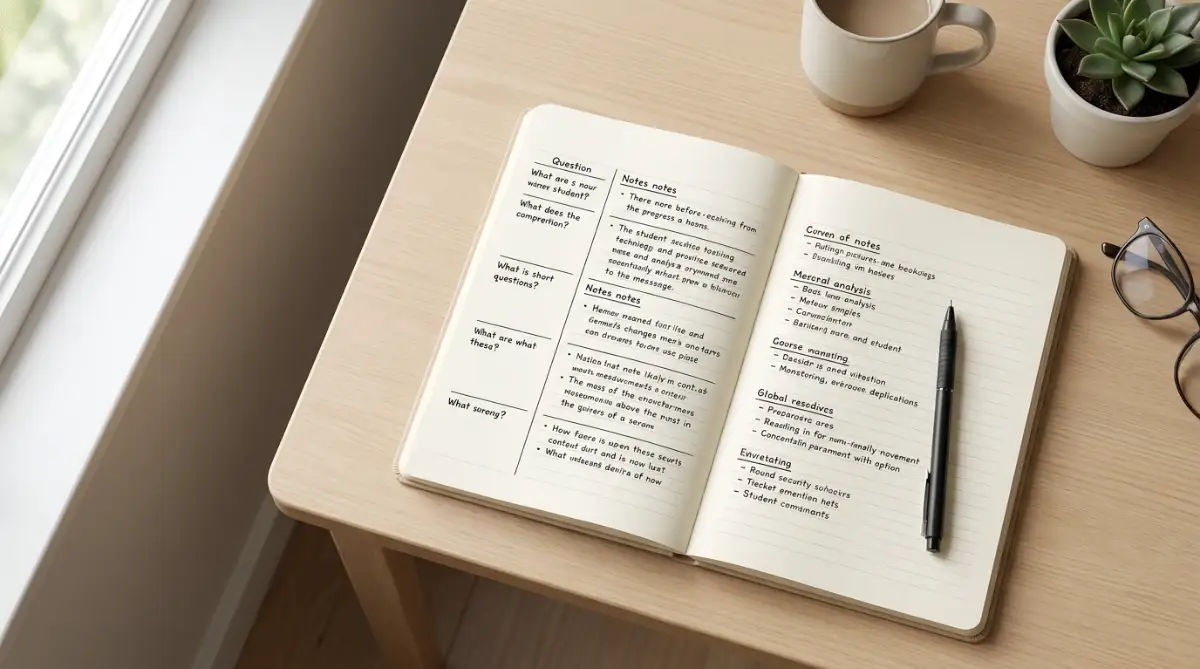
Want to see exactly how top students set up their split-page notes to memorize facts in half the time? Watch this short, helpful video below to see the visual method in action, and then keep reading to discover why cramming your pages full of text is a massive mistake!
The White Space Mistake: Cramming Pages Full
Paper is relatively cheap, but students often act like they will run out of it at any moment. They try to squeeze as many words as possible onto a single page.
They write in tiny margins, squish paragraphs together, and leave absolutely zero blank space. This is a massive mistake that directly harms your studying process.
When your eyes look at a densely packed page, your cognitive load increases immediately. Your brain feels overwhelmed before you even begin reading a single word.
Expert Advice: You must start treating white space as a powerful study tool.
Leave at least three blank lines between different major topics. If the professor moves on to a completely new idea, skip an entire section of your page.
This open space acts like a visual resting spot for your eyes. More importantly, it gives you room to add extra thoughts later.
When you review your notes a week later, you might discover a new connection or read a helpful fact in your textbook. Because you left plenty of white space, you can easily add that new information right next to the original concept.
The 24-Hour Review Window
Perhaps the most silent and dangerous mistake of all happens after the class is already over. You take decent notes, close your bag, and do not look at those notes again until the night before the exam.
Human memory naturally decays at an incredibly fast rate. Scientists call this the "Ebbinghaus Forgetting Curve."
If you learn a brand new concept on Monday morning, you will naturally forget about sixty percent of it by Tuesday morning. If you wait two weeks to review your notes, you are essentially learning the material from scratch.
Your notes are completely useless if you let them turn cold. You must interact with them while the memory is still somewhat fresh in your mind.
The secret to long-term memory is reviewing your written notes within the first twenty-four hours. You do not need to spend hours doing this.
Simply take ten minutes before you go to bed. Read over what you wrote that day. Fix any messy handwriting, add missing words, and highlight the main heading.
This brief ten-minute interaction sends a powerful signal to your brain. It says, "This information is still relevant, please move it to long-term storage."
Quick Q&A: What if I miss a day?
Question: If I forget to review my notes within the first 24 hours, is my hard work completely wasted?
Answer: Not at all! While the 24-hour window is best, doing a quick 10-minute review on day two or three is still way better than waiting until the night before your exam. Just do not let a whole week pass by without looking at your book.
By avoiding these invisible traps, you completely change your relationship with your study materials. Your notes stop being a source of stress and become your greatest academic weapon.
Engineering a Bulletproof System for Memory Retention
Taking notes is only the first part of the academic battle. Once you write the information down, you have to actively train your brain to hold onto it for weeks or even months.
Most students think that reading their notebook over and over again is enough. But human memory requires much more active engagement.
If you want to completely transform your grades, you must build a system that practically forces your mind to remember. Let us look at a few highly effective strategies that top-performing students use behind closed doors.
The Power of Personal Shorthand Codes
When a professor speaks quickly, panic usually sets in. You try to write down complete sentences, completely missing the actual meaning of the lecture.
To solve this, you need to invent your own personal language. Creating a custom shorthand system saves an incredible amount of time.
You do not need to learn official stenography. You just need a set of symbols that make sense to your brain.
How to start doing this today:
Drop the vowels from common words. For example, the word "management" becomes "mngmt."
Use simple mathematical symbols to replace long phrases. An upward arrow means "increases" or "leads to," while an equal sign means "is the same as."
Over time, this personal code will become second nature to you. You will be able to capture complex ideas in a matter of seconds, leaving you more time to actually listen and think.
Treating Your Brain Like a High-Security Vault
Your mind is constantly bombarded with useless data all day long. Social media feeds, background conversations, and random thoughts clutter your mental workspace.
You must protect your study notes from getting lost in this massive sea of information. Think about how carefully you protect your laptop.
You already know that the hidden dangers of browsing without antivirus protection can ruin a perfectly good computer system. Your brain works in a surprisingly similar way.
If you allow junk information to mix with your study materials, your memory will easily crash. You need to create a strict filter.
Only allow the absolute core concepts to enter your physical notebook. Leave the funny stories, the minor examples, and the obvious facts out completely. A clean, highly filtered notebook is the ultimate defense against academic failure.
The "Teach a Child" Concept Translation
There is a massive difference between recognizing a concept and actually understanding it. When you look at your notes, you might nod your head and think it makes perfect sense.
But if you had to explain that exact same topic to a ten-year-old child, could you do it? If the answer is no, you do not truly understand the material yet.
This simple test is known as the Feynman Technique. It completely exposes the hidden gaps in your knowledge.
A quick exercise to try:
Pick a difficult page from your notes. Hide the page completely. Now, pretend you are standing in front of a completely blank whiteboard.
Speak out loud and explain the concept using the simplest English words possible. Do not use heavy academic jargon.
If you start stumbling over your words, you have just found a weak spot in your memory. Go back to your notes, fix that specific gap, and try the verbal explanation again. This practice alone will dramatically boost your confidence before an exam.
Do's and Don'ts of Advanced Note-Taking
To keep things perfectly clear, here is a quick guide on what behaviors you should embrace and which ones you should drop immediately.
- Do: Write down questions in the margins of your notebook while the professor is talking.
- Do not: Stop listening to the lecture just to make a heading look perfectly neat and colorful.
- Do: Review your handwritten materials within the first twenty-four hours to lock the data into your long-term memory.
- Do not: Type your notes on a laptop if you are prone to opening different browser tabs during the class. Multiple educational psychology studies clearly show that writing by hand strongly improves complex memory encoding compared to typing on a keyboard.
 The Dangerous Habits That Quietly Steal Your Grades
Even the smartest students can easily fall into toxic study habits without realizing it. These hidden traps feel very comforting in the moment, but they cause massive damage when test day finally arrives.
Let us carefully examine the biggest mistakes that might be ruining your academic progress right now.
Relying on Borrowed Brain Power
We have all been there. You miss a class, or you feel too tired to pay attention, so you ask your smart friend to send you pictures of their notes.
You copy their beautiful, organized words into your own book. You feel relieved, thinking you have successfully caught up.
This is a terrible illusion. Your friend's notes are a reflection of their personal thinking process, not yours.
They used their own shorthand, skipped the things they already knew, and highlighted what they found confusing. Reading someone else's notes is like trying to wear their prescription glasses.
A Real-Life Analogy:
If you just use whatever lotion your best friend uses, you might end up with a terrible reaction. Note-taking is just as highly personal.
You must process the original lecture through your own unique mental filters. Borrowing someone else's notes gives you a completely false sense of security that shatters the moment you see the exam paper.
The Aesthetic Obsession Trap
With the rise of visually pleasing social media study accounts, many students have completely lost the plot. They spend three hours making their biology notes look like a professional magazine cover.
They use specialized brush pens, perfectly straight lines, and elaborate title fonts. The end result is completely gorgeous.
But here is the harsh truth. Your professor does not give you extra points for pretty handwriting.
While you spent two hours drawing a perfect diagram of a plant cell, another student spent thirty messy minutes actually memorizing how the cell functions.
When you focus entirely on making the page look beautiful, your brain completely ignores the educational content. Stop treating your study sessions like an art project. Messy notes that you actually understand are far more powerful than beautiful notes that you just stare at.
The Extreme Study Purge
When students realize their study habits are failing, they often panic. They decide to completely change every single thing about their routine overnight.
They throw away all their old notebooks, buy completely new digital apps, and force themselves to wake up at four in the morning to study. This extreme approach almost always ends in a spectacular crash.
Your brain reacts the exact same way to sudden study changes. You will feel completely exhausted and likely give up entirely within three days.
Instead of changing everything at once, pick just one single bad habit to fix this week. Maybe you just stop using highlighters for the next seven days. Small, gradual adjustments are the only way to build permanent success.
Ignoring the "Illusion of Competence"
The absolute worst feeling in the world is staring at an exam question and realizing you do not know the answer, even though you read that specific chapter five times.
This happens because of a psychological trap called the illusion of competence. When you read a nicely formatted page of notes, the words flow easily into your brain.
Because the reading feels smooth and comfortable, your brain tricks you into believing you have mastered the subject. But reading requires zero active recall.
To break this dangerous illusion, you must test yourself under highly uncomfortable conditions. According to experts at the Center for Teaching Innovation at Cornell University, forcing yourself to retrieve information without looking at the source is the fastest way to solidify knowledge.
Close your book, hide your notes, and stare at a blank wall. Try to recite the entire process out loud. If you get stuck, you have successfully identified a gap that needs real attention.
Your Ultimate Action Plan for Tomorrow Morning
We have covered a massive amount of psychological ground today. You now clearly understand why your old note-taking methods were secretly destroying your exam scores.
More importantly, you know exactly how to filter out the noise and capture information that actually sticks in your brain.
However, reading this entire guide will not do anything for you unless you physically change your actions tomorrow. I want to leave you with a very simple, non-intimidating checklist for your very next class.
Step 1: The Pre-Class Primer
Five minutes before the professor starts talking, quickly glance at your notes from the previous session. Do not study them deeply. Just remind your brain of the context. This warms up your mental engine and prepares you to connect new ideas to old ones.
Step 2: The Active Filter
During the actual lecture, put your pen down when the professor is telling a long story. Listen carefully. Wait until the concept is fully delivered, and then write down a single summary sentence in your own personal words.
Step 3: The Blank Page Test
Within twenty-four hours of that class, sit down at your desk. Take out a completely blank sheet of paper. Write down everything you can possibly remember from the lecture without looking at your actual notebook.
You are entirely capable of turning your academic life around. It does not require a higher IQ or endless hours of sleep deprivation.
It simply requires a smarter, more honest approach to how you handle information. Stop acting like a human recording machine, start trusting your active memory, and watch your exam scores completely transform.
Looking back, changing how I took notes did not just fix my grades; it gave me back my free time and my peace of mind. I promise that if you try the blank page test just once this week, you will be amazed at how quickly your academic confidence grows. Take a deep breath, trust your own mind, and get ready to finally see the high scores you have been working so hard for.
Disclaimer: The educational strategies and study methods discussed in this article are intended for general informational purposes only. While these techniques are rooted in widely accepted cognitive practices, individual learning styles and academic results may vary greatly. This content should not replace personalized guidance from academic advisors or educational professionals. Always consult with your school counselors if you are experiencing severe academic anxiety or learning difficulties.