
The Tuesday Morning Panic: When Numbers Lie to You
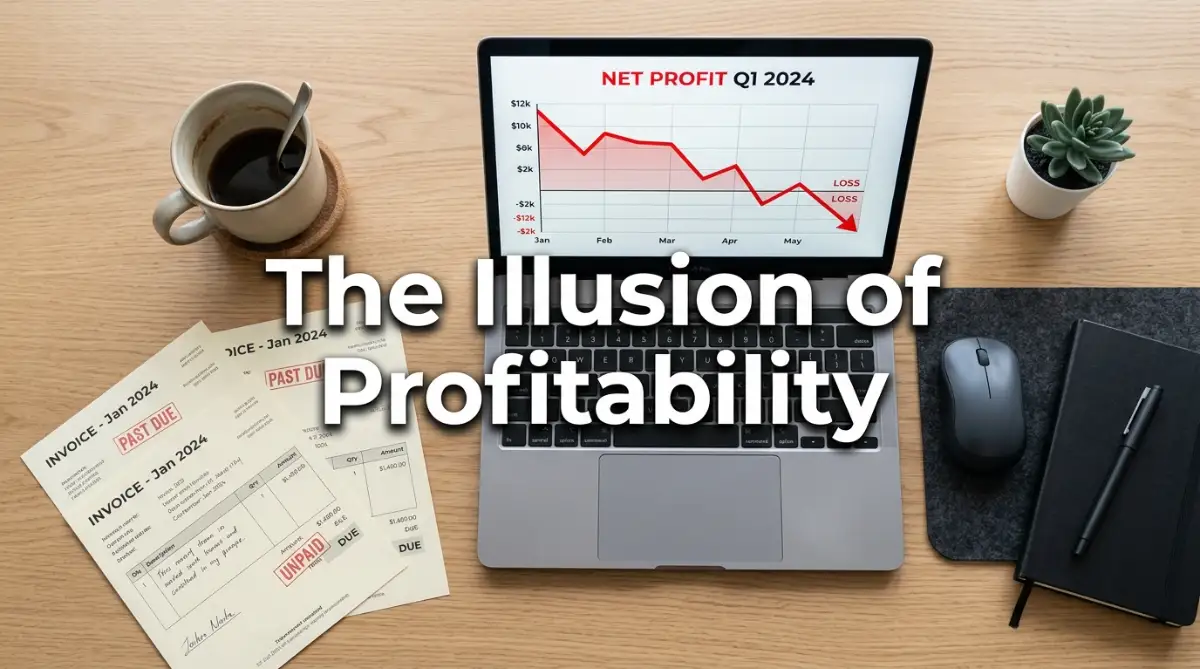
I will never forget staring at my laptop screen, completely frozen. My sales dashboard told me we just had a record-breaking month, but my bank account balance told me I couldn't even afford groceries that week. It turns out, being "profitable" on paper means absolutely nothing if the actual cash isn't sitting in your bank. If you are a self-funded founder constantly panicking about payroll despite closing deals, I am going to show you exactly how to stop the invisible money leaks draining your business right now.
On paper, your bootstrapped company is highly profitable. You are finally making it.
But then, you log into your business bank account to pay your monthly software bills. Your heart instantly drops into your stomach. The balance is terrifyingly low.
You find yourself staring blankly at the screen, a cold sweat breaking out on your forehead. How is this even possible? You sold thousands of dollars worth of services last month. Yet, you barely have enough actual cash to cover your own rent next week.
This is the silent, exhausting nightmare that haunts self-funded founders every single day. The stress doesn't just stay at the office. It follows you home.
It sits with you at the dinner table. It keeps you staring at the ceiling at 3 AM, your mind racing with panic about upcoming payroll. You start dodging calls from your own suppliers.
The mental toll is incredibly heavy. You feel like a complete failure, even though your sales team is breaking records. You feel like you are desperately pouring water into a bucket that is full of invisible holes.
The worst part is the isolation. You cannot tell your team that the company is almost broke. You cannot tell your family, because they already warned you about the risks of starting a business.
You suffer in total silence. But I want you to know something very clearly right now. You are not alone, and you are not bad at business.
I will never forget the day my own small agency hit our first $50k sales month, only for me to cry in my car because my business checking account had exactly $42 left in it. I was so embarrassed that I couldn't even pay myself enough to buy groceries, despite working eighty-hour weeks. That painful reality check forced me to realize that making money on paper means absolutely nothing if the cash is not actually sitting securely in your bank.
You have simply fallen into the classic trap of confusing your profit margins with your actual cash flow. These two things are completely different animals.
Let's fix those invisible holes in your bucket right now.
Founder's Cheat Sheet: Stop the Cash Bleed
- Ditch Net-90: Stop acting like a free bank for rich companies. Demand 50% upfront.
- Audit Your Tools: Cut out the random software subscriptions your team forgot about months ago.
- Build the 90-Day Wall: Save enough cash to run your business for 3 full months even if your sales drop to zero.
- Friday Money Date: Spend 15 minutes every single Friday tracking exactly what money came in and what went out.
Unmasking the Money Leaks: A Founder's Survival Manual
To stop the financial bleeding, we need to completely change how you look at money. Making a sale is only half the battle. Getting the money safely into your bank account is where the real war happens.
Below, I will walk you through the most dangerous money leaks that quietly destroy self-funded companies. We will also cover exactly how you can patch them up today.
If you are still confused about how your highly profitable business can suddenly have zero cash in the bank, watch this eye-opening short video below. It perfectly explains this dangerous startup trap, and right after you watch it, keep reading to find out how to permanently fix your biggest money leaks today!
The Corporate "Net-90" Payment Nightmare
Let's start with the most common trap for B2B service providers. You just landed a massive contract with a huge corporate client. You are thrilled.
You deliver the work flawlessly. You send over the invoice and eagerly wait for the money to arrive. Then, you read the fine print on their vendor agreement.
They operate on Net-60 or Net-90 payment terms. This means they will not pay you for two to three months after you finish the work.
The Reality Check: While you wait for their payment, your own bills do not pause. You still have to pay your team, your server costs, and your own rent today.
You are effectively acting as a free, zero-interest bank for a massive corporation. This setup will drain your startup's cash reserves faster than anything else.
How to Fix It Today: You need to completely restructure your payment agreements. Never accept Net-90 terms as a self-funded startup.
Always ask for a 50% upfront deposit before you begin any project work. If a large corporate client refuses to pay upfront, negotiate a milestone payment structure.
Quick Q&A: But what if the client says no?
You: "I need a 50% deposit to schedule my team."
Corporate Client: "Our company policy only allows Net-60 payments."
Your response: "I totally understand. Since I operate a specialized team, I can offer you a 5% discount if we switch to Net-15. Otherwise, we can break the project into 4 smaller milestones paid upfront."
Never be afraid to negotiate terms. You are a business owner, not a charity.
Tell them you need 25% to start, 25% at the midway point, and 50% upon final delivery. This ensures actual money is continuously flowing into your bank account while you do the work.
If they completely refuse these terms, you must seriously consider walking away. A massive contract is entirely worthless if it forces your small company into bankruptcy while you wait for the check.
The Deadly SaaS Subscription Creep
When you first launch your business, you need tools. You sign up for an email marketing platform, a project management tool, and a fancy CRM.
Individually, these tools seem incredibly cheap. What is an extra $20 or $50 a month when you are building an empire?
But over the months, something dangerous happens. Your team members sign up for specialized design tools. You try out three different AI writing assistants and forget to cancel the trials.
The Reality Check: You look at your credit card statement six months later. You are bleeding hundreds, sometimes thousands of dollars every single month on software nobody even uses.
These small, recurring charges are silent killers. They slowly drain your cash reserves while you are busy focusing on bigger problems.
My absolute biggest financial mistake was ignoring my credit card statements just because I was too scared to look at the real numbers. Once I finally sat down with a red pen to do a software audit, I found out I was wasting over $400 every single month on duplicate design tools my team had completely stopped using a year ago.
How to Fix It Today: You must conduct a ruthless software audit this weekend. Print out your last two months of bank statements.
Grab a bright red pen. Circle every single recurring software charge you see.
Create a simple spreadsheet. List the tool, the monthly cost, and the specific person on your team who actively uses it. If a tool cannot be directly tied to saving time or making money, cancel it immediately.
Downgrade expensive premium plans to basic tiers until your cash flow stabilizes. You can always upgrade again later when you have a healthy financial buffer.
The Premature Over-Hiring Trap
You experience one incredibly good month of sales. You feel overwhelmed with the workload.
Your immediate reaction is to hire three new full-time employees to handle the rush. You sign them to comfortable salaries, expecting the good times to last forever.
Then, the market naturally cools down. Your sales drop back to a normal level.
The Reality Check: Your revenue dipped, but your new payroll obligations did not. You are now stuck paying massive fixed salaries with a shrinking pool of cash.
Bootstrapped companies die quickly when fixed operational costs outweigh their baseline revenue. You cannot afford to pay people just to sit around during slow months.
How to Fix It Today: Adopt a flexible scaling model instead of rushing into full-time hires. When a sudden rush of work hits, build a reliable network of skilled freelance contractors.
Yes, a highly skilled freelancer might charge a higher hourly rate than a full-time employee. But when the project ends, your financial obligation to them ends too.
Only hire full-time employees when your baseline, worst-case-scenario monthly revenue can easily cover their salaries for six consecutive months. Protect your fixed costs at all times.
Myth vs. Reality: Bootstrapped Finances
Let's clear up some dangerous misunderstandings that many new founders believe.
The Bulk Discount Inventory Trap
If you run an e-commerce or product-based business, this trap is specifically for you. Your supplier offers you a massive discount if you order 10,000 units instead of 1,000 units.
The math makes perfect sense on paper. Your profit margin per item will double. So, you empty your entire business bank account to buy the massive bulk order.
The Reality Check: All of your liquid, usable money is now transformed into physical boxes sitting in a dark warehouse.
If a sudden marketing expense comes up, you cannot pay for it with boxes of inventory. If a competitor launches a better product tomorrow, you are stuck holding out-of-date stock.
How to Fix It Today: Order the absolute minimum amount of inventory needed to satisfy your current customer demand.
Ignore the temptation of massive bulk discounts until your business has deeply established sales channels. Cash flexibility is far more valuable to a young startup than a slightly better profit margin on unsold goods.
The Danger of Mixing Personal and Business Money
In the very early days, things are chaotic. You pay for a business server using your personal credit card. You buy personal groceries using the business debit card.
You tell yourself you will sort out the math at the end of the month. But you never actually do.
The Reality Check: This tangled mess creates a total blind spot. You have absolutely no clear idea if the business itself is actually sustaining its own weight.
Worse, come tax season, you will spend weeks trying to untangle hundreds of mixed transactions. This leads to costly accounting mistakes and unexpected tax bills.
How to Fix It Today: Draw a thick, permanent line between your personal life and your company.
Open a dedicated business checking account immediately. Force every single piece of business revenue to flow into that specific account.
Pay every single business expense strictly from that account. If the business account runs completely out of money, it forces you to face the reality of your cash flow problem, rather than secretly hiding it behind your personal savings.
Building Your Defensive Financial Buffer
Knowing the traps is good. But actively building a defense system is much better.
Most self-funded founders operate on a week-to-week survival basis. One delayed client payment can ruin their entire month.
You need to actively build what financial experts call a "cash runway." This is simply the amount of time your business could survive if your revenue completely dropped to zero tomorrow.
How to Fix It Today: Start building a 90-day cash buffer. Calculate your absolute minimum operating costs for one month.
This includes rent, basic software, payroll, and your own minimal salary. Multiply that number by three.
This total amount is your ultimate safety goal. Every time you have a highly profitable month, do not spend the extra money on fancy office upgrades.
Instead, sweep that extra profit directly into a separate, high-yield business savings account. Do not touch this money for regular operations.
Once you hit that 90-day buffer, your daily stress levels will plummet. You will stop making desperate, short-term decisions out of fear. You will finally have the clear headspace needed to focus on long-term growth.
The Simplicity of Weekly Tracking
You do not need an advanced finance degree to survive. You do not need confusing accounting jargon to track your money.
Many founders avoid looking at their numbers because traditional accounting software feels too intimidating. They hide from the reality of their own business.
How to Fix It Today: Create a simple "Cash In, Cash Out" document.
Every single Friday afternoon, sit down for exactly fifteen minutes. Look at your bank balance.
Write down exactly how much money actually entered your account that week. Then, write down exactly how much money left your account.
Compare those two numbers. If the money leaving is consistently higher than the money entering, you have a massive problem.
This simple weekly habit removes the mystery from your finances. It forces you to confront the reality of your cash flow before it turns into an unstoppable crisis.
Here is the exact 15-minute Friday routine I use to keep my mind completely clear over the weekend:
Protecting your self-funded business is not about having the smartest product. It is about deeply understanding how money moves in and out of your hands. When you master your cash flow, you completely master your own destiny.
Architecting a Defense System for Unpredictable Markets
Now that we have plugged the most obvious holes in your bucket, we need to talk about building a fortress around your money. Surviving week-to-week is exhausting. You want to reach a point where you actually control your financial destiny.
This requires shifting your mindset from reactive panic to proactive strategy. Most self-funded founders only look at their numbers when something goes wrong. We are going to completely flip that habit on its head.
Let's dive into some advanced strategies that highly successful founders use to protect their cash flow quietly behind the scenes.
Negotiating Leverage Instead of Handouts
One of the biggest secrets in the self-funded world is that almost everything is negotiable. We often accept software prices, supplier rates, and service fees at face value because we think we have no power.
But suppliers want guaranteed, predictable income just as much as you do. You can use this mutual desire to your advantage.
If you use a costly inventory supplier, do not simply ask for a generic discount. Offer them predictability instead.
Say something like, "I will guarantee an order of 500 units on the first Monday of every single month for the next six months, if you drop the price by 15% and extend my payment terms to Net-30."
You are giving them a guaranteed pipeline, and in return, you are keeping your hard cash in your pocket for a full thirty days longer. This tiny delay in cash outflow can literally save your business during a slow sales week.
The Dynamic "Profit First" Pipeline
Traditional business accounting tells you to take your total sales, subtract all your expenses, and whatever is left over is your profit. The painful reality is that there is almost never anything left over.
There is always a new expense waiting around the corner. A server upgrade, a new marketing test, or a surprise legal fee will magically appear to eat that money.
Instead, reverse the entire equation. When a client payment clears your bank account, immediately pull out your target profit percentage first.
Take 10% of that payment and move it completely out of your main operating account. Put it into an account that is difficult to access. Only after you secure your profit should you use the remaining 90% to run the business.
This forces artificial scarcity. If you only have 90% of your revenue available to spend on operations, you will suddenly find very creative ways to cut unnecessary expenses.
Tiered Pricing to Smooth Out Revenue Spikes
Service-based businesses usually suffer from extreme feast-or-famine cycles. One month you make twenty thousand dollars, and the next month you make zero. This rollercoaster destroys your mental health and your cash runway.
To smooth out these spikes, you need to introduce recurring revenue tiers alongside your heavy, one-off projects. Let's say you build expensive custom software platforms for local clinics.
Do not just hand over the keys and walk away. Create an automatic, non-negotiable monthly retainer for security updates, hosting maintenance, and priority bug fixes.
Even if this retainer is relatively small, having thirty clients paying you every single month creates a reliable safety net. This baseline recurring revenue should eventually cover all of your fixed monthly expenses like rent and core software.
When your baseline expenses are automatically covered, every new big project you land becomes pure growth capital.

The Silent Saboteurs That Trap Smart Entrepreneurs
Even founders who deeply understand cash flow management can still fall victim to emotional decision-making. Building a business from nothing puts immense pressure on your ego.
Sometimes, our desire to look successful actually becomes the exact thing that destroys our success. Let's examine the dangerous mental traps you must avoid at all costs.
Confusing Gross Revenue with Founder Wealth
This is perhaps the most tragic mistake I see. A young founder lands their first six-figure contract. Suddenly, their personal lifestyle changes overnight.
They upgrade their apartment, start eating at expensive restaurants every night, and buy a luxury car to "look the part." They justify it by pointing at the massive revenue numbers on their business dashboard.
But they completely forget that gross revenue is not personal wealth. That six-figure contract comes with massive delivery costs, heavy tax burdens, and unpredictable delays.
When the contract ends and the client decides not to renew, the founder is suddenly trapped in a high-cost personal lifestyle with no actual business profit to support it. The business then starves to death because the founder is desperately pulling out cash just to pay their personal car lease.
Always pay yourself a modest, fixed salary that the business can comfortably afford even during a bad month. If you want a lifestyle upgrade, base it entirely on quarterly profit distributions, never on projected gross revenue.
Treating the IRS as a Short-Term Lender
When cash gets tight, founders often look around for the easiest bill to ignore. Unfortunately, they usually choose their tax obligations.
They collect sales tax from a customer or withhold payroll taxes from an employee, but they use that money to pay a supplier instead. They tell themselves they will catch up on the taxes next month when sales improve.
This is not a cash flow strategy; this is a countdown to a financial catastrophe. Government tax agencies are the most aggressive and unforgiving creditors on the planet.
They will not listen to your excuses about a slow economy. They will freeze your business bank accounts without warning, and they will apply massive, compounding penalties that completely bury your company.
The moment tax money enters your hands, immediately transfer it to a separate, untouchable tax savings account. Treat that money as if it does not belong to you, because legally, it doesn't.
Holding Onto Toxic Clients Out of Desperation
We have all had them. The client who demands endless revisions outside the scope of work. The client who calls you at midnight on a Sunday to complain about something tiny.
More importantly, the client who always pays your invoice thirty days late, forcing you to beg for your own money.
When you are bootstrapping, you feel like you have to accept every single dollar that comes your way. You tolerate extreme disrespect because you are afraid of losing the revenue.
But toxic clients actually cost you money. The time you spend fighting with them over late payments is time you cannot spend pitching high-quality, respectful clients. The emotional drain ruins your productivity for days.
Fire your worst client. Yes, it feels terrifying. But the moment you drop them, you open up the mental space and time needed to find a client who respects your boundaries and pays your invoices on time.
Securing Your Financial Peace of Mind
Building a self-funded startup is one of the hardest things you will ever attempt. You are fighting against massive corporations with deep pockets, and you are doing it relying entirely on your own wits and determination.
You deserve to succeed. You deserve to sleep soundly at night without a knot of anxiety in your stomach. But that peace of mind only comes when you drag your finances out of the shadows.
Stop managing your money by quickly checking your bank balance on your phone. Start taking real, proactive control of every dollar that enters and leaves your ecosystem.
Your Immediate Action Plan
I want you to take three specific actions before this week ends. Do not put this off until next month.
First, schedule a recurring 15-minute calendar block for every single Friday afternoon. Label it "Weekly Cash Audit." Stick to this appointment with yourself as strictly as you would a meeting with your biggest client.
Second, identify one single recurring software subscription that you have not used in the last fourteen days. Cancel it right now. Take that twenty dollars and officially start your emergency cash buffer.
Third, review your standard client contract or vendor agreement. If you are currently working without upfront deposits, rewrite that clause today.
Protecting your startup requires courage. It requires the courage to say no to bad deals, the courage to face ugly numbers, and the courage to build slowly and sustainably.
Your business is an extension of your own energy. Protect its resources fiercely, and it will eventually reward you with the financial freedom you have been working so hard to achieve.
I know exactly how scary it feels to look at a messy bank account, but I promise that taking control of your cash flow will give you more peace than any new sales record ever could. Please do not wait until next month to face your numbers—sit down this Friday for just fifteen minutes to track your money, because your future self will heavily thank you for being brave today.
Disclaimer: The information provided in this article is for educational and informational purposes only and does not constitute professional financial, tax, or legal advice. Always consult with a certified public accountant (CPA) or a qualified financial advisor regarding your specific business situation before making major financial decisions.