The Exhausting Illusion of Getting Everything Done at Once
I used to sit at my desk with a heavy textbook open, fourteen browser tabs loaded, and my phone buzzing every three minutes. I actually thought I was crushing it. But after two hours, my mind was totally blank. If you are tired of reading the exact same page over and over without remembering a single thing, I get it. Today, I want to show you exactly how to fix your broken focus and get your free time back.
Spotify is playing your favorite lo-fi beats in the background. Every three minutes, your smartphone screen lights up with a new text message or a social media notification.
You think you are being incredibly productive. You feel like a high-performing machine, absorbing information from the book, replying to a friend, and typing a quick email all at the exact same time.
But then, two hours pass by. You close your textbook, take a deep breath, and try to remember exactly what you just read.
Your mind goes completely blank. A heavy sense of frustration washes over you. You just spent two exhausting hours "studying," yet you cannot recall a single meaningful concept.
Does this sound familiar? You are definitely not alone. Millions of students struggle with this exact same invisible barrier every single day.
We often blame our memory, thinking we are simply not smart enough. We feel overwhelming guilt for wasting time. This constant cycle of trying to do everything and achieving absolutely nothing slowly eats away at our mental peace and academic confidence.
The truth is, your memory is not broken. Your intelligence is perfectly fine. The real enemy hiding in the shadows is the modern habit of splitting our attention into tiny, useless fragments.
I remember sitting in my room a few years ago, surrounded by empty coffee cups, trying to study for a big test while chatting with my friends online. I spent six whole hours staring at my screen, but when I took a practice quiz that night, my mind was totally empty and I failed it completely. That embarrassing moment made me realize that trying to do everything at once was actually destroying my memory, and I knew I had to fix my study habits immediately.
What You Will Learn Today (At a Glance):
- The 23-Minute Rule: Why one quick phone glance costs you almost half an hour of real focus.
- Attention Residue: How leftover thoughts from social media block your ability to memorize facts.
- The Single-Tab Policy: A super simple browser trick to instantly boost your daily productivity.
- Active Over Passive: Why making pretty flashcards is actually wasting your time, and what to do instead.
Why Your Brain Completely Rejects Split Focus
Let me share a hard, scientific truth with you right now. Human beings are entirely incapable of processing multiple complex tasks at the exact same time.
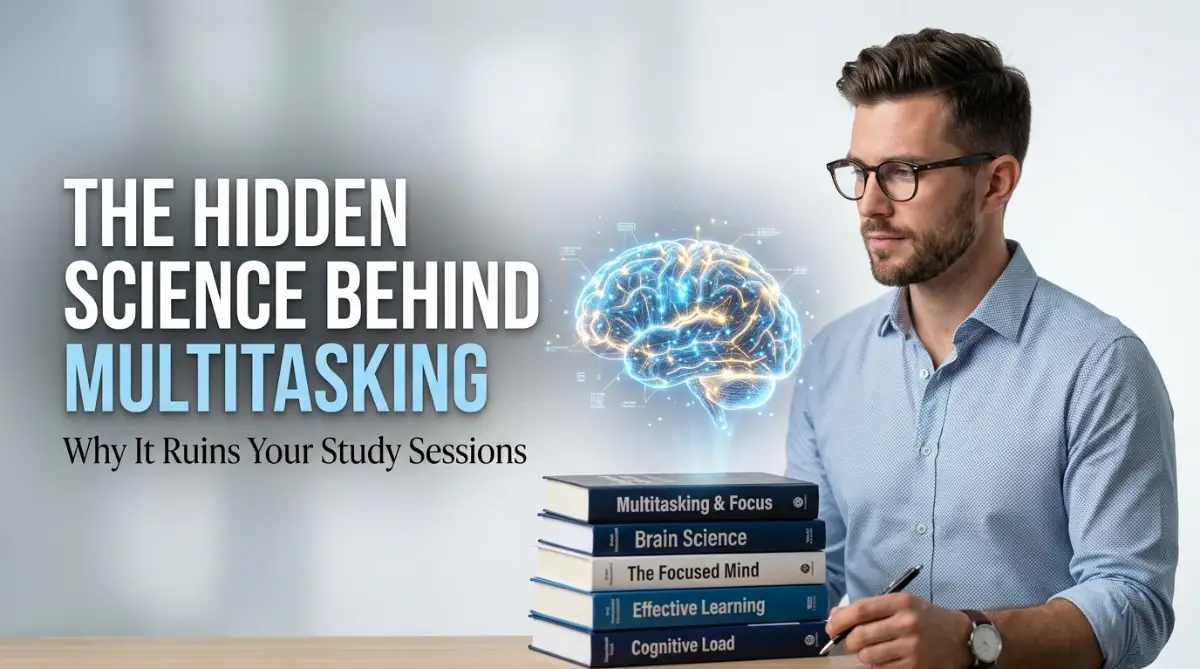
When you think you are multitasking, you are actually just rapidly switching your attention back and forth. Neuroscientists call this phenomenon "context switching."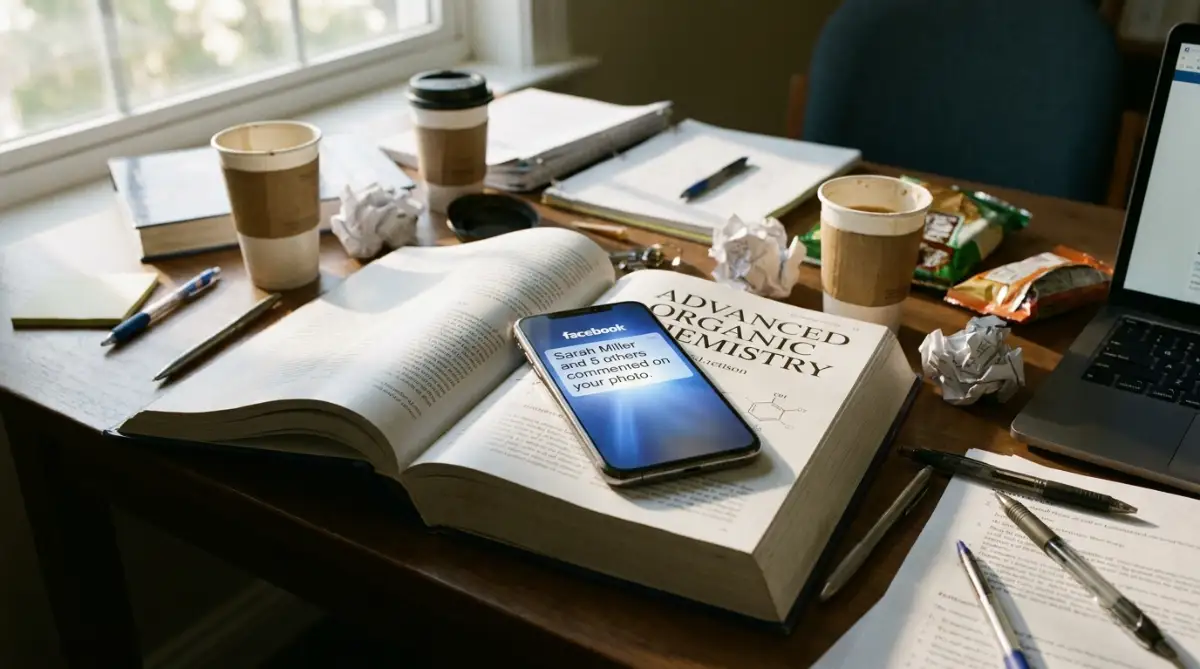
Every single time you look away from your study notes to check a notification, your brain has to hit the brakes on learning. It then has to load the new rules for reading a text message. When you look back at your book, your brain has to completely reboot the learning process all over again.
The Hidden Tax of Attention Residue
This constant starting and stopping comes with a massive cognitive penalty. Think of your brain like a high-performance computer.
If you open twenty heavy software programs all at once, your computer's RAM gets completely exhausted. The fan starts spinning loudly, the screen freezes, and everything slows down to a frustrating crawl.
Your mind works in a surprisingly similar way. When you jump from a math problem to a funny video, a small part of your attention actually stays stuck on that video. This lingering distraction is scientifically known as attention residue.
Because a piece of your focus is left behind, you cannot fully engage with the math problem in front of you. Over a two-hour study session, this attention residue builds up heavily, leaving you feeling mentally drained and completely confused.
Expert Insight: Research shows that it takes the average human brain about 23 minutes to fully regain deep focus after a single minor distraction. Let that sink in. Just one quick glance at an Instagram message can cost you almost half an hour of genuine, productive learning.
Quick Data Check: The True Cost of Split Focus
I put together this simple table so you can see exactly what happens to your brain when you try to do too much at once.
Myth vs. Reality: The Multitasking Trap
Before we discuss the actionable steps to fix this problem, we need to clear up some widespread confusion. The internet is full of bad advice regarding productivity, and we need to separate fact from fiction.
The Myth: High achievers get more done because they know how to juggle multiple projects simultaneously.
The Reality: Top-performing students and world-class professionals actually practice aggressive single-tasking. They focus all their mental energy on one specific goal until it is completed.
The Myth: Having a video playing in the background helps you study better because it prevents boredom.
The Reality: Background noise featuring human voices or complex narratives forces your brain to subconsciously process that information. This steals valuable processing power away from your actual study materials.
Actionable Strategies to Rewire Your Academic Focus
Now that we understand exactly why juggling tasks destroys our memory, it is time to take action. You do not need expensive tools or a complicated system to fix this.
You simply need a structured approach to managing your environment and your mindset. Let us look at a few highly practical methods you can start using tonight.
Strategy 1: The Ruthless Environment Cleanse
Your study environment dictates your level of success before you even open a book. If your desk is full of triggers, your brain will constantly fight the urge to be distracted.
Willpower is a limited resource. Do not waste your mental energy trying to ignore your phone when you can easily remove the temptation altogether.
How to apply this right now:
- The "Out of Sight" Rule: Put your smartphone in a completely different room. Do not just place it face down on your desk. The mere physical presence of a phone has been proven to reduce cognitive capacity.
- The Single-Tab Policy: If you are reading an online journal or a PDF, close every single other tab on your browser.
- Declutter the Visual Field: Remove everything from your desk that is not directly related to your current subject. A clean desk sends a powerful signal to your brain that it is time to work.
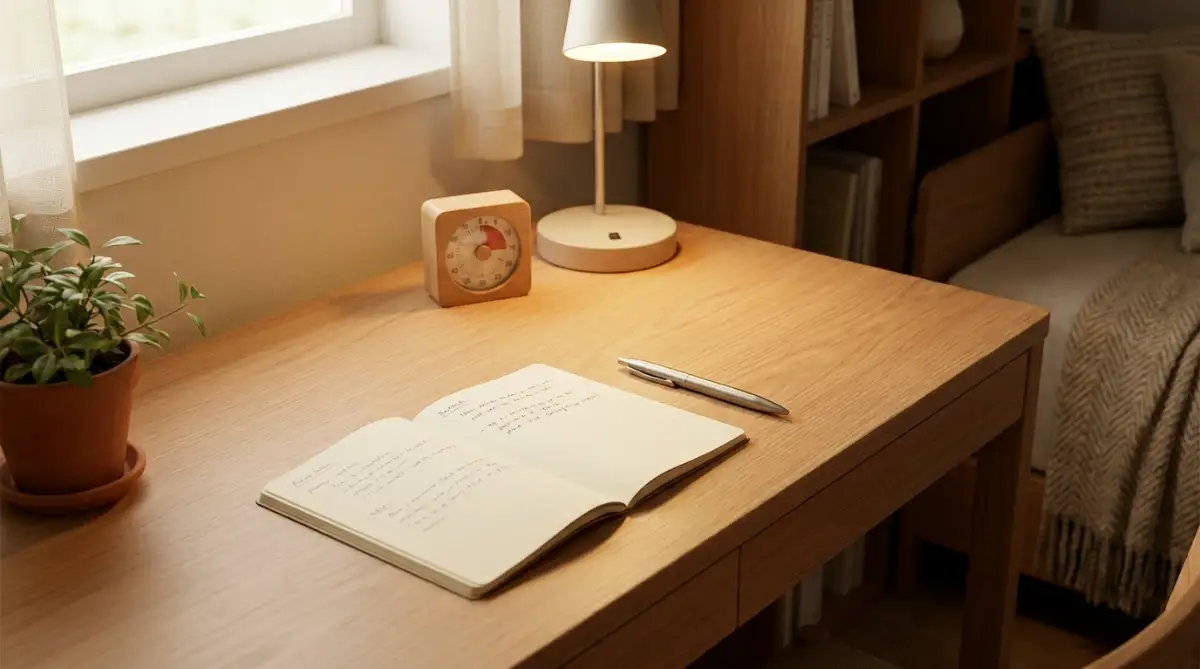
Strategy 2: Time-Blocking for Unbroken Deep Work
You cannot expect your brain to maintain intense focus for four hours straight. That is simply biologically impossible.
Instead of sitting down with a vague goal of "studying all evening," you need to create clear, undeniable boundaries around your time. This is where strategic time-blocking becomes your best friend.
By dedicating specific chunks of time to a single task, you give your brain permission to ignore everything else.
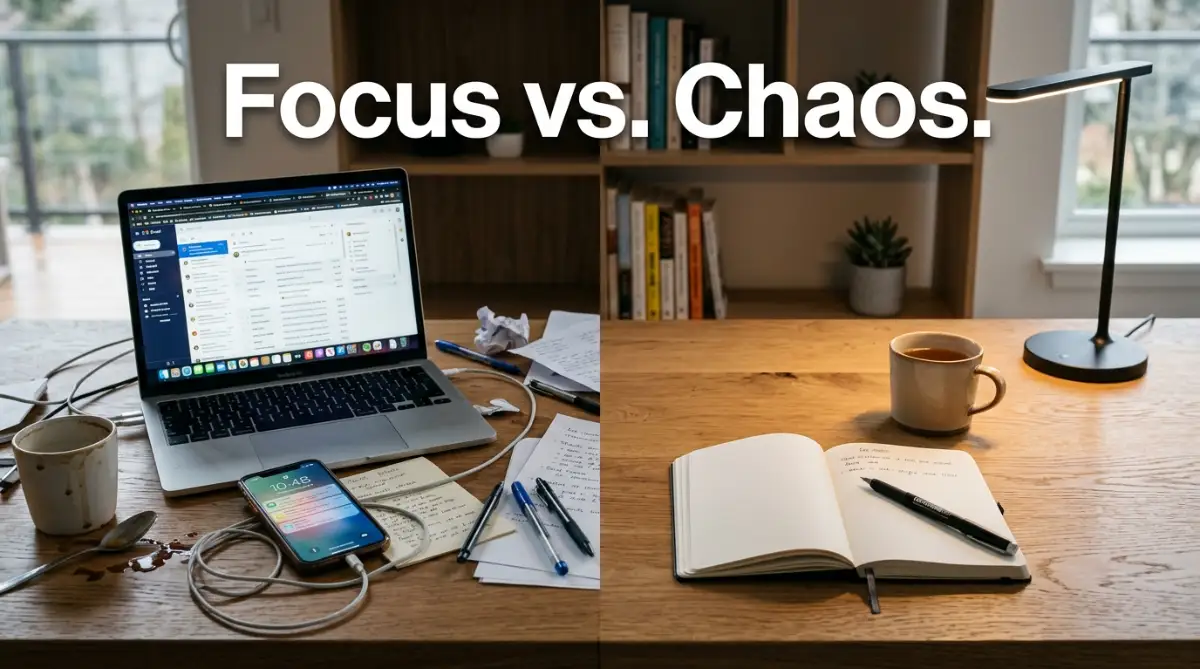
The Difference Between Chaos and Structure
Habit The Chaotic Approach (Multitasking) The Deep Work Approach (Single-Tasking)
Duration "I'll study until I get tired." "I will focus entirely on Chapter 3 for exactly 45 minutes."
Execution Switching between reading, texting, and eating. Reading only. Phone is away. Snacks are for breaks.
Outcome Feeling exhausted with zero real memory retention. Feeling accomplished with high memory retention.
To start time-blocking, pick just one subject. Set a physical timer for 45 minutes. During this period, you are only allowed to look at that specific subject.
When the timer goes off, you must step away from your desk. Take a five-minute break to stretch, drink some water, or rest your eyes. This structured approach prevents cognitive overload and keeps your mind remarkably fresh.
Strategy 3: The "Brain Dump" Method for Intrusive Thoughts
Even if you perfectly clean your room and hide your phone, distractions will still come from inside your own head. You will suddenly remember that you need to email your professor, or you might wonder what you should eat for dinner.
These internal thoughts are dangerous because they tempt you to abandon your current task.
Instead of fighting these thoughts, you should easily capture them. Keep a blank piece of paper and a pen right next to your study book. We call this the "Brain Dump Pad."
Whenever an unrelated thought pops into your head, do not act on it. Simply write it down quickly on the pad. Tell yourself, "I have captured this idea, and I will deal with it during my next break."
This incredibly simple trick instantly relieves your brain of the pressure to remember the random thought. You can safely return to your studies within seconds, completely avoiding the heavy tax of attention residue.
For a long time, I made the terrible mistake of leaving my phone right next to my textbook, thinking I had enough self-control to simply ignore it. I finally realized my willpower was not that strong, so I started putting my phone in a different room entirely while I studied. It sounds super simple, but physically removing that digital temptation was the absolute best thing I ever did for my grades.
Strategy 4: Using Active Recall Over Passive Reading
When we try to do too many things at once, we often default to the easiest possible study method. Usually, this means just passively re-reading highlighted notes while our mind wanders elsewhere.
Passive reading feels productive, but it is actually a massive waste of your time. Your brain is not working hard enough to build strong neural pathways.
To truly master a subject, you must force your brain to retrieve information. This process is called active recall.
Want to see exactly how top students use active recall to memorize difficult information in half the time? Watch this short, helpful video below, and then keep reading to uncover the hidden focus killers you are probably making right now!
A Real-Life Application:
Instead of reading a page while half-watching a YouTube video, close the book entirely. Take out a blank sheet of paper. Try to write down every single main concept you just read, relying only on your memory.
At first, this will feel difficult and uncomfortable. You will probably only remember a small fraction of the text. But that mental struggle is exactly what signals your brain to store the information permanently.
Once you finish your recall attempt, open the book and check your accuracy. Correct your mistakes in a different color pen. This simple, highly focused feedback loop is worth ten hours of distracted, passive reading.
My Personal Pro-Tip for Active Recall:
If staring at a blank piece of paper feels too scary, try the "Feynman Technique" instead. Pretend you are teaching the concept to a 10-year-old kid. Speak out loud in your room. If you start stuttering or using overly big words to hide your confusion, you have found a gap in your memory. Go back to the book, fix that specific gap, and try explaining it out loud again.
Building an Unbreakable System for Deep Academic Focus
If you want to permanently stop the bad habit of juggling too many things at once, willpower alone will not save you. Our modern devices are literally engineered by psychologists to steal our attention.
You cannot fight a billion-dollar tech company with just good intentions. Instead, you need to build a foolproof system that protects your learning environment automatically.
The most successful students do not have superhuman discipline. They simply design their daily routines so that doing the right thing becomes the easiest option available.
Let me walk you through some highly effective methods to lock in your concentration for the long term.
Treat Your Attention Like a Physical Muscle
Most people expect to sit down and instantly study for three hours straight without looking at their phones. When they fail, they feel incredibly guilty.
But your brain simply does not work that way. Deep focus is an actual physical muscle inside your mind.
If you have never gone to the gym, you would never attempt to lift heavy weights on your very first day. The exact same logic applies to your study sessions.
Start ridiculously small. Aim for just fifteen minutes of unbroken, single-tasking focus.
Once those fifteen minutes are over, allow yourself a genuine break. Over the next few weeks, slowly increase that time to twenty, then thirty, and finally forty-five minutes.
Protecting Your Mental Workspace from Digital Clutter
We often underestimate how much random information our brain absorbs throughout the day. Every social media post, news headline, and text message takes up valuable processing power.
Digital distractions act exactly like a hidden computer virus for your brain. They quietly run in the background, draining your mental battery before you even open a textbook.
To prevent this, you must set up strict digital boundaries. Turn on your phone's "Do Not Disturb" mode an hour before you plan to read.
Block specific distracting websites using free browser extensions. If you do not see the distraction, you will not have to waste your energy fighting it.
The Mental Detox Process
Sometimes, the inability to focus comes from an overwhelming amount of mental burnout. If you have been studying poorly for months, your mind is likely exhausted.
You cannot force an exhausted brain to perform at a high level. You need a complete reset.
You need to apply that exact same care to your mental health. A true mental detox means stepping away from screens entirely for a day.
Go for a walk without your headphones. Read a physical fiction book for pleasure. Let your brain experience actual boredom again, which heavily resets your natural dopamine levels.
Q&A: Navigating Everyday Distractions
Question: What should I do if my study materials are entirely online and I get easily distracted by other tabs?
Answer: Create a completely separate user profile on your laptop dedicated only to studying. Do not log into any of your personal social media accounts on this specific profile. When you log in, your brain will recognize that it is time to work.
Question: Is it okay to study with a group of friends?
Answer: Only if everyone agrees to strict single-tasking rules. If your friends are constantly showing you funny videos or gossiping, they are acting as a major distraction. You must protect your time fiercely.
Question: How do I figure out what distracts me the most?
Answer: You need a customized approach. Just as it is important to figure out how to identify your exact skin type at home before buying expensive lotions, you must identify your personal distraction triggers. Keep a notepad beside you for three days and write down exactly what breaks your focus every single time it happens.

The Silent Focus Killers You Might Be Ignoring
Even when we try our absolute best to stay focused, we often fall back into dangerous habits without realizing it. These hidden pitfalls can easily wipe out an entire week of good progress.
Let us carefully examine the most common traps that students fall into, so you can completely avoid them moving forward.
The "Just Five Minutes" Dopamine Trap
This is arguably the most dangerous lie we tell ourselves. You have been reading a difficult chapter for twenty minutes, and your brain feels slightly tired.
You think, "I will just check my messages for five minutes to take a quick break."
The moment you open that app, a massive rush of unpredictable information hits your brain. The American Psychological Association notes that multitasking can reduce productivity by up to 40 percent, largely because of these small, constant interruptions.
Those five minutes quickly turn into forty-five minutes of mindless scrolling. Even worse, when you finally look back at your book, your brain completely rejects the boring text.
Your mind wants more of that quick, easy stimulation. Never use highly stimulating apps as a reward during your short study breaks.
Confusing "Being Busy" with Genuine Learning
Many students fall into the trap of fake productivity. They spend three hours making beautiful, color-coded flashcards while watching a movie in the background.
At the end of the night, they feel incredibly proud of the massive stack of cards they created. But if you ask them to explain the concepts on those cards, they completely freeze up.
Creating the materials is not the same thing as learning the materials. If your study method feels very easy and requires very little brain power, you are probably not retaining any real information.
Real learning always feels slightly uncomfortable. It requires you to struggle with the material in complete silence.
The False Relaxation Break
How do you usually spend your designated rest periods? If you are like most people, you probably stay in the exact same chair and switch to watching a YouTube video.
This is a massive mistake. Your eyes are still staring at a screen, and your brain is still aggressively processing visual data.
You are not actually resting; you are simply switching the type of work your brain is doing. When your break ends, you will feel just as tired as you did before.
A true break must involve a completely different physical environment. Stand up, walk into the kitchen, drink a glass of cold water, or look out the window at the sky.
Let your mind wander naturally. This deep rest is what allows your brain to organize the information you just learned.
Studying in a Sleep-Deprived State
Juggling multiple assignments often leads to late-night cramming sessions. You push yourself to stay awake until three in the morning, thinking you are doing what is necessary to succeed.
However, science strongly disagrees with this approach. Sleep is not a luxury; it is a biological requirement for memory consolidation.
According to research shared by the National Institutes of Health (NIH), sleep plays a highly essential role in learning and memory. If you do not sleep, your brain cannot move information from short-term to long-term storage.
All those hours you spent forcing yourself to read while exhausted are effectively wasted. You would get far better grades by stopping at a reasonable hour and getting eight hours of solid rest.
Your Action Plan for Tomorrow's Study Session
We have covered a massive amount of ground today. You now completely understand the science behind why splitting your attention ruins your memory.
You also know exactly how to protect your mental energy and avoid the most dangerous productivity traps.
But reading this guide will not change anything unless you take immediate, physical action. I want you to completely transform the way you approach your very next study block.
Instead of waiting for motivation to strike, you are going to follow this simple, proven checklist.
Phase 1: The Setup
Before you even sit down at your desk, remove all completely unnecessary items from your workspace. Bring a glass of water and your physical notebook.
Take your smartphone, turn it completely off, and leave it inside a drawer in another room. Do not keep it in your pocket.
Phase 2: The Execution
Decide on one highly specific goal for the next hour. Do not just say, "I am going to study biology."
Instead, tell yourself, "I am going to memorize the three main functions of the cardiovascular system."
Set a simple kitchen timer for forty-five minutes. Open your book and begin your deep work.
If a random thought pops into your head, write it down on a piece of scrap paper immediately and get right back to the textbook.
Phase 3: The Active Recall Test
When the timer finally goes off, close the book entirely. Take out a blank piece of paper and write down everything you can possibly remember about the cardiovascular system.
Force your brain to work hard. Once you have written down everything you can, check your notes to see what you missed.
You have just completed a perfect, distraction-free learning cycle.
You are fully capable of achieving incredible academic results. It just takes a willingness to slow down, eliminate the noise, and do one thing brilliantly at a time. Go clear off your desk, put your phone away, and start your journey toward real focus today.
When I finally stopped trying to juggle a million things at once, I did not just get better test scores; I actually got my free time and my peace of mind back. I promise you that if you try just one of these simple focus tricks tonight, you will be amazed at how much faster you learn. Take a deep breath, trust the process, and give your brain the gift of real, unbroken attention today.
Disclaimer: The information provided in this educational guide is for general informational and personal development purposes only. While the strategies shared are based on widely accepted study techniques and cognitive principles, individual results may vary. This content does not substitute professional academic counseling or medical advice regarding attention disorders. Always consult with a qualified educational professional or healthcare provider for specific concerns related to learning disabilities or mental health.