The Blank Page Nightmare
Ever feel like your laptop is actually laughing at you? You’ve got twenty tabs open, three empty energy drink cans on your desk, and a deadline that’s getting closer every second. But the page is still white. I've been there, and I promise it’s not about your 'writing talent.' It’s just about having a simple plan to follow. Let’s get those words moving.
Does this heavy, sinking feeling sound familiar?
The heavy pressure of securing a good grade sits tightly on your chest. You start questioning your own intelligence, wondering if you actually belong in a university at all.
The worst part is that you actually understand your topic. You know the information in your head.
But taking all those messy thoughts and organizing them into a professional, high-level academic format feels totally impossible. It feels like trying to build a massive bridge without any engineering plans.
But I want you to take a deep breath right now. Writing a high-level academic document is not a magical talent you are born with.
It is simply a mechanical process. Once you learn the exact architecture behind it, you will never fear a blank page again.
I spent my entire freshman year crying over my keyboard at 3 AM because I had absolutely no idea how to start my history papers. I would stare at the blinking cursor until my eyes hurt, convinced I was the only person in my class who felt completely lost. It took me three painful semesters to finally figure out that writing is just a simple formula, and I am going to share my exact survival method with you today.
### ✍️ How to Beat the Blank Page (The Cheat Sheet)
If you don't have time to read the whole thing, here are the big moves:
- Prep Like a Chef: Don't just start typing. Gather your quotes and sources in a 'Brainstorming File' first.
- One Sentence Rules All: Your thesis is your boss. If a paragraph doesn't help prove that one sentence, delete it.
- Follow the MEAL Plan: Every paragraph needs a Main Idea, Evidence, Analysis, and a Link.
- Write Now, Edit Later: Turn off your internal critic. Get the 'bad' first draft out so you have something to fix later.
Building Your Academic Foundation
If you try to build a huge house without laying down concrete first, the entire building will collapse. Writing an academic essay works in the exact same way.
Most students fail because they open up a blank document and just start typing random thoughts. They hope the sentences will naturally organize themselves into a beautiful essay.
This is a terrible strategy that only leads to frustration and endless rewriting.
To create a strong document, we must borrow a concept from professional chefs called "mise en place." This French term simply means having all your ingredients measured, cut, and perfectly organized before you ever turn on the stove.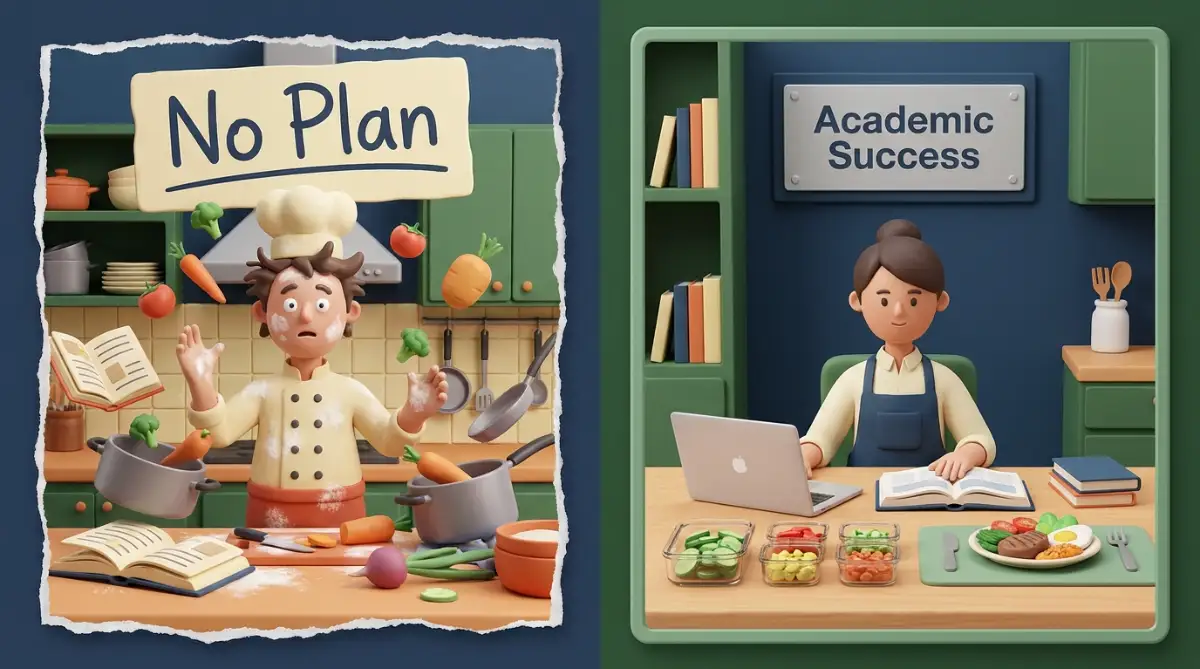
Escaping the Literature Overload
Before you can structure anything, you need to manage your sources properly. When you download twenty different PDF files, your brain gets easily overwhelmed by the sheer volume of text.
You need to extract only the specific information that actually supports your core argument.
Create a completely separate "Brainstorming Document" on your computer. As you read your sources, copy and paste interesting quotes directly into this document.
Right next to the quote, write down the author's name and the page number. This tiny habit will save you hours of painful searching when you finally start building your bibliography.
More importantly, write one simple sentence below each quote explaining why you chose it. How does this specific fact connect to your main topic?
By doing this, you are actually doing the heavy lifting of writing before you officially start your draft.
The Anchor of Your Entire Paper
Every single successful essay revolves around one specific sentence. This sentence is the beating heart of your entire project.
We call this the Thesis Statement.
A good thesis statement does not just announce your topic. It makes a highly specific, arguable claim that the rest of your document will prove.
If your thesis is weak, your entire paper will wander around aimlessly.
Let us look at a quick comparison to make this perfectly clear:
Notice how the strong examples provide a clear roadmap. They tell the reader exactly what specific points you will discuss in the body of your paper.
I always use what I call the 'So What?' Test when I write a thesis. After you write your sentence, ask yourself: 'So what? Why should anyone care?' If your answer is 'Because it’s a big problem' or 'Because it changes the way we think about X,' then you’ve got a winner. If you can’t answer it, your thesis is still too broad.
Designing the Skeleton Framework
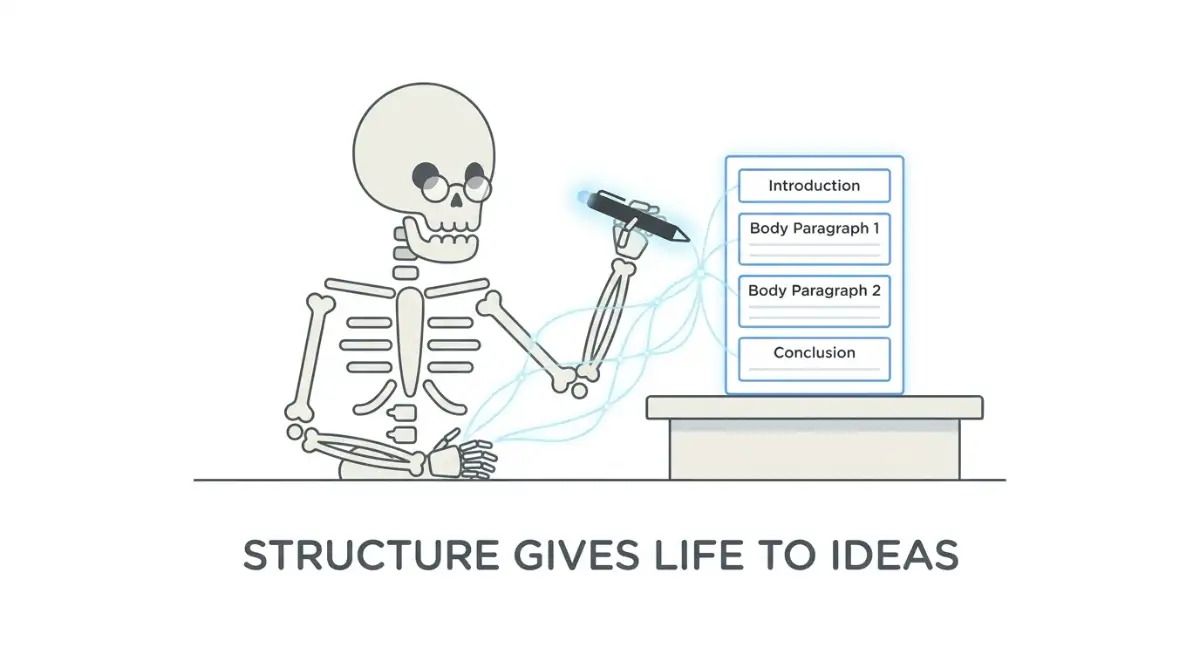 Once you have a strong thesis and a solid list of organized quotes, you are ready to build the skeleton. This is the absolute best way to guarantee a smooth writing experience.
Do not try to write beautiful, perfect sentences yet. You are only drawing the structural map.
The Introduction Hook and Map
Your introduction has two main jobs to do. First, it needs to grab the reader's attention immediately.
Start with a highly interesting fact, a strange statistic, or a thought-provoking scenario. For example, if you are writing about digital privacy, start by stating exactly how much personal data a smartphone collects in a single hour.
Next, you need to provide a very brief background on your topic. Assume your reader is smart, but they do not know anything about your specific research.
Finally, end the introduction paragraph with your completely polished thesis statement. This tells the professor exactly where the journey is going.
Constructing Unbreakable Body Paragraphs
The main body of your document is where you will win or lose your grade. Each paragraph must function like a solid brick in a large wall.
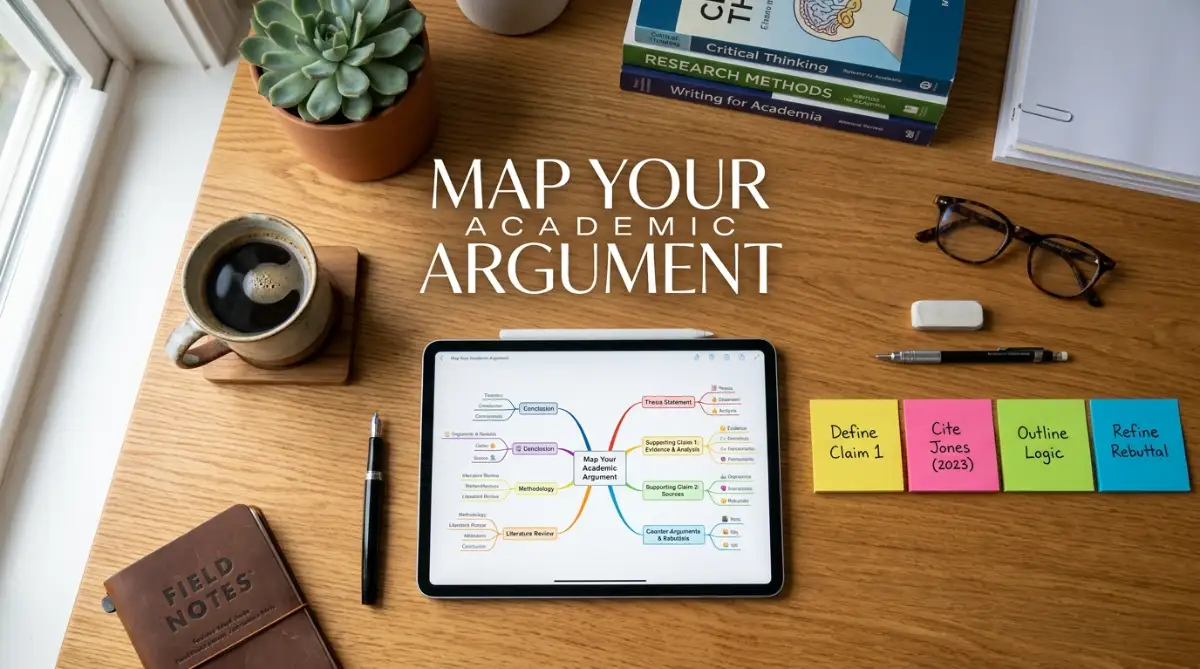
To keep your thoughts perfectly organized, use a highly effective method known as the MEAL plan.
Main Idea: The very first sentence of your paragraph must state the main point clearly. This is often called a topic sentence. It should connect directly back to your thesis statement.
Evidence: Introduce the research you gathered earlier. Use those quotes and statistics from your brainstorming document. Make sure to smoothly introduce the author, rather than just dropping a quote out of nowhere.
Analysis: This is the most important part of the entire paragraph. You cannot just drop a quote and walk away. You must explain what that quote actually means. Why is it relevant? How does it prove your main idea? Your own voice should dominate this section.
Link: The final sentence should wrap up the current thought and create a smooth bridge to the next paragraph.
When you use this specific structure, your writing automatically becomes highly logical and very easy to follow.
Real-Life Body Paragraph Breakdown:
Look at how I’d build a paragraph about social media using the MEAL plan:
- M (Main Idea): Instagram filters are hurting teen body image.
- E (Evidence): A 2023 study showed that 60% of teens feel worse about their skin after scrolling.
- A (Analysis): This proves that constant exposure to 'perfect' images creates an impossible standard for kids.
- L (Link): This mental health dip is exactly why we need better digital literacy in schools."
If you are still struggling to see how your evidence is supposed to connect to your main ideas, watch this quick video breakdown of how to structure a perfect body paragraph. It will completely change how you organize your thoughts, so take a quick look before we move on to grouping your essay themes below!
The Art of Thematic Grouping
If you are writing a longer document, you will likely have many different points to make. You cannot just throw these points together randomly.
You need to group your body paragraphs into specific themes. Think of these themes as separate rooms inside your house.
For example, if you are analyzing the impact of social media on mental health, your first few paragraphs should focus entirely on the psychological data.
Your next few paragraphs might focus entirely on the societal consequences.
Do not bounce back and forth between psychology and society in every single paragraph. That gives the reader terrible mental whiplash.
Keep your themes neatly grouped together. You can even use bold sub-headings in your actual paper to help guide the reader's eye.
Mastering the Counter-Argument
Many students think they should completely ignore any research that disagrees with their thesis. They believe mentioning the opposing side will make their own paper look weak.
This is a massive misconception in the academic world.
If you want to write a truly top-tier paper, you must actively address the other side. You need a dedicated section that acknowledges the counter-argument.
By bringing up the opposing view, you show your professor that you have done deep, well-rounded research. You prove that you are not just heavily biased.
How to Dismantle Opposing Views
When you introduce the opposing side, state their argument fairly and clearly. Do not use insulting language or make their points sound silly.
Once you explain their view, you must immediately pivot and explain why they are ultimately incorrect or short-sighted.
Perhaps their data is outdated. Maybe they ignored a highly significant variable in their research.
You use your own stronger evidence to dismantle their claims logically. This technique makes your original thesis statement look incredibly powerful and bulletproof.
Weaving the Synthesis Conclusion
By the time you reach the end of your document, you will likely feel highly exhausted. Most students just copy their introduction, paste it at the bottom, and change a few words.
This is a terrible way to end a journey.
Your conclusion should never introduce completely new information. Instead, it should act as a powerful synthesis of everything you just discussed.
Remind the reader of your main thesis, but phrase it in a way that reflects the deep journey they just took with you.
Show them how all the different pieces of evidence you presented actually fit together perfectly to form one solid truth.
Finally, leave the reader with a broader thought. Why does this research actually matter in the real world? What should society do with this new understanding?
Give them a strong, lingering thought that stays in their mind long after they close your document.
When you follow this specific blueprint, the stress of the blank page completely vanishes. You transform a chaotic, terrifying task into a highly organized, predictable system.
Expert Techniques for a Flawless First Draft
Now that you have a solid structural framework, you are ready to start writing. But moving from a basic outline to a completely finished paper requires some advanced strategies.
Many students sit down and try to write their essay perfectly from the very first word to the last. This creates massive anxiety and guarantees you will get stuck staring at the screen.
Top academic writers do not work this way at all. They use dynamic techniques to trick their brain into producing words without fear.
Let us look at some powerful methods you can use to make the drafting process incredibly smooth and entirely painless.
Start in the Middle (The Hollywood Method)
There is absolutely no rule that says you must write your introduction first. In fact, writing the introduction first is often a terrible idea.
How can you introduce a paper when you do not even know what the main body will look like yet?
Instead, I want you to borrow a trick from Hollywood movie directors. Movies are almost never filmed in chronological order.
Directors shoot the easiest and most exciting scenes first to build momentum. You should do the exact same thing with your research paper.
Look at your outline and find the single easiest body paragraph to write. Find the section where you have the absolute best quotes and the strongest arguments.
Start writing that specific paragraph right now. By tackling the easiest sections first, you build instant writing momentum and completely crush your writer's block.
Mastering the Reverse Outline
What happens when you finish your first draft, but the paper feels messy and confusing? This is exactly where the reverse outline saves the day.
After you write your draft, take a blank sheet of paper. Read through your essay, and write down the main idea of every single paragraph in just one sentence.
When you look at this new, shortened list, you will instantly see if your logic flows naturally. You will quickly spot paragraphs that repeat the same information or wander completely off-topic.
Using a reverse outline helps you guarantee that your paper stays sharply focused on your thesis. It is a highly effective way to self-edit before you submit your work.
If you want to understand exactly how effective this strategy is, many top universities strongly recommend it. You can see how the academic writing guidelines at the Purdue Online Writing Lab teach students to use this exact method for clarity.
Q&A: Overcoming Mid-Draft Burnout
Sometimes, right in the middle of writing, your brain simply stops working. Let us address this common problem directly.
Question: What should I do when I know what I want to say, but the words just sound terrible?
Answer: Just write the terrible words anyway. Your only goal in a first draft is to put black text on a white screen. You can always fix ugly sentences tomorrow, but you cannot edit a blank page.
Question: How do I stop losing my scattered research notes while I write?
Answer: This usually happens because your initial research phase was too disorganized. You must fix your silent note-taking mistakes that are secretly sabotaging your exam scores. Always keep your notes in one single, searchable document.
Question: Should I use a thesaurus to sound smarter?
Answer: Absolutely not. Professors easily notice when you use big, unnatural words just to sound intelligent. Clear, simple, and direct language will always earn you a much higher grade.

The Hidden Traps That Destroy Your Final Grade
Even if you have an amazing outline, there are several dangerous traps waiting for you during the writing phase. Falling into these specific pitfalls can destroy hours of your hard work.
Imagine spending five days researching a topic, only to get a terrible grade because of a few silly mechanical errors. It is a deeply heartbreaking and completely avoidable experience.
You need to know exactly what these mistakes look like so you can actively avoid them. Let us break down the worst habits that frustrate college professors the most.
The Tragedy of the "Orphan Quote"
An orphan quote is a piece of evidence that is just dropped randomly into your paragraph. It has no introduction, no context, and no explanation attached to it.
Imagine you are sitting in your living room, and a total stranger walks in, shouts a random statistic about apples, and walks away. You would be highly confused.
When you drop an orphan quote into your essay, your professor feels that exact same confusion. You must carefully introduce every single piece of evidence.
Always tell the reader who is speaking and why they are a trusted expert. For example, instead of just dropping a quote, write: "According to Dr. Smith, a lead researcher at Oxford, the data shows that..."
If you want a deeper look at proper integration, many schools offer great resources. You can read how the Harvard College Writing Center explains integrating sources to see perfect examples of this technique.
Editing While You Write
This is arguably the most toxic habit a student can develop. Writing and editing require two entirely different parts of your brain.
Writing is a creative process where you generate new ideas. Editing is an analytical process where you judge and cut things apart.
If you try to write a sentence, immediately delete it, and rewrite it five times, you will exhaust yourself in ten minutes. Your word count will barely move at all.
You must separate these two tasks completely. Force yourself to write the entire messy draft without touching the backspace key.
I used to miss my deadlines constantly because I obsessed over making my first paragraph sound completely perfect before moving to the next one. Now, I actually turn my screen brightness all the way down so I cannot even see the typos I am making, which forces my brain to just keep typing raw ideas without judging them.
This habit is directly tied to how your brain handles multiple tasks. If you want to know why trying to do both at once is so harmful, read about the hidden science behind why multitasking ruins your study sessions.
Ignoring the Professor's Rubric
This mistake is entirely based on completely ignoring instructions. A rubric is literally a cheat sheet that tells you exactly how to get an A on the assignment.
Yet, thousands of students completely ignore the rubric until after they finish writing. They write a beautiful, deeply researched ten-page paper on the wrong topic.
If the rubric asks you to compare two different historical events, do not just summarize one event. If you fail to follow the specific prompt, your brilliant writing will still get a failing grade.
Before you write your very first sentence, print out the rubric. Tape it directly to the wall next to your computer screen so you can constantly see it.
Quick Do's and Don'ts for Academic Success
To keep things incredibly simple, here is a quick list of rules you should always keep in the back of your mind while drafting.
- DO read your final draft entirely out loud. Your ears will catch awkward sentences much faster than your eyes will.
- DON'T rely entirely on automated spelling checkers. They will not tell you if you used the word "their" instead of "there."
- DO save multiple versions of your document. Name them Draft 1, Draft 2, and Final Draft to protect your hard work from computer crashes.
- DON'T use highly informal language or slang. Always maintain a professional, objective tone throughout your paper.
Your Ultimate Action Plan for Tomorrow
We have covered a massive amount of valuable ground today. You now have the exact blueprint to take any complex topic and turn it into a highly organized, professional research paper.
You know how to build a strong thesis, outline your main ideas, and avoid the dangerous traps that ruin most essays. The blank page should no longer terrify you.
However, reading this guide will not magically write your paper for you. You have to take this framework and actively apply it to your current assignment.
I know academic writing can feel incredibly heavy and stressful. But I promise you, if you trust this step-by-step system, the heavy anxiety will completely disappear.
The 24-Hour Implementation Checklist
To help you get started without feeling overwhelmed, I want you to follow this exact checklist over the next 24 hours. Do not try to do everything at once.
Step 1: Open a brand new document and write out three different versions of your thesis statement. Pick the strongest, most specific one.
Step 2: Create your messy brainstorming file. Pull out your top five favorite quotes from your research and paste them onto the page.
Step 3: Review those quotes using an intelligent memory system. You can easily do this by mastering spaced repetition: the ultimate study hack for students, which helps you deeply remember your source material.
Step 4: Build your skeleton map. Write out just the main topic sentences for your body paragraphs. Do not write the full paragraphs yet.
Step 5: Walk away from your computer. Give your brain a total break for at least a few hours before you actually start drafting.
When you sit back down to write, you will feel a massive sense of relief. You will know exactly what you need to say, and you will know exactly what order to say it in.
Your entire academic journey is about to become significantly easier. You will spend less time staring at a blank screen and more time actually enjoying your university experience.
Take a deep breath, trust the system, and start building your best paper today. You absolutely have the power to do this.
Writing academic papers used to give me actual panic attacks, but now I can easily knock out a long essay in a single weekend without losing any sleep. You already have all the smart ideas sitting inside your head right now, so just trust this simple outlining process and go get the amazing grade you deserve!
Disclaimer: This blog post is designed for educational and informational purposes only. It is not intended to replace the specific guidelines, formatting rules, or academic rubrics provided by your individual university or professors. Always consult your specific course syllabus and your academic advisor to ensure you are fully complying with your institution's unique academic integrity and formatting policies.