

The Embarrassing Mistake That Ruined My Dream Trip
I will never forget the burning feeling in my cheeks when a local guard blew his whistle loudly and pointed directly at me. I was standing in the middle of a stunning, ancient temple complex in Southeast Asia. The sun was incredibly hot, so I had decided to wear my favorite comfortable tank top and a pair of running shorts. Within seconds, hundreds of other tourists and praying locals stopped what they were doing and stared right at me.
The guard walked over, shook his head in extreme disappointment, and physically escorted me out of the sacred gates. I did not speak the language, but the message was completely clear. My choice of clothing was deeply offensive to their religious traditions.
I felt like the absolute worst person in the world at that moment. I had spent thousands of dollars to fly across the ocean, only to insult the very people welcoming me. I sat on a dusty bench outside the monument for two hours, waiting for my friends to finish their tour. My entire day was ruined because I did not bother to learn the unspoken rules of the place I was visiting.
This painful experience is surprisingly common for everyday people traveling abroad. You pack your bags, book your tickets, and expect everything to be as casual as a trip to your local shopping mall. When you arrive at a 900-year-old monument, you completely forget that this is not just a tourist attraction.
For the locals, these places are sacred resting grounds, active places of worship, or memorials of great tragedy. When tourists treat these heavy spaces like cheap amusement parks, the cultural clash is explosive. Locals feel deeply disrespected, and tourists end up feeling publicly humiliated.
The anxiety of making a social mistake actually destroys the mental peace of your vacation. You start second-guessing every single step you take. You wonder if pointing your camera is offensive, or if speaking too loudly will get you kicked out.
Instead of enjoying the beautiful history around you, you are constantly on edge. Ignorance is definitely not bliss when you are traveling in a foreign country. The only way to truly enjoy your trip is to understand the deep, unwritten laws that govern these ancient spaces.
Decoding the Hidden Laws of Ancient Spaces
When you step onto the grounds of a historical monument, you are stepping into a different world. The normal rules of modern society simply do not apply here. You have to adapt your behavior to match the history and the culture of the specific site you are standing on.
Many tourists assume that buying a ticket gives them the right to do whatever they want. This is a very dangerous mindset. Your ticket simply grants you the privilege of observing, not the right to disrespect. Let's break down exactly how you should behave to blend in and show true respect.
The Psychology Behind Modesty Rules
One of the biggest shock factors for tourists from Western countries is the strict dress code at international monuments. In many parts of Europe, Asia, and the Middle East, showing your shoulders and knees is considered highly inappropriate in certain settings. You might think this is an outdated concept, but the logic behind it is very deep.
Think of it like attending a very formal wedding or a serious corporate meeting. You would never show up to a job interview wearing a bathing suit. The way you dress communicates your level of respect for the occasion. For locals, visiting a grand cathedral or an ancient temple is the highest form of a formal occasion.
When you walk into these places showing a lot of skin, the locals interpret it as a direct insult to their ancestors or their faith. It tells them that your personal comfort is more important than their deeply held beliefs. Adjusting your wardrobe is the easiest way to silently tell the local community that you honor their history.
My Personal Realization: I used to get really annoyed about packing long pants for summer trips until I realized how much better locals treated me when I wore them. I now keep a large, lightweight scarf folded at the bottom of my daypack everywhere I go. Throwing it over my shoulders right before entering a church has saved me from being turned away at the door multiple times.
The Invisible Boundary of Photography
We live in an era where everyone wants to document every single second of their lives. Taking photos is a wonderful way to capture memories. However, historical monuments are not photo studios, and treating them like one creates massive problems.
The first issue is the physical damage caused by cameras. This might sound completely crazy, but your camera flash actually destroys ancient history. Many ancient tombs and palaces are decorated with highly sensitive pigments that are thousands of years old.
When thousands of tourists fire off bright flashes every single day, the intense bursts of light break down the chemical bonds in the ancient paint. Over time, the beautiful colors slowly fade into a dull gray. This is a proven scientific fact, which is why almost every indoor historical site has strict "No Flash" signs.
Want to understand exactly how light degrades ancient artwork? Watch this fascinating breakdown of what happens when tourists ignore the rules.
The Disrespect of the Perfect Selfie
The second photography rule is entirely about emotional intelligence. There is a very specific type of unwritten rule regarding where and how you pose for photos. You must always read the emotional weight of the room before you smile for a selfie.
For example, taking a happy, jumping photo in front of a beautiful castle in France is perfectly fine. However, taking a smiling selfie while throwing a peace sign at a historical war memorial or a concentration camp is wildly offensive. These are sites of massive human tragedy and deep sorrow.
When locals see tourists posing playfully in spaces where thousands of people lost their lives, it causes intense anger. You are essentially turning their painful history into a cheap social media prop. Always ask yourself if the history of the monument is a happy one or a tragic one before you pull out your phone.
The Destructive Science of Human Touch
It is a very natural human instinct to want to touch things that are incredibly old. When you stand next to a stone pillar carved by the ancient Romans, your brain wants to feel the texture. You want to physically connect with the past.
You must fight this urge with every ounce of willpower you have. Touching historical monuments is usually strictly forbidden, even if there is no sign explicitly telling you to stop. The reasoning behind this rule is pure biology and chemistry.
Human skin is naturally covered in a thin layer of sweat, natural oils, and microscopic acids. When you press your hand against an ancient stone, you leave those oils behind. One single touch does not do much damage.
However, imagine five thousand tourists touching that exact same spot every single day for thirty years. The acid from human hands literally eats away at the stone. Intricate carvings that survived for centuries get rubbed completely smooth just because tourists wanted to feel them.
Keeping Your Hands in Your Pockets
You might think that leaning against a wall for a quick rest is harmless. It is not. The oils on your clothes and your back transfer directly to the ancient structure. Over time, this causes dark, permanent stains on the walls of palaces and ancient homes.
A great mental trick is to pretend every single surface inside a historical monument is covered in wet paint. You should naturally keep your hands folded behind your back or firmly in your pockets. This simple body language also signals to the security guards that you are a highly responsible and educated visitor.
You will notice that guards rarely follow or bother tourists who keep their hands to themselves. By respecting the physical boundaries of the artifacts, you get a much more peaceful and relaxed touring experience.
Managing Your Voice and Acoustic Footprint
When you travel with a large group of friends or family, it is easy to get loud. You want to share exciting facts, laugh at jokes, and call out to someone on the other side of the room. At a historical monument, your voice is actually a form of pollution.
Many ancient structures, especially giant cathedrals and enclosed stone temples, were designed with incredible acoustics. The architects built these spaces to amplify sound so that a single voice speaking at the front could be heard perfectly in the back.
This means that your casual, loud conversation echoes and bounces off the walls, disturbing hundreds of other people. People travel to these specific places to find quiet moments of reflection and awe. When you shout across a massive temple, you instantly shatter that peaceful atmosphere.
The Art of the Library Whisper
The unwritten rule here is very simple to follow. Treat every single historical monument exactly like you would treat a strict public library. If you need to speak to your travel partner, lean in closely and use a very soft whisper.
If you are using a smartphone to listen to a digital audio guide, you must use headphones. Playing audio out loud from your phone speaker inside a historic tomb is considered incredibly rude. It forces everyone around you to listen to your specific tour.
By lowering your volume, you actually allow yourself to experience the monument better. You will start to hear the wind blowing through ancient columns or the soft chanting of local monks. You cannot experience the true magic of a place if you are constantly talking over it.
Navigating the Right of Way in Ancient Spaces
Modern buildings are designed with massive hallways and wide doors to handle heavy foot traffic. Ancient buildings were definitely not. Castles, tombs, and ancient city ruins often feature incredibly narrow staircases and tight corridors.
There is a very distinct walking etiquette you must follow when navigating these tight spaces. When you are climbing a very narrow, spiral stone staircase in an old tower, you cannot just stop in the middle. If you stop to check a text message, you create a massive traffic jam of annoyed tourists behind you.
If you need to catch your breath, you must wait until you reach a landing or a wide-open space. Furthermore, always let people who are exiting a tight room walk out before you try to push your way inside. This is basic human politeness, but it becomes incredibly important in places built a thousand years ago.
You should also never block a major doorway or a beautiful view to check your map. Step entirely to the side, place your back against a non-historical modern railing, and figure out your directions. Keeping the flow of human traffic moving makes the entire experience better for everyone involved.
Elevating Your Travel Experience with Deep Cultural Respect
Once you understand the basic rules of clothing and photography, you can take your travel etiquette to a much deeper level. Truly respectful tourists do not just follow the rules to avoid trouble. They actively try to participate in the local culture with a mindset of learning and appreciation.
This advanced level of awareness actually unlocks a much richer travel experience. When local guides and guards see that you are making a genuine effort, they drop their strict, professional attitude. They will often smile, open up, and share hidden secrets about the monument that they never tell regular tourists.
By showing deep respect, you move from being just another annoying visitor to an honored guest. You get to see the true heart of the country, rather than just the surface-level tourist traps. This is the ultimate goal of anyone trying to create a stress-free international itinerary that feels meaningful.
The Sacred Rule of Footwear
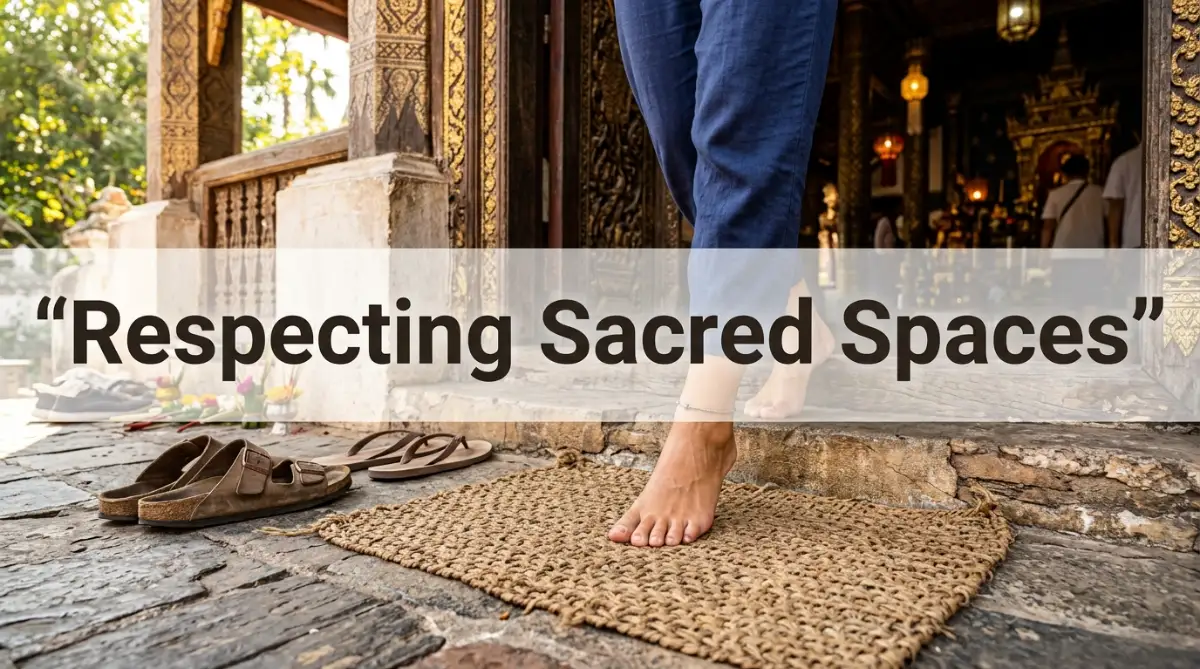
If you are traveling anywhere in Asia or the Middle East, your shoes are going to be a major cultural focal point. In many of these cultures, the head is considered the most sacred part of the body, and the feet are considered the dirtiest. Wearing your outside shoes into a historical temple or an ancient home is a massive insult.
According to cultural research from the Asia Society, stepping into a sacred space with dusty shoes is viewed as bringing the physical dirt of the street into a pure environment. Always look down when you approach a doorway. If you see a pile of shoes outside, that is your immediate signal to take yours off.
I highly recommend wearing simple slip-on shoes when you have a long day of visiting ancient sites. Dealing with complicated shoelaces ten times a day gets very frustrating. You can easily pack smart and save space by choosing one pair of highly comfortable, easily removable walking shoes.
Mastering the Art of Physical Gestures
We use our hands to talk all the time without even thinking about it. However, innocent hand gestures in your home country can be deeply offensive somewhere else. When you are asking a local guide a question about a monument, you must be highly aware of your fingers.
For example, pointing directly at a sacred statue or an ancient artifact with one finger is considered extremely rude in many cultures. It is seen as aggressive and disrespectful. Instead of pointing, you should always use an open, flat hand to gesture toward the object.
Similarly, never touch a local person, especially a monk or a religious figure, without their explicit permission. Even a friendly pat on the back can cause serious cultural shock. Keep your hands relaxed by your sides, and use polite nods to show your appreciation instead.
Eating and Drinking in Sacred Zones
After walking around a giant historical complex for two hours, you are naturally going to feel thirsty and hungry. Your instinct might be to pull out a sandwich and a plastic water bottle right in the middle of an ancient courtyard. You need to suppress that instinct immediately.
Food and drinks attract insects, birds, and rodents, which can cause severe biological damage to ancient stones and wooden structures. Beyond the physical damage, eating in a place of worship or a memorial is simply bad manners. It shows that you treat the site like a public park rather than a protected piece of history.
According to preservation guidelines from UNESCO, maintaining the physical cleanliness of a World Heritage site is highly dependent on visitor behavior. Always wait until you exit the main gates of the monument before you open your snacks. There is usually a designated cafe or a resting area just outside where you can eat comfortably without breaking any rules.
The Most Embarrassing Traps New Tourists Fall Into
Even if you read a hundred guidebooks, it is still very easy to make a massive mistake in the heat of the moment. Travel makes us tired, and when we are tired, our brains go on autopilot. We stop paying attention to our surroundings and fall back into our normal, everyday habits.
These simple mistakes can quickly ruin a perfect afternoon. The locals might yell at you, the security guards might confiscate your camera, or you might be asked to leave entirely. Let's look at the specific traps that constantly catch new tourists off guard so you can easily avoid them.
Assuming the Rules Do Not Apply to Children
This is a very emotional and highly debated topic among traveling families. Many parents believe that because their children are young, they are exempt from strict cultural rules. They let their kids climb on ancient ruins, run through quiet cathedrals, and touch sensitive artifacts.
This behavior causes extreme frustration for the local staff. In many cultures, children are taught from a very young age to show absolute silence and respect in sacred spaces. When tourist children act wildly, the locals view it as a complete failure of the parents.
If you are bringing children to a serious historical monument, you must prepare them beforehand. Explain to them that they are visiting a very special, quiet place, just like a library. If your child is having a bad day and cannot stop crying, the most respectful thing you can do is step outside until they calm down.
Laughing at Cultural Differences
When you encounter a religious practice or a historical ritual that is very different from your own, it can sometimes feel strange or even funny. You might see locals bowing to a statue, walking backward out of a room, or chanting in a language you do not understand.
The absolute worst thing you can possibly do is point, laugh, or make jokes to your friends. This kind of mocking behavior is deeply arrogant and incredibly hurtful. You are a guest in their country, and their traditions have survived for thousands of years before you arrived.
If you do not understand what is happening, just stand quietly in the back and observe. You can always politely ask a local guide to explain the ritual to you later. Approaching different cultures with a genuine sense of curiosity is the mark of a highly educated and professional traveler.