
The Hidden Cost of Sudden Power Drops
My utility company sent me a massive power bill right in the middle of a record-breaking July heatwave. I immediately walked outside to check my home energy equipment, only to pull my hand back quickly because the metal box was literally burning hot to the touch. My entire power system had completely shut itself down to prevent an internal fire. I was paying for premium grid electricity while perfectly good afternoon sunshine blasted my roof panels for hours.
Quick Answer: Why is this happening and how do you fix it?
A residential solar inverter usually overheats because of direct afternoon sunlight exposure, clogged metal cooling fins, or a lack of empty wall space for proper airflow. You can instantly stop the overheating by installing a simple metal shade awning over the unit, blowing out dust with canned air, and ensuring there is at least 12 inches of empty space on all sides of the hardware.
Dealing with this specific hardware failure completely ruins your peace of mind. You invest tens of thousands of dollars into renewable energy to make your life cheaper and easier. Instead, you find yourself obsessively checking the weather app, terrified that another hot afternoon will shut down your air conditioning.
The mental toll of watching your expensive investment fail is incredibly heavy. I spent weeks staring at my phone screen, watching my power production drop to absolute zero right when my house needed the most energy. You start feeling entirely helpless against the weather, assuming the system is just badly designed.
This frustrating behavior is actually a built-in safety mechanism called thermal derating. The internal computer is deliberately throttling the power conversion to stop the delicate circuit boards from melting. While this keeps the machine safe, it leaves you footing a massive bill from the local power company.
I quickly learned that treating this problem does not require calling an expensive technician or replacing the whole unit. Small, highly intentional changes to the environment directly around the metal casing completely change how the system handles intense weather. You can easily take back control of your power generation before the next big heatwave hits.
What Actually Happens Inside the Metal Casing?
Understanding the physics of your energy equipment makes fixing the problem much easier. Your roof panels collect raw direct current (DC) power directly from the sun's rays. However, your home appliances and the local street grid only accept alternating current (AC) power.
The heavy box mounted on your wall acts as the translation bridge between these two electrical formats. But this heavy-duty conversion process is never entirely perfect. The most advanced systems on the market operate at roughly 97% efficiency.
That missing 3% of energy does not magically disappear into the atmosphere. It transforms instantly into pure thermal energy right inside the sealed casing. If your home system is actively processing 10,000 watts of power, it is simultaneously generating about 300 watts of raw heat.
This is exactly like leaving three old-fashioned incandescent light bulbs burning continuously inside a closed metal box. If that massive amount of heat cannot escape fast enough, the internal temperature skyrockets in a matter of minutes. Once the internal sensors detect temperatures climbing above 113°F (45°C), the machine triggers its emergency protocols.
How Do Passive Cooling Fins Actually Work?
Your system relies heavily on its external physical design to stay alive. Look closely at the back or the top of your main unit, and you will see deep metal ridges called heat sinks. These solid aluminum fins are designed to pull heat away from the sensitive internal capacitors.
The fins push the trapped heat outward into the surrounding ambient air. This passive cooling system is beautifully simple, but it has one massive weakness. It completely fails if the air around the box is completely stagnant and motionless.
If there is no natural breeze to carry the hot air away, the heat simply hovers around the metal fins. The machine ends up sitting inside an invisible bubble of its own boiling air.
Pro Tip: I completely ruined my first summer of solar production by ignoring the giant spider webs building up directly behind my equipment. Spiders and mud wasps love the warm, dry gaps between the cooling fins, and their thick webs acted like a winter jacket trapping the heat. I now take a long-handled dry duster and clear out the back of the casing every single month, and my system has not shut down since.
Why Your Wall Placement Is Causing Thermal Throttling
Installers often try to hide these large electrical boxes in tight alleyways or narrow corners to keep the house looking neat. This aesthetic choice is a massive engineering disaster. The machine absolutely needs space to breathe.
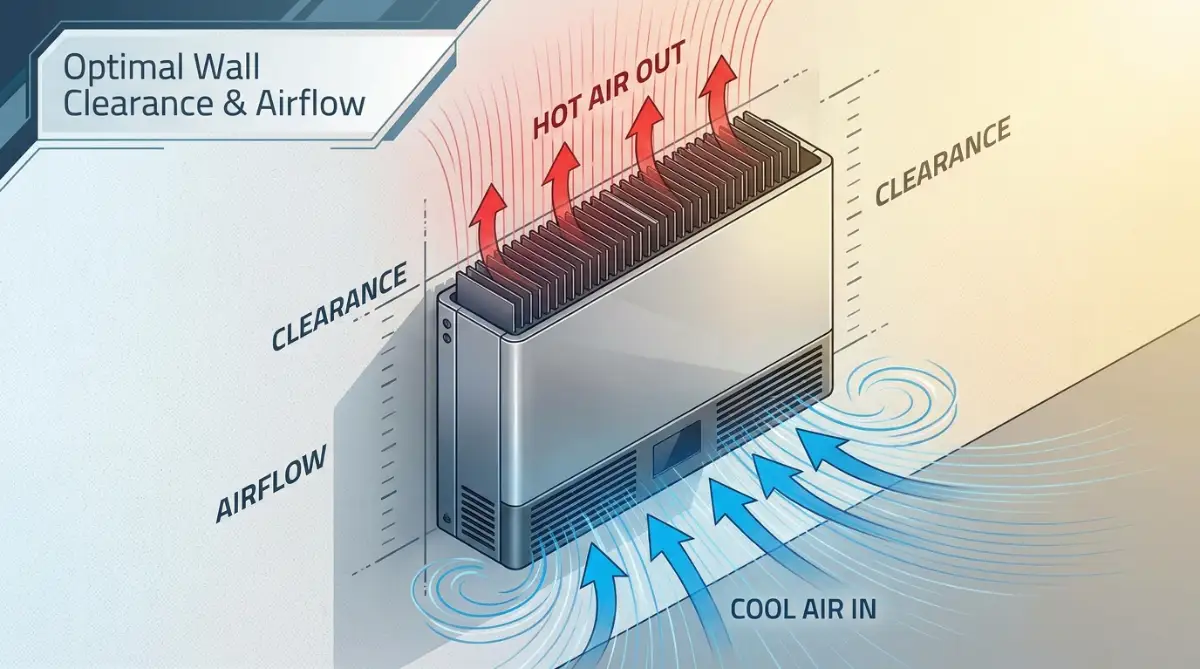
Without adequate clearance, the hot air pushed out by the metal fins simply bounces off the nearby walls. It gets sucked right back into the bottom vents of the machine. You accidentally create a highly efficient, closed-loop oven around your expensive hardware.
You must guarantee specific physical distances around the unit to allow fresh oxygen to circulate.
-
Keep at least 12 inches of completely empty space on the left and right sides of the box.
-
Leave a strict minimum of 24 inches of open clearance directly above the unit.
-
Ensure absolutely nothing is parked, stacked, or stored underneath the casing.
-
Keep fast-growing garden bushes and thick ivy trimmed well away from the operating area.
If your equipment was unfortunately bolted into a tight alcove, you might need to artificially force airflow. Plugging in a small, oscillating floor fan and pointing it at the casing during peak August heat can easily save your system from failing.
Want to see exactly how to safely measure your wall clearance and clean those sensitive cooling fins without risking an electrical shock? Watch this quick demonstration before grabbing your cleaning tools.
Are Direct UV Rays Cooking Your Equipment?
The Myth: Because solar equipment is meant to process sunlight, the main box is completely immune to direct sun exposure.
The Reality: The panels on your roof need the sun, but the computer processing unit on your wall hates it. Exposing the metal casing to direct afternoon UV rays is the fastest way to force a system shutdown.
Blocking the sun from hitting the wall-mounted box is the most effective fix you can implement today. You do not want to build a tight wooden box around the equipment to hide it. Fully enclosing the unit traps the internal heat and guarantees a catastrophic meltdown.
Instead, you need to create an angled shade cover. Think of it like putting a wide-brimmed sun hat on your electronics. You want to block the harsh rays while leaving the sides completely wide open for the wind.
A prefabricated aluminum awning from a local hardware store works absolutely perfectly for this. Make sure the new shade extends at least two feet past the sides of the casing. This extra width blocks the harsh, low-angle afternoon sun that typically causes the most damage.
Is A Layer of Dirt Acting as Insulation?
Take a close look at the metal fins on your processing unit right now. Are they coated in a thick, sticky layer of brown dust and local pollen? Dirt is a surprisingly powerful thermal insulator.
When a blanket of grime covers the cooling ridges, the natural breeze can no longer touch the bare metal. The heat gets entirely trapped inside the dusty coating. Cleaning this surface requires extreme care and the right tools.
Never grab a garden hose or a pressure washer to blast the casing clean. Even though these boxes have outdoor weather ratings, hitting electrical seals with high-pressure water is incredibly dangerous. The rapid temperature change from cold water will also warp the hot metal instantly.
Instead, grab a standard can of compressed air, just like the ones used for cleaning computer keyboards. Use the thin plastic straw to blow out the tight gaps between the metal fins. Following up with a dry, soft-bristled automotive detailing brush will safely remove the remaining stubborn grime.
Active vs. Passive Internal Cooling Methods
Understanding exactly how your specific brand manages high temperatures helps you troubleshoot much faster. Manufacturers generally use two different methods to keep the internal circuit boards from catching fire.
If you happen to own an actively cooled unit, you have another moving part to worry about. Those small internal fans spin continuously during peak afternoon production hours. Over a few years, the cheap plastic fan blades can snap, or the internal bearings can completely dry out.
Put your ear about two feet away from the casing around one o'clock in the afternoon. If the box is hot to the touch but completely silent, your internal cooling fans have likely failed. You will need to contact your original installer to get the fan module physically replaced.
How High Street Voltage Forces the Machine to Overwork
There is a completely invisible factor that forces your home energy system to generate massive amounts of excess heat. It has to do with how the main power grid operates in your specific neighborhood. When the local utility company pushes high voltage down the street lines, your machine struggles to push your generated solar power back out.
Think of it exactly like trying to pump fresh water into a pipe that is already highly pressurized. Your home equipment has to drastically increase its own internal voltage just to beat the incoming street pressure. This extreme physical effort generates massive amounts of unwanted heat inside the unit.
If you notice your system shutting down on surprisingly mild, 75-degree spring days, high grid voltage is almost certainly the culprit. Open your daily monitoring app and look for the incoming grid voltage statistics. If the screen consistently reads above 255V, your hardware is fighting a losing battle against the street.
You cannot fix the neighborhood power lines yourself. You need to take several screenshots of the high voltage numbers and email them to your utility provider. They can physically adjust the neighborhood transformer down the street, instantly relieving the pressure on your equipment.
The Pre-Heatwave Preparation Checklist
When the local news warns about a massive string of 100-degree days, you cannot rely on passive maintenance. You have to prepare your hardware before the morning sun even comes up. Follow this specific routine the night before a major heatwave:
-
Audit the immediate area: Walk outside and ensure nobody leaned a ladder, garbage can, or tall cardboard box near the unit.
-
Clear the intake screens: Use a bright flashlight to look underneath the bottom of the box and brush away any dead bugs blocking the vents.
-
Hose down the concrete: Spray cold water directly on the patio or dirt entirely beneath the unit. The slow evaporation process naturally cools the ambient air pulling up into the machine.
-
Check for firmware updates: Open your mobile app settings and see if the manufacturer released a new digital patch to improve thermal sensor management.