
The Heavy Burden of Juggling Too Many Balances
You are working 50 hours a week, yet your bank account is totally empty three days after payday. I know the exact feeling of staring at a stack of credit card bills, wondering how the math got so incredibly messy. You are not bad with money; you are just caught in a system designed to keep you paying minimums forever. Let me show you exactly how to stop spinning your wheels, beat the high interest rates, and finally breathe a little easier.
It is a very specific type of exhaustion. You sit down at your kitchen table with a pile of statements, opening different apps on your phone, trying to make the math work for the month. You see four different credit card bills, a medical bill, and maybe a small personal loan.
Every single one of these accounts demands a payment on a different day of the month. You feel like a circus performer trying to keep plates spinning in the air. If you drop even one plate, you know the late fees will instantly destroy your hard-earned budget.
The most painful part is looking at the actual statements. You send a $200 payment, but the balance only goes down by $40. The rest of your hard-earned money simply vanishes into the pockets of the bank as interest charges.
This is not a failure of your character or your work ethic. It is the direct result of a mathematical system designed to keep you paying minimums forever. You are trapped in a cycle that feels impossible to break, and the stress is deeply overwhelming.
But you do not have to live this way anymore. There is a very logical, structured way to stop this endless cycle and take back your peace of mind. We are going to walk through a highly protective method to merge these chaotic bills into one manageable plan.

Before We Start: 3 Rules to Stop the Bleeding
- Find out exactly what you owe today (ignoring the math will not make the debt disappear).
- Stop paying 25% interest to the credit card companies by moving your balance to a fixed 10-12% loan.
- Freeze your physical credit cards (literally in a block of ice) to instantly break the habit of swiping.
Mapping Your True Financial Baseline
Before we change anything about your banking, we need to uncover the exact reality of your situation. Most people are terrified to look at the total number they owe. They prefer to ignore the big picture and just focus on surviving the next payment due date.
You cannot defeat an enemy you refuse to look at. We must bring every single detail out into the light. You need to grab a blank piece of paper or open a simple spreadsheet on your computer.
On this paper, you will list the name of every single account you owe money to. Next to the name, write down the exact current balance. Then, write down the specific annual percentage rate (APR) for that account.
Finally, write down the minimum monthly payment they demand from you. Once you have everything listed, take a deep breath and add up the total balances. It might be a scary number, but acknowledging this number is the very first action toward true financial freedom.
Now, look at those APR numbers. Any interest rate above 15% is considered a severe financial emergency. These high-rate accounts are actively burning your wealth every single day, and they must be our absolute top priority.
The Science of Interest Bleed and The Leaky Bucket
To understand why consolidation works, you need to understand how banks use interest against you. Imagine you are carrying a large bucket of water up a long, steep hill. The water represents the principal amount you actually borrowed.
Now, imagine someone pokes five different holes in the bottom of your bucket. These holes represent the different interest rates on your credit cards. As you walk up the hill, the water is pouring out of the bottom.
You keep stopping at the river to pour more water in (making your monthly payments). But because the holes are so large, the bucket never gets full, and you never reach the top of the hill. You are putting in massive amounts of effort, but the leaks make your progress impossible.
When you consolidate your debts safely, you are essentially buying a brand-new bucket with zero holes. You pour all the water into this new, solid container. Suddenly, every single step you take up the hill actually matters.
Mathematically, paying 24% interest on a $10,000 balance means you are throwing away roughly $2,400 a year just for the privilege of owing money. By moving that balance to a 10% environment, you instantly stop a massive financial bleed. That saved money can now go directly toward paying off the actual debt much faster.
Reviewing The Mathematics: A Practical Scenario
Let us look at exactly how this plays out in the real world. We will use a very common scenario involving three average credit cards. Seeing the exact numbers side-by-side changes how you view your strategy.
Debt Source Current Balance Interest Rate (APR) Monthly Payment
Credit Card A $4,500 22% $140
Credit Card B $3,000 25% $110
Store Card C $2,500 28% $90
Total Chaos $10,000 Average: 24% $340/month
In this scenario, paying $340 a month means it will take you over four years to pay off the debt, and you will pay thousands in extra interest.
Now imagine taking a smart, structured approach. You secure a single consolidation plan at a 12% interest rate for the exact same $10,000.
Your new monthly payment drops to $222 over a four-year term. You just freed up $118 in your monthly budget immediately. More importantly, the mental chaos of tracking three different due dates completely vanishes.
Choosing Your Consolidation Vehicle Safely
If you are a visual learner, watch this quick breakdown of how debt consolidation actually works to save you money. Check out the video below, and then keep reading to find out which specific method is the safest for your credit score!
Not all consolidation methods are created equal. In fact, choosing the wrong tool can actually put you in a worse position than when you started. We must evaluate your options based on safety, fees, and your current credit profile.
The first option is a Balance Transfer Credit Card. This is a powerful tool if you have a good credit history. Banks will often offer a 0% introductory interest rate for 12 to 18 months if you move your debt to them.
This means every single dollar you send them goes entirely to your principal balance. It acts as an incredible pause button on your financial stress. However, you must pay attention to the transfer fee, which is usually around 3% to 5% of the total amount moved.
You also need a very strict plan to pay off the entire balance before the promotional period ends. If you fail to do this, the interest rate will suddenly spike back up to a dangerous level.
Quick Fact-Check: The 0% Transfer Trap
Myth: A 0% balance transfer card is basically free money from the bank.
Fact: Banks usually charge a 3% to 5% transfer fee upfront. So, moving a $10,000 balance will instantly cost you $300 to $500. Plus, if you miss just one single payment deadline, that sweet 0% rate gets canceled instantly. Always do the math before moving your debt!
The second option is a Personal Consolidation Loan. This is a fixed installment loan provided by a bank or a credit union. They hand you a lump sum of money, you immediately pay off all your messy accounts, and then you pay the bank back over a set period.
This is incredibly safe because the interest rate is locked in place. It will never suddenly increase, and you have a guaranteed payoff date. You know exactly when you will be completely debt-free.
Pro Tip for Smart Borrowers:
Always check for origination fees when looking at personal loans. Some lenders hide a 5% fee right in the contract. A truly safe consolidation plan should have low or zero hidden fees attached to the approval process.
The Pre-Approval Protection Strategy
One of the biggest fears people have is being rejected for a new loan. When you apply for credit, banks perform a "hard pull" on your credit report. If you apply for three different loans and get denied, those hard pulls will actually drop your credit score.
Q&A: Soft Pull vs. Hard Pull
Q: Wait, will checking my loan rates hurt my credit score?
A: No! Prequalification uses a "soft pull," which is just a background peek. It has absolutely zero impact on your credit history.
Q: So when does it actually drop my score?
A: Your score only takes a hit when you find a rate you love and officially click "Accept Loan." That triggers a "hard pull" (which usually causes a tiny 3 to 5 point drop that bounces back quickly).
You can completely bypass this risk by using the pre-qualification process. Most modern, reputable lenders offer a way to check your potential rates without impacting your credit score. They perform a "soft pull" to review your basic history.
You simply enter your income, your desired loan amount, and your basic details on their secure platform. Within seconds, they will show you the estimated interest rate and the monthly payment they can offer you.
I want you to test this with at least three different trusted lenders. Take an hour on a quiet evening to gather these different offers. Compare the rates, look closely at the monthly payments, and read the terms carefully.
Myth vs Reality: Credit Score Impact
The Myth: Moving your balances around or taking out a consolidation loan will permanently ruin your credit score.
The Reality: While you might see a tiny, temporary dip when a new account is opened, your score will usually increase rapidly. By paying off revolving credit card debt, you dramatically improve your credit utilization ratio, which is one of the biggest factors in a healthy credit profile.
Do not rush this specific part of the process. You are setting up a financial structure that will guide your life for the next few years. Being methodical and protective of your credit score right now will yield massive benefits later on.
Securing Your Financial Future: Advanced Strategies to Protect Your Progress
I made a huge mistake the first time I paid off a high-interest credit card by immediately taking my family out to a fancy dinner to celebrate. That one dinner started a slow slide back into bad habits, and within six months, I had racked up debt on that exact same card again. Learn from my mess up: the moment your balance hits zero is when you need to be the most strict with yourself.
Getting approved for a smart consolidation plan is only the first half of the battle. The real challenge begins the moment those old, high-interest balances drop to zero. For many people, seeing an empty credit card balance triggers a dangerous psychological response.
Your brain instantly feels a massive sense of relief. You suddenly feel wealthy because your available credit has returned. This is the exact moment where your long-term financial health is determined.
If you do not change your daily money habits, you will end up in a much worse position. We need to implement strict behavioral changes to ensure you never fall back into the high-interest trap. Here are some highly effective methods to lock in your success.
The Automated Cash Flow Redirect
When you consolidate your debts, your required monthly payment usually drops significantly. If you were paying $500 a month to various cards, your new single loan payment might only be $300. This leaves you with an extra $200 of free cash flow in your budget every single month.
Most people accidentally absorb this extra money into their daily lifestyle. They start buying slightly nicer groceries, eating out more often, or upgrading their subscriptions. Before they know it, that $200 has completely vanished from their bank account.
To prevent this, you must redirect that money immediately. Set up an automatic transfer with your bank to move that exact $200 into a separate, hard-to-reach savings account on the exact day you get paid. This builds a powerful emergency fund while keeping your daily spending habits completely unchanged.
Building this financial buffer is a core step in establishing genuine financial independence over time. When a real emergency happens, you will use this cash instead of reaching for a credit card.
The "Icebox" Method for Open Accounts
A common question people ask is what to do with the old credit cards once they are paid off. Your instinct might be to call the bank and cancel them immediately. Doing this can actually cause significant harm to your financial reputation.
Closing old accounts suddenly reduces your total available credit, which negatively impacts your credit utilization ratio. It also shortens the average age of your credit history. Instead of closing them, you need to physically remove the temptation to use them.
Take those plastic cards out of your wallet today. Place them in a small plastic bag, drop that bag into a container of water, and put it in the back of your freezer. If you ever feel the impulse to buy something online, you will have to wait hours for the ice to melt, which usually destroys the emotional urge to spend.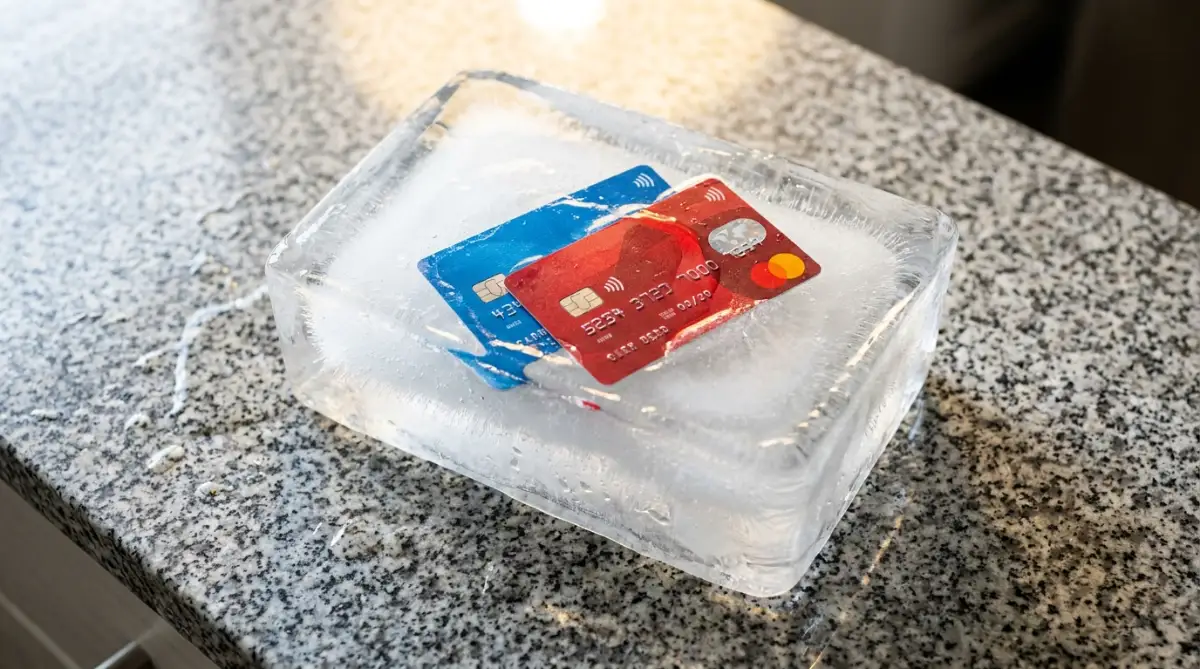
For a deeper look into how lenders view these types of actions, it is smart to spend time understanding unsecured personal borrowing rules. The more you know about how banks calculate risk, the safer you will be.
Do's and Don'ts of Post-Consolidation Life
- Do check your statements monthly: Even if your new loan is on auto-pay, log in every four weeks. Make sure the payment was applied correctly to your principal balance.
- Don't co-sign for anyone: Your credit profile is healing. Never risk your newly organized financial life by taking on the legal burden of someone else's spending habits.
- Do read official consumer resources: The government provides excellent guidelines on handling consumer obligations that can help you understand your legal rights against aggressive lenders.
- Don't apply for new store cards: Retail cashiers are trained to offer you a 20% discount if you open a card at checkout. Politely decline every single time, as these cards carry some of the highest interest rates in the market.

The Silent Traps That Destroy Debt Relief Progress
Even with the best intentions, smart people often fall into invisible traps set by the financial industry. Lenders know that human behavior is largely driven by emotion rather than logic. They design specific pitfalls that look like great opportunities on the surface.
If you step into one of these traps, your entire consolidation effort could completely collapse. Let us look at a real-life scenario to understand how dangerous this can be.
Imagine a woman named Sarah who successfully consolidated $15,000 of high-interest credit card debt into a single, fixed-rate personal loan. She felt incredibly proud of her smart decision. However, six months later, her car broke down and needed a $2,000 repair.
Because Sarah had not built an emergency fund, she reached for one of her old, newly emptied credit cards to cover the mechanic's bill. She promised herself she would pay it off quickly. But life happened, expenses piled up, and she began making only minimum payments on the car repair bill.
By the end of the year, Sarah was paying her monthly consolidation loan AND a new, rapidly growing credit card bill. She essentially doubled her financial burden. This emotional relapse is the single biggest threat to your financial recovery.
The Deferred Interest Time Bomb
Another massive mistake involves promotional financing offers. Many furniture stores or electronics shops offer deals like "Zero Interest if paid in full within 12 months." People often use these to consolidate small consumer debts, thinking they are outsmarting the system.
What the salesperson does not explain clearly is the concept of retroactive interest. If you miss a single payment by just one day, or if you leave a balance of even one dollar after the 12-month period ends, the trap snaps shut.
The bank will instantly charge you all the interest that would have accumulated from the very first day of purchase. Suddenly, a $500 balance balloons into a $900 nightmare overnight. The federal government maintains strict consumer protection standards for banking, but deferred interest contracts are still perfectly legal and highly profitable for lenders.
Frequently Asked Questions About Avoiding Mistakes
Should I use a home equity loan to pay off my credit cards?
This is extremely risky. When you use your home's equity to pay off unsecured credit card debt, you are transferring the risk directly to your shelter. If you lose your job and cannot pay the credit card, your score drops; but if you cannot pay the home equity loan, the bank can foreclose on your house.
Will one late payment on my new loan hurt me?
Yes, significantly. Missing a payment on a brand-new installment loan signals massive financial distress to credit bureaus. It is one of the fastest ways of protecting your long-term credit profile poorly, causing your score to drop by dozens of points almost instantly.
Why do I keep getting mail offers after I consolidate?
Once you pay off large balances, your credit score usually improves. Lenders actively monitor this and will flood your mailbox with "pre-approved" offers to lure you back into their high-interest products. You must shred these letters immediately upon opening them.
Your First 48 Hours: A Blueprint for Total Action
Reading about financial strategies feels productive, but nothing changes until you take physical action. The anxiety you feel about your monthly bills will not disappear on its own. You have the exact knowledge required to fix this problem, and now it is time to execute.
Do not wait until Monday, and do not wait until your next payday. I want you to treat this situation with the urgency it deserves. Here is your specific action plan for the next 48 hours.
Step One: Uncover the exact numbers tonight.
After dinner, sit down with a notebook and log into every single banking app you have. Write down the total balance and the interest rate for each account. You must face the ugly truth on paper before you can cure it.
Step Two: Check your pre-qualified options tomorrow morning.
During your morning coffee, visit two or three highly reputable lending platforms. Use their soft-pull pre-qualification tools to see what kind of fixed-rate personal loans you qualify for. Write down the offered interest rates and compare them to the horrible rates you are currently paying on your credit cards.
Step Three: Freeze your plastic immediately.
Once you see how much money you can save, physically separate yourself from your high-interest cards. Delete the saved card numbers from your internet browser and your favorite shopping apps. Remove the friction of easy spending so you can focus entirely on your new, single monthly payment.
You absolutely have the strength to change your financial path. It requires a few days of uncomfortable planning, but the reward is years of total peace and stability.
Take a deep breath, trust your ability to learn, and start making those power moves today. You are building a secure wall around your money, and your future self will be incredibly grateful for the work you do right now.
Looking back now, taking that scary first step to face my numbers was the single best thing I ever did for my family's peace of mind. I sleep so much better knowing exactly where my money is going, and I promise you will feel that same amazing relief soon. Grab your pen, open those apps, and let today be the day you finally take your financial life back.
Disclaimer: The information provided in this article is for educational and informational purposes only and does not constitute financial, legal, or tax advice. Always consult with a certified financial planner or professional advisor before making any major decisions regarding your personal loans or debt management strategy.