
The 14th of the Month Panic: Why Having Too Many Bills Hurts
Ever look at your checking account on a random Tuesday and realize a massive bill just drained it? It feels awful. When your paydays and your bill due dates do not match up, you end up living in a constant state of low-grade panic. But here is the good news: you can easily fix this messy cycle without making a single extra dollar at your job. Let me show you how to take control of your calendar.
Does this scenario sound familiar to you? You just got your paycheck on Friday. You feel a brief moment of happiness seeing fresh money in your checking account.
But then Sunday evening rolls arouna, and a heavy feeling settles in your chest. You suddenly remember that the car payment is due on the 3rd. The student loan comes out on the 11th. Your personal loan is scheduled for the 18th, and a medical bill needs to be paid on the 26th.
You are not broke, but you feel completely out of control. Keeping track of all these different dates feels like a part-time job. You constantly log into different banking apps just to make sure you did not miss anything.
The worst part is the constant fear of making a mistake. If you accidentally write down the wrong date, a late fee hits your account. That single late fee can cause an overdraft, triggering a domino effect of extra charges from your bank.
If you are tired of living in this constant state of financial anxiety, you are in the right place. Managing multiple accounts does not require a degree in accounting. It simply requires a reliable system that works quietly in the background of your life.
Let us build that system together today. We will set up a protective barrier between your hard-earned money and the chaos of multiple lenders.
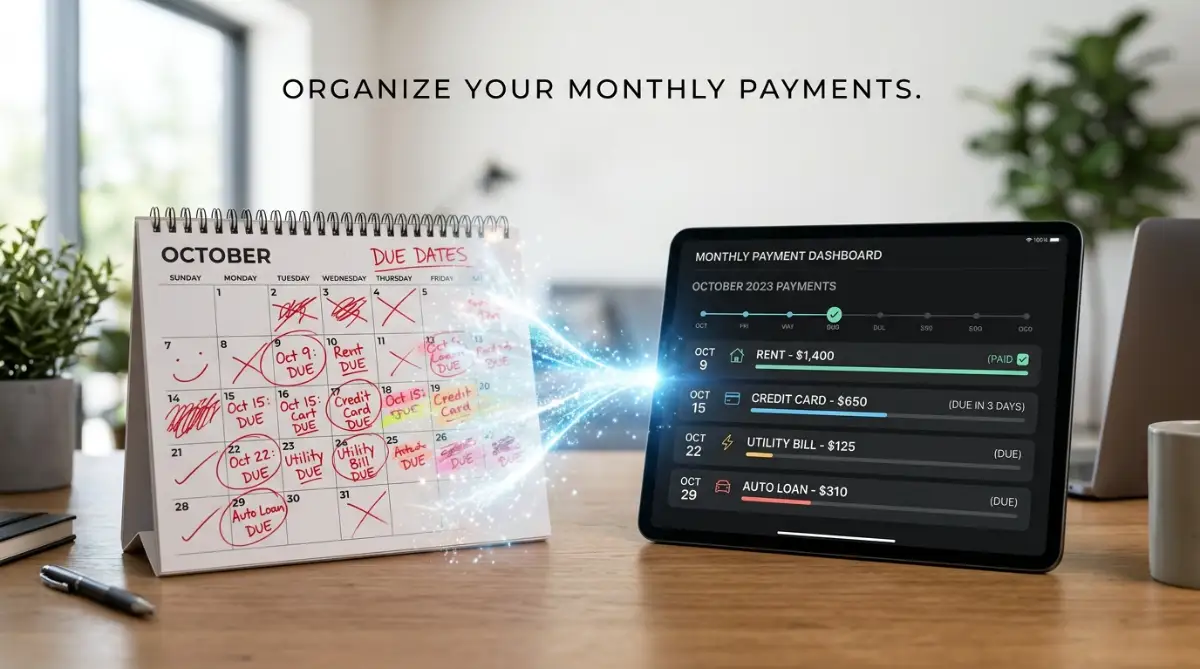
Fast Action Summary: Stop the Bill Panic
- Consolidate all your scattered due dates onto a single sheet of paper so you stop guessing.
- Call your banks and force them to move your due dates to match your actual paydays.
- Open a second, completely free checking account used only for auto-paying loans.
- Keep a $50 cash buffer in your bill account to swallow variable rate changes safely.
Creating Your Personal "Air Traffic Control" Dashboard
When you have airplanes flying all over the sky, you cannot just guess where they are going. You need an air traffic control tower to see everything on one screen. The same logic applies directly to your monthly financial obligations.
Right now, your payment details are scattered across five different websites and three paper envelopes. We need to pull all that data into one central location. This is the very first action you must take to stop the bleeding of your mental energy.
You do not need to buy expensive software to do this. A simple piece of paper or a basic digital spreadsheet works perfectly. The goal is to create a visual map that your brain can easily process in five seconds.
On this map, you will create four specific columns. Write down the name of the lender, the exact minimum payment amount, the specific due date, and the website login link. Having this information on one single page instantly reduces your anxiety.
You no longer have to rely on your memory. When a random Tuesday rolls around, you do not have to wonder if a bill is due. You simply glance at your master dashboard and move on with your day.
The Payday Alignment Strategy: Taking Back Your Schedule
Here is a major secret that banks rarely advertise. You do not have to accept the random due dates they assign to you. In most cases, you have the legal right to change when your bills are due.
Think about how chaotic it is to pay a bill on the 7th, the 14th, the 21st, and the 28th. Your bank account is constantly draining throughout the entire month. This makes it incredibly difficult to know exactly how much money you can safely spend on groceries or gas.
Instead of playing this guessing game, you can align your due dates with your natural cash flow. If you get paid on the 1st and the 15th of the month, your bills should only be due on the 3rd and the 17th.
This creates a highly predictable "money waterfall" effect. Your paycheck lands in your account, the bills are immediately pulled out two days later, and the remaining balance is yours to keep. You never have to worry about a random bill sneaking up on you during the third week of the month.
How to Request a Due Date Change
Many people feel intimidated by the idea of calling their lender. They assume the bank will say no or charge them a fee. This is completely false. Banks want you to pay on time, and they are usually very happy to accommodate a new schedule.
To make this easy, just call the customer service number on the back of your statement. Use this simple, polite script:
"Hello, I am calling to update my account preferences. I currently get paid on the 1st of the month, but my bill is due on the 22nd. I want to permanently change my monthly due date to the 4th so it perfectly matches my payroll schedule."
Most lenders will process this change immediately. Just be aware that it might take one full billing cycle to take effect. During that transition month, you still need to pay close attention to the old date.
The "Change My Date" Cheat Sheet
- Credit Cards: They usually allow you to pick any exact day of the month (like the 4th or 16th).
- Auto Loans: Most car lenders will only let you shift the payment date by 10 to 15 days from the original date.
- Mortgages: These are almost strictly due on the 1st of the month (do not waste time trying to change this one!).
Building the "Bill Pay Buffer" Account
If you are still nervous about mixing automatic payments with your daily spending money, watching a visual breakdown of the separate bill account method will put your mind at ease. Watch the short video below, and then keep reading to learn how to protect your new system from surprise bank fees!
Before I learned to separate my money, I once bought a big load of groceries on a Friday, completely forgetting my utility bill was set to auto-draft the next morning. My account went negative, the bank hit me with a huge penalty fee, and that embarrassing mistake finally forced me to open a separate checking account just for my bills.
One of the biggest fears beginners face is setting up automatic payments. You probably worry that the bank will pull money out right before you buy groceries, leaving your card declined at the store. This fear keeps people paying bills manually, which eats up massive amounts of time.
The smartest way to solve this is by separating your money into two different worlds. You should never pay your bills from the exact same account you use to buy coffee or dinner. Mixing your daily spending with your loan payments is a recipe for disaster.
Instead, open a completely free, secondary checking account at your current bank. Name this account "The Bill Vault." This account will have only one purpose: holding money for your lenders.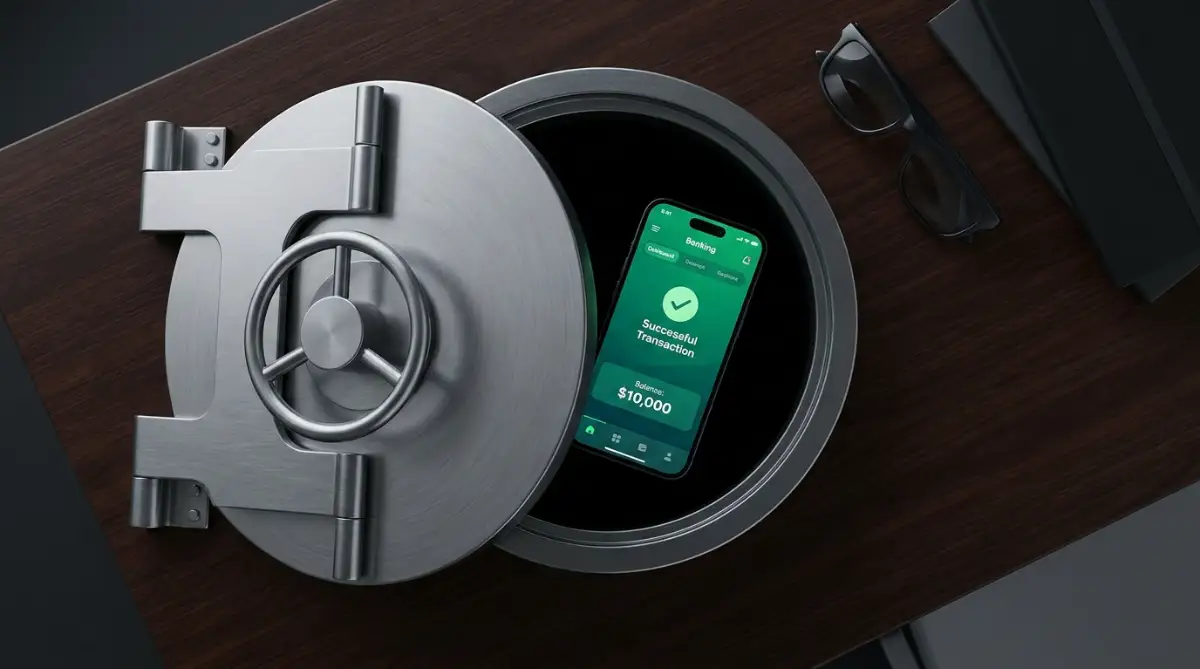
When your paycheck arrives in your main account, you will instantly transfer the total amount needed for your loans into the Bill Vault. You then link all of your automatic loan payments to this specific secondary account.
Because you do not carry a debit card for the Bill Vault, you can never accidentally spend that money at a restaurant. The money sits there perfectly safe until the lender automatically pulls it on the due date.
Quick Math: The Bill Vault Method in Action
Let's say you take home $3,000 a month and your total fixed bills equal $1,200.
On payday, you move exactly $1,200 straight into your Bill Vault. You now have $1,800 left in your main checking account. You can spend that $1,800 on groceries, gas, or having fun without ever worrying about a bounced loan payment!
Myth vs Reality: Automatic Payments
- The Myth: Setting up auto-pay means giving banks total control to drain your account whenever they want.
- The Reality: Auto-pay is heavily regulated. Lenders can only pull the exact agreed-upon amount on the specific date you authorize. By using a secondary "Bill Vault" account, you maintain 100% control over the funds.
Handling the Stress of Variable Interest Rates
Sometimes, managing multiple accounts gets complicated because the monthly amounts change. If you have a credit card or a variable-rate personal loan, your minimum payment might be $105 one month and $108 the next month.
This tiny fluctuation can completely mess up your automated system if you are running a very tight budget. If your Bill Vault only has $105 in it, that extra $3 charge will trigger an overdraft fee.
To completely eliminate this risk, you need to establish a permanent buffer zone. A buffer is a small, protective cushion of extra cash that lives permanently in your Bill Vault.
You do not need thousands of dollars to create a buffer. Start by leaving an extra $50 in that account and pretend it does not exist. This extra cash acts as a shock absorber.
If a variable interest rate pushes your payment up by a few dollars, the buffer absorbs the hit smoothly. You will not get an overdraft fee, and your payment will still process perfectly on time. You simply log in once a month, notice the buffer dropped slightly, and top it back up to $50.
The Psychological Win of "Set and Forget"
Imagine waking up on a Saturday morning and not thinking about money. You drink your coffee, go for a walk, and enjoy your weekend in total peace. This is the true benefit of setting up a structured management plan.
When you group your due dates together, use a secondary bill account, and add a small buffer, your finances run on autopilot. You are no longer reacting to demands from banks. You have designed a proactive machine that handles the heavy lifting for you.
This shift in strategy does something incredible to your confidence. You start to view yourself as someone who is good with money. That identity shift is incredibly powerful.
When you feel in control of your daily obligations, you naturally start making better decisions about your future. You might finally feel brave enough to start an emergency fund or look into saving for a house.
The hardest part is simply taking the time to write everything down on day one. Once the dashboard is built and the auto-pays are directed to the right place, the anxiety melts away. You have built a solid foundation that will protect your credit score and your mental health for years to come.
Mastering the Long Game of Financial Organization
Setting up your initial payment dashboard is an amazing first victory. However, the real magic happens when you turn that basic system into a long-term habit. Many beginners start strong but slowly abandon their tracking methods after a few months.
To prevent this, we need to implement a few expert-level strategies that keep you engaged without feeling overwhelmed. These are the exact methods professional financial advisors use to keep their clients on track. They require very little effort but produce massive results over time.
The Power of the Bi-Weekly Micro-Adjustment
Most people structure their lives around a monthly calendar. They look at their budget once every thirty days, which leaves a huge gap for mistakes to happen. If a problem occurs on the 5th of the month, you might not notice it until the 30th.
Instead of waiting an entire month, I highly recommend adopting a bi-weekly check-in routine. This simply means logging into your master dashboard every fourteen days. You do not need to do any heavy math during this session.
Your only goal is to spend exactly three minutes looking at the screen. Verify that your recent automatic payments went through properly. Make sure your "Bill Vault" account has enough money for the next two weeks.
This tiny habit keeps your financial awareness incredibly sharp. It is similar to checking the oil in your car; a quick glance prevents a massive breakdown later on.
Applying the "Round-Up" Psychological Hack
If you want to pay down your balances faster without feeling the pinch in your daily budget, you need to use the round-up trick. When people hear the phrase "extra payments," they usually imagine sending an extra $100 or $200. That amount feels intimidating for a beginner.
Instead, look at your minimum required payment. If your car loan demands $283 a month, change your automatic payment to an even $300. You are only adding $17 extra, which you will barely notice missing from your checking account.
However, that tiny $17 goes directly toward the principal balance of the loan. Over the life of a standard auto loan, that small adjustment can shave off several months of payments. It also saves you a significant amount of money in interest charges.
To fully grasp why this works so well, it is helpful to look into the hidden reality of unsecured personal loans revealed by financial experts. Understanding how banks calculate daily interest gives you a massive advantage.
Expert Insight: Protecting Your Emotional Energy
Managing debt is not just a mathematical equation. It is a deeply emotional journey that can drain your energy if you do not protect yourself. Financial anxiety is a recognized psychological burden.
According to research published by the FINRA Investor Education Foundation, individuals who use automated tracking systems report significantly lower levels of daily stress. When you remove the burden of remembering due dates, your brain actually relaxes.
You stop associating the mail carrier with fear. You no longer dread answering unknown phone calls. This emotional freedom is the true reward of organizing your multiple accounts.
Do's and Don'ts of Long-Term Management
- Do celebrate small wins: When you successfully pay off one of your smaller accounts entirely, treat yourself to a nice coffee or a movie. Positive reinforcement builds excellent habits.
- Don't close accounts immediately: If you pay off a credit card, leave the account open but cut up the physical plastic. This protects your credit utilization ratio.
- Do update your passwords: Once a year, change the login passwords for all your financial apps to keep your dashboard secure.
- Don't ignore the mail entirely: Even with a digital dashboard, you still need to open physical letters from your bank. They might contain important legal updates about your contract.

The Invisible Traps That Ruin Your Payment System
Even with a beautiful, automated dashboard, you are still human. Humans get comfortable, and comfort often leads to small mistakes. When dealing with multiple lenders, a small mistake can quickly turn into a highly expensive disaster.
Lenders are constantly waiting for you to slip up. Their entire business model relies on charging you late fees and penalty interest rates. Let us walk through the most common pitfalls so you can actively avoid them.
The "Set and Forget" Illusion
Automation is an incredible tool, but it is not completely foolproof. The biggest mistake beginners make is trusting the computer blindly. They set up auto-pay in January and completely ignore their accounts until December.
Technology breaks all the time. Sometimes a bank will perform a software update that accidentally deletes scheduled payments. Other times, the debit card linked to your automatic payment expires, and the payment simply bounces.
When a payment bounces, the bank does not care that it was a technical glitch. They will immediately hit you with a $35 returned payment fee. They will also charge you a late fee, doubling your financial pain in a single day.
If that payment remains unpaid for thirty days, they will report it to the credit bureaus. This is one of those silent credit score killers ruining your chances for a mortgage approval in the future. You must always act as the final supervisor of your own money.
A Real-Life Scenario: The Danger of Co-Mingling
Let us look at a practical example of how quickly things can go wrong. Consider a guy named Mark who decided to organize his four different credit cards. He wrote down all the due dates, but he refused to open a separate "Bill Vault" checking account.
He kept all his bill money right next to his grocery and entertainment money. One Friday night, Mark went out to dinner with friends. He checked his banking app, saw $400 in his account, and assumed he was totally safe to buy a nice meal.
He completely forgot that his $150 student loan payment was scheduled to pull automatically on Saturday morning. By the time Monday rolled around, his account was overdrawn. The bank hit him with a massive overdraft fee, and his student loan payment failed.
Mark's entire week was ruined by extreme stress. He had to borrow money from a family member just to cover the negative balance. All of this emotional pain could have been completely avoided if he simply separated his bill money from his spending money.
The Minimum Payment Comfort Zone
When you finally organize your chaos, seeing those low minimum payments feels like a huge relief. You might feel tempted to just pay those minimums forever because it keeps your monthly budget loose. This is a very dangerous psychological trap.
Paying only the minimum requirement is exactly what the bank hopes you will do. It maximizes the amount of interest you pay over the long run. Educational data provided by the National Foundation for Credit Counseling consistently shows that paying only minimums can extend a simple balance for over a decade.
Once your system is stable and running smoothly, you must shift from defense to offense. You need to pick the account with the highest interest rate and start attacking it aggressively. Use the dashboard you created to track your progress as that specific balance drops faster than the others.
Ignoring Changes in Variable Rates
If you have a loan with a variable interest rate, your minimum payment is not actually fixed. It will move up or down depending on the broader economy. If the central banks raise rates, your required payment will suddenly jump higher.
Many people miss the notification letter from their bank explaining this change. Their auto-pay sends the old, smaller amount, leaving a tiny unpaid balance on the account. That tiny unpaid balance then triggers a massive late fee the following month.
You must read every single email and letter your lender sends you. If you see a notice about a rate adjustment, log into your dashboard immediately and update your records. Adjust your auto-pay amount that exact same day so you do not forget.
Your 48-Hour Implementation Checklist
You must take physical action before the motivation fades away. The anxiety of disorganized bills is heavy, but the relief of a structured system is incredibly light. I want you to experience that lightness starting right now.
To make this completely stress-free, I have broken down your next steps into a simple checklist. Do not try to do everything at once. Just follow these instructions over the next two days.
Day One: The Information Gathering Phase
Tonight, grab a notebook and your favorite pen. Log into every single account where you owe money. Write down the lender's name, the current balance, the minimum payment, and the exact due date.
Do not judge the numbers, and do not panic about the totals. Your only job tonight is to collect the data and put it on one single page. Once you finish writing, close the notebook and go enjoy your evening.
Day Two: The System Setup Phase
Tomorrow morning, open a free, secondary checking account with your current bank. Transfer enough money into it to cover your upcoming bills for the next two weeks. Finally, log into your loan accounts and switch your automatic payments to pull directly from this new "Bill Vault."
You have just built a permanent wall between your living expenses and your debts. The process of getting organized is the first major step toward true financial independence. If you want to continue growing your knowledge, exploring what building real online wealth takes is an excellent next move.
You absolutely have the power to take control of this situation. Stop letting the banks dictate your stress levels. Build your dashboard, automate your payments safely, and take your life back today.
Getting my bills organized finally gave me the breathing room to actually enjoy my weekends without checking my banking app every hour. If I can go from drowning in late fees to running a smooth automatic system, I know you can absolutely do it too. Grab a pen, start your checklist today, and watch how quickly that heavy money stress simply disappears.
Disclaimer: The information provided in this article is for educational and informational purposes only and does not constitute financial, legal, or tax advice. Always consult with a certified financial planner or professional advisor before making any major decisions regarding your personal loans or debt management strategy.