The Nightmare of the Endless All-Nighter
I will never forget the physical pain of my third-year biology final. It was 4:00 AM, my eyes were burning from staring at my laptop screen, and my hands were actually shaking from drinking three energy drinks back-to-back. I was desperately trying to shove six weeks of scientific terms into my brain in a single night. I felt completely miserable, highly anxious, and deeply terrified that I was going to fail anyway. When I finally sat down to take the test a few hours later, my mind just went completely blank.
I stared at the paper, reading the exact same question five times, but the words looked like a foreign language. I had spent twelve hours "studying," yet I could not recall a single basic concept. That terrible morning changed my entire perspective on how we are taught to handle academic pressure.
Have you ever noticed how students almost brag about how little they sleep during exam week? We walk around campus looking like absolute zombies, wearing our dark under-eye circles like a weird badge of honor. We truly believe that if we are not suffering, we are not working hard enough.
This toxic mindset completely destroys our mental peace. We feel intensely guilty the moment our head hits the pillow, thinking about all the flashcards we should be reading. The anxiety builds up in our chests, making it impossible to relax even when we try to take a break.
We end up in a terrible cycle of fake studying. We sit at our desks for ten hours, but our exhausted brains only absorb about twenty minutes of actual information. Then, because we feel unprepared, we stay up even later the next night.
You absolutely do not have to torture yourself to get excellent grades. In fact, sacrificing your rest is the exact reason you are struggling to remember your notes. We are going to completely flip the script today. I am going to show you exactly how to organize your days so you can master your material and still get your full eight hours of beautiful, uninterrupted rest.
Why Exhaustion is Destroying Your Memory
To build a schedule that actually works, we first have to understand what happens inside your head when you close your eyes. Most students treat sleep like a luxury, something they will catch up on after the semester ends. This is a massive scientific mistake.
Think of your brain like a busy office desk. During the day, as you read textbooks and listen to lectures, you are piling messy paperwork all over that desk. By the evening, the desk is completely covered in random notes, loose papers, and sticky notes.
When you finally go to sleep, a tiny imaginary librarian walks into your brain. This librarian takes all those messy papers off the desk, organizes them neatly, and files them away into permanent filing cabinets. This physical filing process is called memory consolidation.
If you pull an all-nighter, the librarian never shows up to work. You go into your exam with a messy, chaotic desk. This is exactly why you can read a paragraph five times at 3 AM and instantly forget it by 9 AM. Your brain literally needs deep sleep to hit the "save" button on your hard work.
Once you truly understand this concept, you stop viewing sleep as wasted time. You start seeing a full night of rest as the most powerful study tool in your entire arsenal. Your goal is no longer to stay awake as long as possible. Your new goal is to study efficiently during the day so the librarian can do their job at night.
The Art of Reverse Engineering Your Syllabus
Now that we know we have to protect our sleep, how do we actually fit all the work into our waking hours? The biggest mistake people make is sitting down and just reading randomly from chapter one. This leads to immediate panic when you realize you have ten chapters left and only two days to go.
Instead of moving forward blindly, you need to work backward from your exam date. Take out a blank piece of paper and write down the exact date and time of your test. Now, count exactly how many days you have between today and the exam.
Let us say you have exactly fourteen days until your big history final. The next step is to grab your syllabus and count the total number of topics, chapters, or lecture slides you need to master. If you have twenty-eight specific topics to cover, the math becomes incredibly simple.
You need to master exactly two topics per day. Suddenly, that massive, terrifying mountain of work becomes a very small, highly manageable daily task. You do not have to worry about the whole mountain anymore. You only have to focus on today's two topics.
This simple math immediately removes the heavy anxiety from your chest. You know exactly what success looks like for today. Once you finish those specific topics, you have full permission to close your books, relax, and go to bed without a single drop of guilt.
Mapping Out Your Biological Prime Time
We all have specific hours of the day when our brains feel sharp, focused, and highly energetic. Some people love waking up at 5 AM to read, while others do their best critical thinking right after lunch. This natural window of high energy is your biological prime time.
If you try to study your hardest subject when your energy is naturally low, you will just stare at the wall. A chapter that should take you forty-five minutes will drag on for three painful hours. You will get frustrated, grab your phone, and start scrolling through social media just to escape the boredom.
To prevent this massive waste of time, you need to match your hardest tasks to your highest energy windows. Spend a day just noticing how your body feels. When do you naturally want coffee? When do you feel sleepy?
If you realize your brain is incredibly sharp at 10 AM, you must protect that hour with your life. Do not use your prime time to organize your desk, highlight your notes, or casually chat with your roommates. Use that specific golden hour to tackle the most difficult math formulas or the heaviest reading assignments.
Save the easy, passive tasks for your low-energy hours. When you feel that afternoon slump hitting around 3 PM, that is the perfect time to organize your flashcards or review things you already know well. Matching your tasks to your energy levels helps you get double the work done in half the time.
Want to instantly double your daily focus?
Understanding how to block your time is totally useless if you cannot actually sit still and concentrate. Check out this quick, highly effective breakdown on how to train your brain to stay completely locked onto your study materials without getting distracted.
Ditching Passive Reading for Active Combat
We need to address a very uncomfortable truth about how most people study. If your main strategy is just re-reading your textbook and highlighting sentences with a bright yellow marker, you are totally wasting your time.
Science calls this "passive review," and it is the least effective way to learn anything. It feels like you are studying because your eyes are moving across the page, but your brain is actually on autopilot. You are just recognizing the words, not actually remembering them.
This is exactly why students feel they need ten hours a day to prepare. They are using an incredibly weak tool to dig a massive hole. We need to upgrade your tools immediately by switching to active recall.
Active recall means forcing your brain to retrieve information from scratch. Instead of reading a chapter about the human heart, you close the book completely. Then, you grab a blank piece of paper and try to draw and label the entire heart purely from memory.
When you get stuck, that specific moment of struggle is where true learning actually happens. You open the book, find the exact detail you forgot, and then close it again. Testing yourself constantly builds incredibly strong neural pathways in your brain.
Two hours of intense active recall will give you better results than seven hours of passive reading. By studying with highly aggressive methods, you drastically cut down the amount of time you need to sit at your desk. This creates plenty of room in your schedule to hit the gym, eat a proper dinner, and sleep soundly.
The Power of the Hard Cut-Off Time
Even with a perfect schedule, ambitious students tend to let their study sessions bleed into the night. You tell yourself you will just finish one more page, and suddenly it is midnight. To protect your sleep, you have to establish a strict, non-negotiable cut-off time.
Think of your study space like a retail store. The store has clearly posted business hours, and when the clock strikes closing time, the doors lock. Your brain needs this exact same boundary to properly wind down.
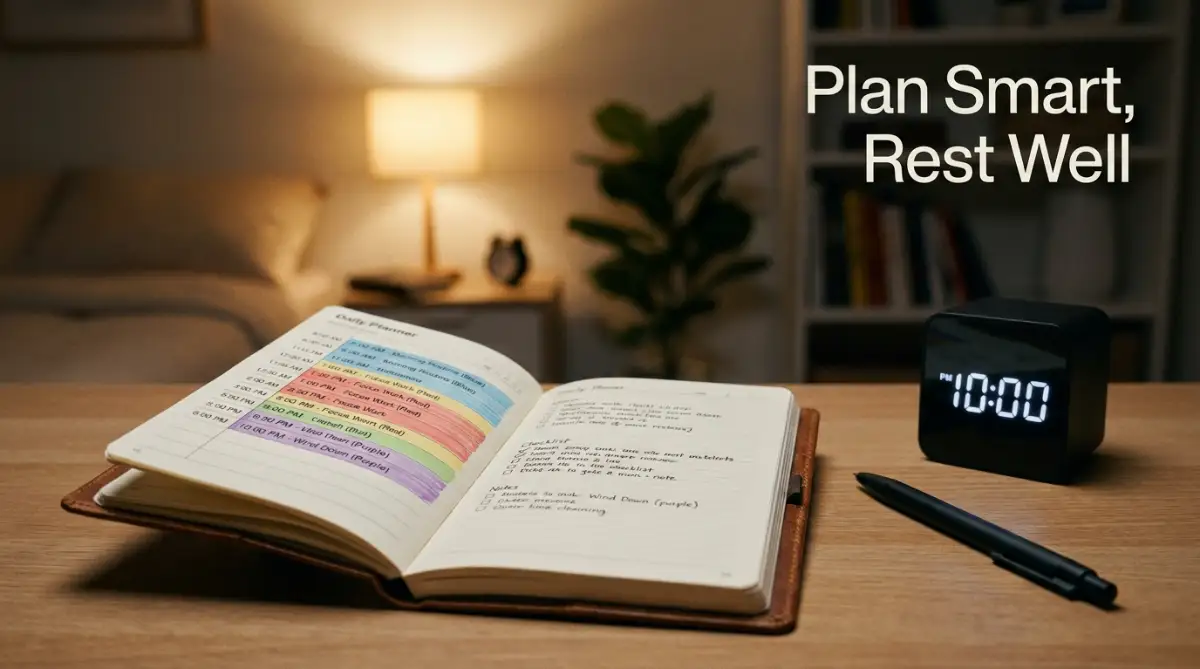
If you want to be asleep by 11:00 PM, your study session absolutely must end by 9:30 PM. You cannot go from intense academic focus straight into a deep sleep. Your nervous system needs time to cool off and realize the workday is officially over.
I used to think studying right up until the minute I closed my eyes was the smartest move. I thought I was maximizing every single second. Then I realized my brain was so wired with anxiety that I would just toss and turn in the dark for two hours anyway. Now, I forcefully shut my laptop a full ninety minutes before bed, and I actually fall asleep the moment my head hits the pillow.
During this wind-down period, step completely away from your study area. Do not study on your bed, because your brain will start associating your mattress with academic stress. Take a warm shower, read a fictional book, or just listen to some calm music.
When you respect your own closing time, you build immense trust with yourself. You know that no matter how stressful the exams are, you will always protect your physical health. This removes the dread of studying because you know exactly when the pain will end for the day.
Mastering Your Mind: Next-Level Exam Strategies
Once you have a solid schedule on paper, you have to maximize the actual minutes you spend sitting at your desk. Many students sit down for three hours, but their brain checks out after the first forty-five minutes. You can completely avoid this mental fatigue by using a few highly advanced cognitive tricks.
Instead of staring at a single subject all day, try mixing two different topics together. Cognitive psychologists call this practice interleaving, and it is a massive game-changer for your memory. According to educational guidelines from the American Psychological Association, mixing different types of problems forces your brain to constantly adapt and stay highly alert.
For example, do not study chemistry for four hours straight. Study chemistry for one hour, switch to history for the next hour, and then go back to chemistry. This constant shifting stops your brain from getting bored. It feels a little bit harder in the moment, but you will remember the facts significantly better the next morning.
You also need to become incredibly strict about your study environment. Your bedroom should be a sanctuary for sleep, completely separate from your academic stress. If you study in bed, your brain starts associating your pillows with exam anxiety, which completely ruins your sleep quality at night.
Try to do your most intense reading at a local library, a quiet coffee shop, or a dedicated desk. When you leave that specific location, you leave your stress behind. Top academic advisors at Stanford University Learning Lab constantly remind students that changing physical locations can drastically improve their ability to focus on complex materials.
If you want to remember things permanently, you have to let go of old, comfortable habits. Constantly repeating the same definitions out loud might feel productive, but it is actually a massive waste of time. Once you understand why rote memorization is killing your grades, you will naturally switch to smarter methods like taking practice tests.
Another incredible secret is learning how to leverage strategic breaks. Your brain physically cannot process new information for hours without a pause. Try setting a timer for fifty minutes of intense work, followed by a mandatory ten-minute break where you walk away from your screen.
During this short break, do not look at your phone. Go get a glass of water, stretch your legs, or look out a window. This tiny reset prevents the heavy mental fog that usually hits around the third hour of reading.
Finally, do not underestimate the power of teaching someone else. When you try to explain a complex theory to a friend or even to your dog, you instantly realize which parts you do not actually understand. If you can explain a topic simply, your brain has successfully locked that information into your permanent memory.

The Silent Saboteurs Ruining Your Hard Work
Even with a perfect calendar and eight hours of sleep, certain hidden habits can completely derail your progress. We often do things that feel productive in the moment, but they are secretly sabotaging our final grades. Let us look at the most dangerous traps you must avoid during finals week.
The Illusion of Pretty Productivity
Have you ever spent two hours perfectly color-coding your notebook with expensive highlighters? You probably felt incredibly accomplished afterward. The harsh reality is that making your notes look beautiful is just a sneaky form of procrastination.
While you were drawing perfect titles, you were not actually testing your memory. This is one of those silent note-taking mistakes that tricks your brain into thinking you studied. You must separate organizing your materials from the actual act of learning the concepts.
Spend exactly ten minutes gathering your papers and pens. After that, your focus must shift entirely to active recall and practice questions. Messy notes that you actually understand will always beat beautiful notes that you just stare at blankly.
The Toxic Group Study Trap
Studying with friends sounds like a fantastic idea on paper. You can share notes, quiz each other, and keep morale high. However, unless your group is highly disciplined, these sessions almost always turn into a social hour.
You sit down to review economics, but ten minutes later, someone brings up a funny video or campus drama. Before you know it, three hours have passed, you have eaten a whole pizza, and you have not learned a single economic formula. The guilt hits you as soon as you walk back to your dorm room alone.
If you choose to study in groups, you must set incredibly strict ground rules. Agree to work in complete silence for an hour, and then use your ten-minute break to chat and catch up. If your friends cannot respect the silent focus time, you must protect your grades and study entirely alone.
Destroying Your Biological Clock with Caffeine
When we feel tired in the late afternoon, our first instinct is to grab a massive iced coffee or a chemical-filled energy drink. While caffeine gives you a quick burst of focus, using it at the wrong time completely destroys your goal of getting eight hours of rest.
Caffeine has a surprisingly long half-life in your body. If you drink a strong coffee at 4:00 PM, half of that caffeine is still actively bouncing around your bloodstream at 10:00 PM. According to sleep hygiene experts at the Centers for Disease Control and Prevention, late-day caffeine is the primary reason young adults struggle with severe insomnia.
You might successfully fall asleep, but the caffeine prevents your brain from entering the deep sleep cycles required for memory consolidation. You will wake up feeling groggy, confused, and desperate for even more coffee.
To break this terrible cycle, set a hard caffeine cut-off time at 2:00 PM. If you feel a heavy slump in the late afternoon, try drinking cold water, doing twenty jumping jacks, or stepping outside for fresh air. Your natural energy will return, and your sleep schedule will remain perfectly intact.
The Disaster of Split Attention
We live in a world where we think we can do five things at once. You might try to watch a lecture video while texting your roommate and keeping a movie playing quietly in the background. You think you are being highly efficient.
In reality, the human brain is completely incapable of processing multiple complex tasks simultaneously. When you jump between your phone and your textbook, your brain has to constantly restart its focus engine. You can read more about how multitasking ruins your study sessions to understand the massive tax it puts on your daily energy.
Put your phone in a completely different room when you sit down to work. If you need it for emergencies, turn on the "Do Not Disturb" mode and throw it inside a closed drawer. When you eliminate all background noise, a task that normally takes three hours can easily be finished in just ninety minutes.
Pushing Through the Pain of Burnout
Some students have an incredibly high tolerance for academic pain. They will force themselves to stare at a computer screen even when their eyes are watering and their head is pounding. They believe that taking a day off makes them lazy or weak.
Ignoring your body's physical warning signs leads directly to a complete mental crash. When you hit that wall, you will not be able to study for days, which totally destroys your carefully planned schedule. Learning how to beat severe academic burnout requires you to actively schedule days where you do absolutely nothing related to school.
If you mapped out your calendar correctly in the beginning, you should easily have enough time to take a full Sunday off. Go for a long walk, watch a movie, and let your brain completely decompress. You will return to your desk on Monday morning feeling incredibly sharp, motivated, and ready to dominate your exams.
Your Blueprint for a Stress-Free Finals Week
Finals week does not have to be a dark, depressing time filled with panic attacks and sleep deprivation. You now have the exact tools needed to completely take control of your academic life.
By working backward from your test dates, you can break massive textbooks into small, friendly daily tasks. You know exactly how to match your hardest subjects to your peak energy hours. Most importantly, you understand that sleeping for eight hours is not a sign of weakness, but a biological requirement for scoring top grades.
You no longer have to rely on passive reading or pretty highlighters. You can attack your material with active recall, secure your knowledge, and confidently close your books at a reasonable hour. When you respect your personal boundaries, learning actually becomes a highly rewarding experience.
I remember the exact moment I stopped pulling all-nighters, and it honestly felt like a massive weight lifted off my chest. I started walking into my final exams feeling deeply rested, totally calm, and ready to show off what I knew. You absolutely deserve to experience that same peace of mind, so grab your calendar right now and start claiming your sleep back!
Common Questions About Exam Sleep and Study Schedules
Is six hours of sleep enough during finals week?
No, six hours is rarely enough for your brain to fully process and store complex academic information. Most adults need a full eight hours to complete all the necessary deep sleep cycles. Cutting your sleep short directly harms your ability to recall facts the next morning.
How do I fall asleep if I am stressed about a test?
You must create a strict buffer zone before bed by stopping all study activities ninety minutes before you want to sleep. Write down all your anxious thoughts on a piece of paper to get them out of your head. Taking a warm shower or listening to calm music also helps signal to your body that the workday is officially over.
Should I wake up early to cram on the day of the exam?
Waking up early just to frantically read new material usually causes massive anxiety and panic. If you followed your daily schedule, you already know the material perfectly well. Wake up at your normal time, eat a healthy breakfast, and trust the hard work you have already done.
What if I accidentally fall behind on my study schedule?
Do not panic or try to squeeze three days of work into one completely sleepless night. Look at your remaining topics and ruthlessly prioritize the most heavily weighted subjects. Adjust your schedule calmly, focus on the biggest concepts, and still protect your strict bedtime.
Disclaimer: The information provided in this educational guide is for informational purposes only and is based on general study techniques and sleep hygiene practices. It does not replace professional academic advising or medical advice regarding severe sleep disorders or chronic anxiety. Always consult with your university counselors, professors, or a licensed healthcare provider if you are experiencing severe academic distress or mental health challenges.