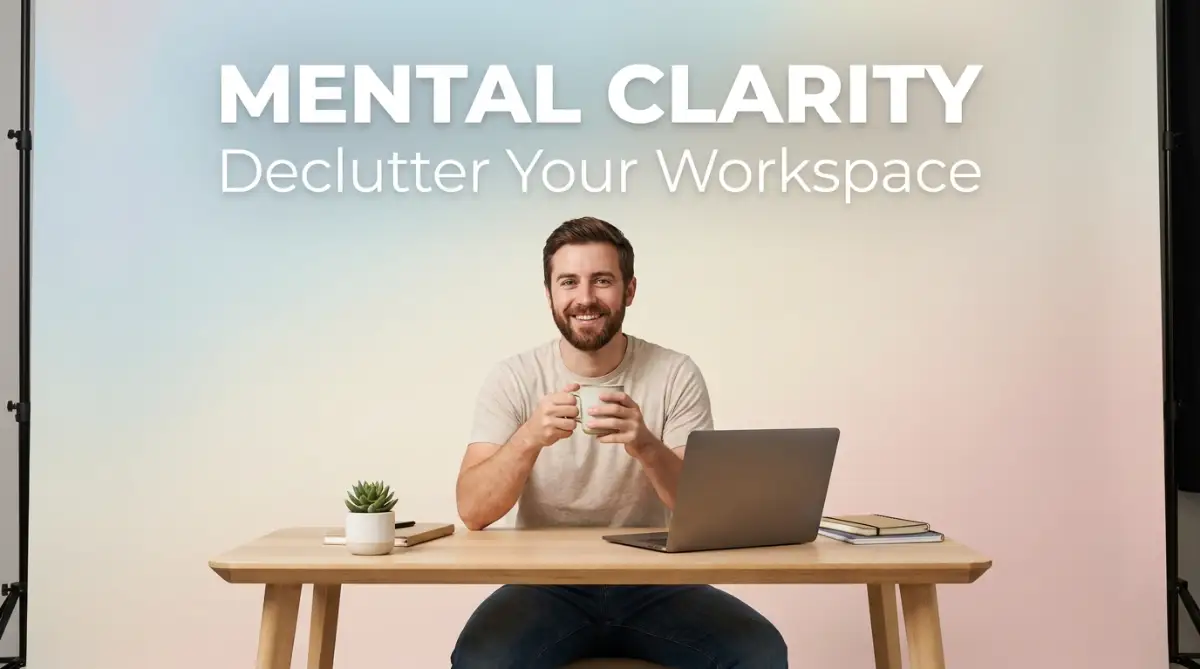
The Heavy Weight of an Unorganized Life
You sit down at your desk with a massive coffee, fully intending to crush your to-do list, but you instantly feel exhausted. You stare at the random mail, the empty mugs, and the tangled charging cables scattered everywhere, and your brain just shuts down. I used to think I was just a lazy procrastinator until I realized my messy desk was secretly spiking my cortisol levels and draining my energy before I even typed a single word. If your chaotic workspace is silently killing your focus and making you feel stressed all day long, let me show you the simple psychological tricks to clear your desk and your mind today.
I kept telling myself I would clean it up later, but later never actually came. The physical mess was slowly turning into a heavy mental block that ruined my daily productivity and joy. I felt constantly exhausted before my workday even started, just by looking at that chaotic pile of paper.
Millions of people face this exact same invisible barrier every single morning in their own homes. We sit down to work, hoping for a highly productive day, but our eyes are immediately pulled toward the surrounding clutter. This constant visual distraction quietly drains your mental energy without you even realizing what is happening.
People often blame themselves for being lazy or lacking discipline when they cannot finish their daily tasks. The reality is that your brain simply cannot process deep, meaningful thoughts when it is surrounded by physical junk. The stress hormone cortisol naturally rises when we are placed in a messy, disorganized space.
This automatic chemical reaction makes relaxing or feeling creatively inspired almost impossible for anyone. The good news is that fixing this hidden problem does not require a week-long cleaning marathon. Making tiny shifts in how you organize your physical environment can completely change how your mind operates.
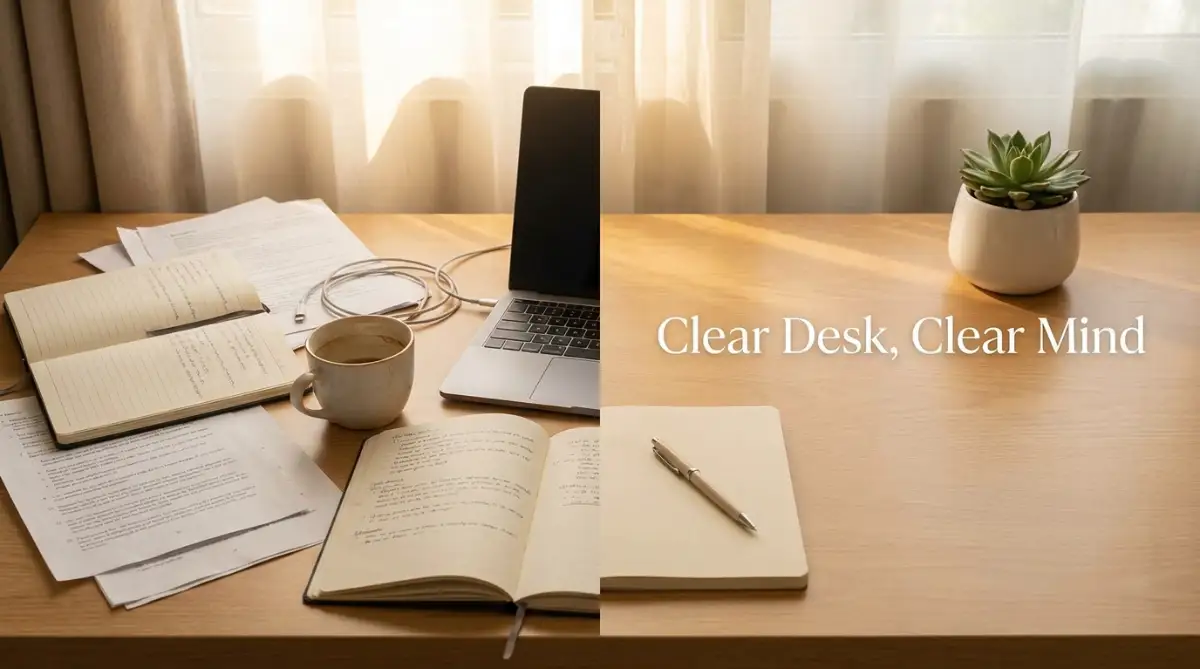
Your Quick Guide to a Stress-Free Workspace
- The Brain Drain: Physical clutter acts exactly like having 100 tabs open on your computer. It drains your mental energy and directly spikes your stress hormone (cortisol).
- The Blank Canvas Method: Don't try to organize a mess. Take every single item off your desk, wipe it down, and only put back the 3 things you actually use today.
- The One-Touch Rule: Never pick up a piece of paper and set it back down. When you touch a bill or a letter, immediately file it, pay it, or throw it away.
- The Closing Shift: Take exactly 5 minutes at the end of your workday to reset your desk to zero. Your tomorrow-self will thank you.
Why Your Brain Hates Physical Mess
To truly fix this problem, we need to understand exactly how our minds react to our surroundings. Think of your brain like a highly advanced computer trying to process thousands of small details at once. When you have too many tabs open on your web browser, the computer naturally slows down and freezes.
A messy room acts exactly like a computer with a hundred open tabs, draining your internal battery. Every single item sitting on your desk silently demands a tiny piece of your attention. That old receipt reminds you of money you spent, and that empty mug reminds you of a dish you need to wash.
All these silent demands overload your visual cortex, which is the part of your brain that processes what you see. Science tells us that clearing away these visual distractions physically lowers your heart rate and reduces stress. When you remove the junk, you instantly give your brain the breathing room it desperately needs to function properly.
The "Blank Canvas" Method for Immediate Relief
One of the best ways to completely reset your mental state is to start from absolute zero. Instead of trying to clean around your current mess, you need to clear the space entirely. Take every single item off your desk and place it in a large box on the floor.
Wipe down the empty surface with a nice-smelling cleaner and just look at that beautiful, blank space for a moment. Notice how much lighter your chest feels when there is nothing screaming for your attention. From this point forward, you only put back the items you actually need to complete today's work.
If you are struggling to keep your desk organized, watching this simple visual breakdown will completely change your daily routine.
This method completely shifts your psychology from "managing a mess" to "intentionally designing a workspace." You will quickly realize that you only actually use about three things on a daily basis. Everything else in that box can easily go into a drawer, a closet, or directly into the trash can.
My 5-Minute "Ruthless Purge" Checklist:
Grab a trash bag right now and throw away these exact items:
- Any dried-out pens or highlighters you have been keeping "just in case."
- Fast-food receipts or sticky notes that are older than 48 hours.
- Coffee mugs that have been sitting there since yesterday morning.
- Broken charging cables that you have to twist at a weird angle to make work.
Sorting the Chaos with the Three-Box Strategy
When you finally decide to tackle the remaining items, you might feel a sudden wave of panic. Decision fatigue is a real psychological condition where your brain simply gets tired of making choices. To avoid this overwhelming feeling, you can use the highly effective three-box sorting strategy.
Label three separate cardboard boxes as "Keep," "Donate or Sell," and "Trash." Pick up an item from your messy pile and force yourself to place it into one of these three boxes immediately. Do not allow yourself to create a "maybe" pile, because that just creates another future mess to deal with.
I used to just shove everything into a single desk drawer to make the top look clean for a few days. My best tip is to use small cardboard boxes to actively categorize items, which literally saved my sanity during busy workdays. When everything has a specific home, your brain stops worrying about where things belong.
Cluttered Space vs. Clean Space: A Mental Comparison
Understanding the exact difference between these two states can highly motivate you to maintain your new habits. Let us look at a simple comparison of how your brain reacts to different environments.
Managing Digital Clutter for Total Peace
We often focus entirely on physical objects and completely forget about the glowing screens in front of us. Your digital environment plays a massive role in your overall psychological health and daily anxiety levels. A computer desktop covered in hundreds of random files creates the exact same stress response as a messy physical room.
Take a few minutes today to delete those old screenshots and organize your important documents into clearly labeled folders. Change your computer background to a calming image of nature or a simple solid color. This small digital change instantly signals to your brain that it is time to work peacefully.
You should also aggressively clean out your email inbox, as unread messages act like unfinished chores hanging over your head. Unsubscribe from newsletters you never read and delete promotional emails that just cause you stress. A clean digital workspace beautifully complements your clean physical desk, creating a powerful zone of deep focus.
The Power of the "Closing Shift" Routine
Many people struggle to keep their workspace clean because they treat organization as a massive, rare event. They wait until their office is completely destroyed before they finally decide to clean it up. The secret to long-term success is treating your personal desk just like a professional coffee shop.
In the service industry, workers always perform a "closing shift" routine before they go home for the night. They wipe the counters, wash the tools, and prepare everything for the next morning's opening shift. You can easily apply this exact same psychological trick to your own daily work routine.
Take exactly five minutes at the end of your workday to reset your entire space to zero. Throw away your trash, put your pens back in their cup, and neatly stack any important papers. When you sit down the next morning, you will feel a massive wave of relief instead of instant stress.
Personalizing Without Creating New Clutter
Once your space is perfectly clean, you might feel the urge to decorate it to make it feel more welcoming. Adding personal touches is a wonderful way to boost your mood and make your office feel safe. However, you must be extremely careful not to accidentally recreate the mess you just spent hours removing.
Limit yourself to one or two highly meaningful items, like a framed family photo or a small green plant. Plants are scientifically proven to reduce stress and improve indoor air quality, making them perfect desk companions. Avoid adding multiple funny coffee mugs, extra toys, or useless gadgets that just take up valuable surface area.
The Incredible Ripple Effect on Your Life
The most amazing thing about decluttering your workspace is that the positive effects never stay in just one room. When you experience the deep psychological relief of a clean desk, your brain naturally wants more of that feeling. You will suddenly find yourself organizing your kitchen counters, your bedroom closets, and your car.
This creates a beautiful snowball effect where your entire living environment slowly becomes a sanctuary of peace. As your physical spaces become lighter, your mind naturally follows that exact same pattern. You will notice that you are sleeping much better at night because your brain is no longer quietly worrying about unfinished chores.
Your relationships might even improve because you are no longer carrying that heavy, invisible stress around with you all day. You will have more patience with your children, your partner, and even your pets. All of this incredible personal growth starts simply by throwing away the trash on your desk today.
Advanced Psychology for a Permanently Peaceful Workspace
Once you clear away the initial surface junk, you have to protect that clean space like a personal sanctuary. Maintaining an organized desk is completely different from cleaning it just once on a random Sunday afternoon. To keep this mental clarity forever, we have to look deeper into how human habits actually work.
The most successful people do not rely on sheer willpower to keep their environment perfectly neat. Instead, they build invisible, highly functional systems that make being messy practically impossible. Let me share some deeply psychological strategies that will completely change how you view your personal working environment.
The Brilliant Concept of "Zone Mapping"
Your brain is incredibly sensitive to physical movement and the amount of effort required to complete a task. When you have to stand up to grab a pen, your deep workflow is instantly broken. We can solve this mental friction by applying a concept called zone mapping to your newly cleared desk.
Zone One is the immediate physical circle right in front of your body, where your hands naturally rest. Only the absolute essentials belong here, like your keyboard, mouse, and a single glass of water. Keeping this primary zone completely empty of paperwork drastically reduces visual stress and keeps your breathing steady.
Zone Two includes the areas you can easily reach by simply stretching your arm without leaving your chair. This is the perfect spot for your daily planner, a single pen, and maybe a small desk lamp. Everything else must go into Zone Three, which are drawers or shelves that require you to physically stand up to reach.
Regulating Your Senses for Deep Focus
We talk heavily about physical clutter, but we often completely ignore sensory clutter in our environment. Bad lighting, weird smells, and uncomfortable chairs quietly attack your senses all day long. When your senses are overwhelmed, it becomes incredibly difficult to practice proper nervous system regulation techniques while you work.
Start by bringing in a warm, natural light source rather than relying on harsh overhead fluorescent bulbs. A soft desk lamp instantly tells your brain that you are in a safe, comfortable environment. You can also introduce a very light, natural scent like peppermint or lavender to quietly boost your mood.
Do not forget about the physical feeling of your workspace and how it affects your body over time. Taking a few moments to properly adjust your screen height is an amazing way to reverse sitting damage and prevent neck pain. When your body feels physically comfortable, your mind naturally stops hunting for distractions.
The "One-Touch" Paperwork Rule
Paper is the absolute worst enemy of a peaceful mind because it represents unfinished decisions. Every single bill, sticky note, or printed memo is basically a tiny little argument you are having with yourself. According to fascinating scientific research on visual clutter, multiple visual stimuli directly compete for your brain's processing capacity.
To stop paperwork from taking over your life, you must adopt the strict "One-Touch" rule today. When a piece of paper lands on your desk, you are only allowed to touch it exactly one time. You must immediately file it, pay it, digitize it with your phone camera, or throw it away.
By forcing a quick decision, you stop the endless cycle of moving the same paper from one side of the desk to the other. You will be amazed by how much extra mental energy you have when there are no loose papers starring back at you. This simple habit completely kills the anxiety that usually surrounds opening the daily mail.
Pro-Tip: The Digital Scanner Hack
I used to let medical bills and insurance letters pile up for weeks because I hated filing paper. Now, I use the free "CamScanner" app on my phone. The second I open a piece of important mail, I scan it with my phone camera, save it to a specific Google Drive folder, and throw the physical paper straight into the recycling bin. Zero paper, zero stress.

Hidden Traps That Quietly Destroy Your Progress
Even with the best intentions, it is incredibly easy to slide right back into messy, chaotic habits. The journey to a clear mind is filled with sneaky psychological traps that look like helpful solutions. If you do not recognize these specific pitfalls, you will find yourself surrounded by the exact same mess next month.
I have watched so many friends spend entire weekends cleaning their offices, only to ruin it by Wednesday. They usually fall victim to consumer marketing or deeply ingrained emotional habits they do not even realize they have. Let us explore the most dangerous mistakes you must actively avoid to protect your peace.
The Illusion of Expensive Organizing Bins
When people decide to get organized, their very first instinct is usually to drive to a fancy home goods store. They spend hundreds of dollars on beautiful woven baskets, clear acrylic trays, and expensive file folders. They mistakenly believe that buying professional organizing tools will magically fix their internal behavioral problems.
This is a terrible trap because you are just bringing more plastic and physical objects into an already crowded room. Putting useless junk into a highly expensive, color-coded box does not make the junk disappear. You are simply hiding your bad decisions behind a very pretty, heavily marketed aesthetic wall.
You must ruthlessly purge your belongings before you even think about buying a single storage container. Once you throw away the trash, you might realize you do not even need extra storage boxes anymore. True mental clarity comes from owning fewer things, not from buying better boxes to hide your stuff.
The "Out of Sight, Out of Mind" Disaster
One of the most common reactions to a messy desk is the classic "arm sweep" method. When unexpected guests arrive or a video meeting starts, people just sweep everything into a nearby drawer. They slam the drawer shut, breathe a huge sigh of relief, and pretend the mess no longer exists.
This creates a terrifying "junk drawer" that acts like a black hole for your mental health. Even though you cannot see the mess, your subconscious brain absolutely knows it is hiding in there. The psychological effects of chronic stress often stem from these hidden, unresolved problems piling up in the background of your life.
You eventually become terrified of opening that specific drawer because you know a mountain of chaos is waiting for you. Stop hiding your clutter in dark spaces, and force yourself to deal with items properly in the open. A clean desk with stuffed, chaotic drawers is just a clever lie you are telling yourself.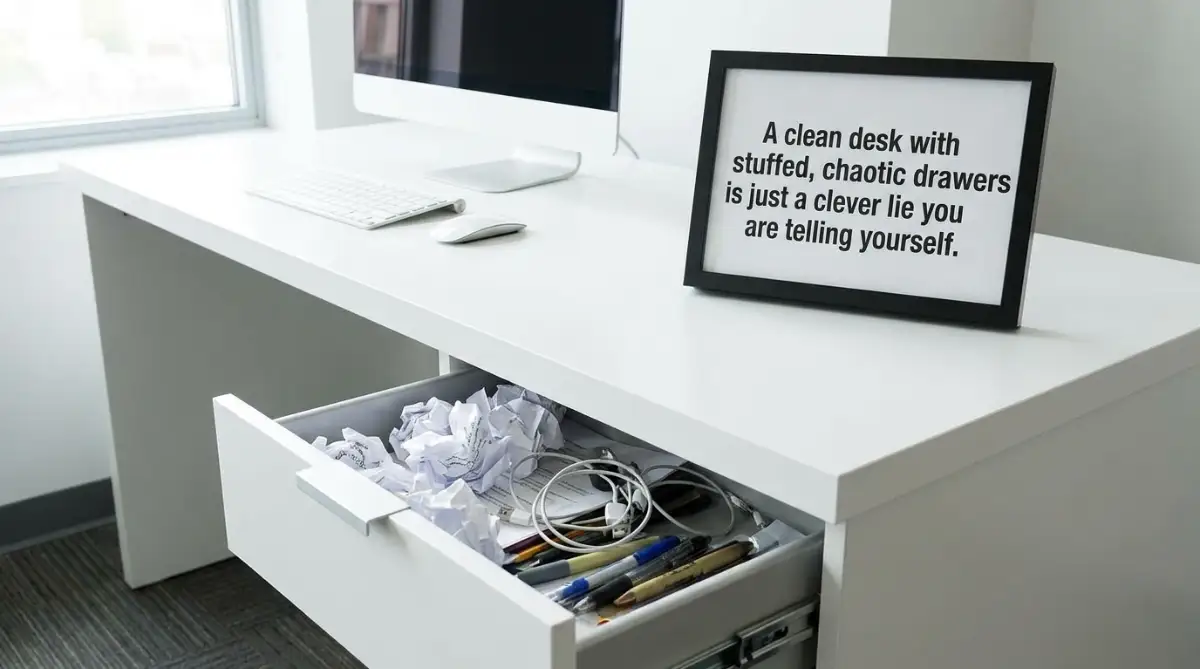
Chasing the Impossible "Instagram Aesthetic"
Social media has completely warped our idea of what a healthy, productive workspace is supposed to look like. We see photos of perfectly white desks with exactly one succulent plant and a glowing keyboard. We start feeling incredibly guilty when our real-life desks have actual pens, coffee stains, and printed reports on them.
Trying to maintain a completely flawless, movie-set office will drive you absolutely crazy. You will spend more time arranging your pencils for a photo than actually doing your meaningful work. This toxic perfectionism acts just like those morning habits that ruin your focus, draining your energy before the day begins.
Your desk is a functional tool meant for getting things done, not a modern art museum exhibit. It is perfectly fine for your space to look slightly messy while you are in the middle of a big project. The true goal is simply having the ability to easily reset it back to zero when the work is finally finished.
Holding Onto "Just In Case" Items
Fear is the underlying emotion behind almost every single piece of useless clutter in your home. We keep old charging cables from phones we haven't owned in five years because we might magically need them. We save extra notebooks and dried-out highlighters just in case a sudden emergency writing situation occurs.
This scarcity mindset convinces your brain that you will never have enough resources to survive in the future. In reality, keeping broken or outdated items heavily blocks new, positive energy from entering your life. If you have not used an item in the last six months, you probably do not even remember you own it.
Practice trusting yourself to handle future problems without hoarding useless safety blankets in your desk drawers. If a highly unlikely emergency does happen, you can easily buy a new charging cable for five dollars. Releasing these useless items is incredibly liberating and completely removes the heavy weight off your shoulders.
A Daily Maintenance Blueprint for Total Success
You now have all the psychological tools you need to completely transform your environment and your mindset. Changing your physical surroundings is undeniably one of the fastest ways to upgrade your internal thoughts. When you clear away the visual noise, your true creativity and deep focus finally have room to breathe.
To maintain this amazing new reality, you must embrace the concept of daily micro-habits. Do not wait for the mess to become completely overwhelming before you decide to take action. Spend just three minutes every single evening putting your essential tools back in their proper homes.
As you start enjoying this newfound peace during the day, try applying these same healthy boundaries to your evenings. Just as a clean desk clears your mind, avoiding the health risks of late-night scrolling will deeply improve your sleep quality. Everything in your lifestyle is deeply connected, and winning in one area naturally helps you win in others.
Experts who study how physical environment impacts productivity agree that your workspace is a direct mirror of your mind. By keeping that mirror clean, you are actively telling yourself that your time and mental health are highly valuable. You are building a powerful environment that fully supports your biggest dreams and daily goals.
Make sure to bookmark our main lifestyle resource hub so you can return whenever you need a quick burst of motivation. Building these systems takes a little bit of practice, but the massive reduction in daily anxiety is absolutely priceless.
I spent way too many years feeling totally exhausted and overwhelmed by the simple act of sitting at my desk. Taking back control of my physical space completely cured my daily work anxiety and brought me incredible joy. I am so excited for you to experience this exact same mental freedom, so take a deep breath and clear that desk today!
Common Questions About Workspace Psychology
Does a messy desk really mean I have a messy mind?
Not necessarily a messy mind, but it absolutely means your brain is being forced to process unnecessary stress. Highly creative people often have messy desks, but they still suffer from the invisible cognitive load it creates. Clearing the clutter allows that same natural creativity to flow much faster and without the hidden anxiety.
How can I keep things organized if I share a desk with someone?
Sharing a workspace requires crystal clear boundaries and excellent communication with your partner or coworker. Use a simple desktop organizer with a strict dividing line to keep your personal items totally separate. Agree on a firm "clean surface" policy where both of you must clear your items away at the end of every day.
What should I do if my job requires handling massive amounts of paper?
If paper is essential to your specific career, you must build a highly aggressive vertical filing system. Stop laying papers flat on the desk where they easily stack up and take over your visual field. Use sturdy upright folders and clearly label them, so the papers are organized but physically out of your direct line of sight.
How long does it actually take to feel the mental benefits of cleaning?
You will experience a massive, physical sigh of relief the exact moment you clear your desk surface. The deep psychological benefits, like improved daily focus and better sleep, usually become highly noticeable within the first three days. As your brain realizes the chaos is permanently gone, your overall baseline anxiety will naturally drop.
Will organizing my physical room actually help with my daily anxiety?
Yes, organizing your immediate environment is a proven grounding technique used heavily in modern psychology. When the outside world feels chaotic and uncontrollable, organizing your desk gives you a powerful sense of personal control. This physical act of taking charge directly lowers your stress hormones and naturally brings you back to a state of calm.
Disclaimer: The content provided in this blog post is strictly for informational and educational purposes only. It does not constitute professional medical, psychological, or psychiatric advice. If you are experiencing chronic anxiety, severe stress, or overwhelming emotional difficulties, please consult with a certified mental health professional or doctor.